
Quick Summary
Buying used saves money mainly because you skip the steepest depreciation a new car suffers in its first few years, which lowers the purchase price, financing costs and total cost of ownership. Compare out-the-door totals over the years you plan to keep the vehicle, not just monthly payments, and budget a repair reserve for wear items.
- A new vehicle loses significant value fastest in its first few years, which the first owner absorbs.
- Compare the full out-the-door cost, including taxes and dealer fees, not just the advertised price.
- Build five-year total cost of ownership for both options using the same model and annual distance.
- Certified pre-owned vehicles can offer warranty coverage at a lower price than new, so check the terms.
- Set aside a repair reserve from day one, and get a pre-purchase inspection and insurance quote first.
Table of Contents
- Why Buying Used Over New Often Makes Financial Sense
- How Depreciation Shapes the Real Cost of a Vehicle
- Upfront Price, Taxes and Out-the-Door Costs Compared
- Total Cost of Ownership Over Five Years: New vs Used
- Certified Pre-Owned Cars: Getting Warranty Coverage Without the New Price
- Financing a Used Car: Rates, Loan Terms and Monthly Payments
- Reliability, Repair Risk and Insurance Considerations
- Used Car Buying Checklist: What to Inspect Before You Sign
- Booking Your Next Step: Browse Variety Auto's Used Inventory
- Frequently Asked Questions
Why Buying Used Over New Often Makes Financial Sense
Buying a used vehicle is often the smarter money move in Canada, and the savings can begin the moment you drive off the lot. A new car loses a significant share of its value within the first few years, while a well-maintained used vehicle has already absorbed that loss. For many Vancouver families and first-time buyers, that gap decides whether a reliable, all-wheel-drive vehicle fits the budget at all.
Used cars are not automatically the better choice for everyone. New cars are often more reliable and more satisfying to their owners, but they are also the most expensive option. The trade-off is real, and the right answer depends on how long you plan to keep the vehicle and how much you can comfortably spend up front.
Buyers often weigh these trade-offs carefully. The common question is not whether used is cheaper, but whether the savings hold up once you count everything. This guide walks through seven benefits, including the costs most buyers overlook, so you can make the decision with the full picture.
How Depreciation Shapes the Real Cost of a Vehicle
Depreciation is the drop in a vehicle's value over time, and it is one of the largest costs of owning a car. A new vehicle loses value fastest in its first few years, which means the first owner absorbs the steepest part of that decline. Buying used lets you step in after that steep drop has already happened.
Think of it this way: you pay for the years you use the car, not the years someone else did. When you buy a used vehicle that is a few years old, you avoid most of that early depreciation. You still get a vehicle with plenty of useful life left, often for a fraction of the original sticker price.
The catch is that depreciation does not stop. A used car keeps losing value, just at a slower pace. Vehicles with strong resale demand, such as reliable AWD models, often hold their value better than others. Check how a model has held its value before you commit, because a car that depreciates slowly will cost you less over the years you own it.
Upfront Price, Taxes and Out-the-Door Costs Compared
The sticker price is only the starting point. When you compare a used vehicle with a new one, look at the full out-the-door cost, which includes the vehicle price, applicable taxes, and dealer fees.
Used vehicles often have a lower upfront number. A lower purchase price reduces the total you pay before you reach financing. That matters most for budget-conscious buyers, who often need to keep the total under a firm ceiling.
Ask for an itemized breakdown before you agree to anything. A transparent quote should show:
- The advertised vehicle price
- Applicable provincial sales tax and GST
- Documentation or administration fees
- Any optional add-ons, which you can decline
Compare the out-the-door totals from each option, not just the advertised prices. A used car with a clear, itemized quote is often a better deal than a lower advertised price with unexplained charges.
Total Cost of Ownership Over Five Years: New vs Used
Total cost of ownership is the full amount you spend over the time you keep a vehicle. It includes the purchase price, depreciation, financing interest, insurance, fuel, maintenance and repairs, and it nets out against what the vehicle is worth when you sell or trade it. Looking at only the monthly payment can make a new car seem affordable when it is not, because the payment hides depreciation and the cost of borrowing.
The cleanest way to compare is to build two five-year scenarios side by side using the same model, the same annual distance driven, and the same ownership period. The numbers below are illustrative placeholders, not quotes; substitute your own out-the-door price, rate, and resale estimate.
Scenario A: buy new. Build the five-year total from your own out-the-door price, loan rate, down payment and resale estimate. Add insurance, fuel, maintenance, and repairs, then subtract the resale value to get the five-year total.
Scenario B: buy the same model a few years old. Build this scenario the same way using your own out-the-door price and rate. Maintenance and repair spending is often higher in later years than on a new car, so budget a repair reserve for the period.
The pattern most buyers see is that the used scenario wins on purchase price, interest, and depreciation, while the new scenario wins on warranty coverage and lower early repair risk.
Three adjustments change the answer more than anything else:
- How long you keep it. The longer you hold the vehicle, the more the lower purchase price and lower interest dominate, and the more the new-car warranty period becomes a small share of total ownership.
- How you pay. A larger down payment or a shorter term reduces interest in both scenarios, but it helps the used scenario more because the principal is smaller.
- What you buy. A reliable model with a documented service history keeps the used repair reserve low; a complex or neglected model can erase the savings.
Watch out: comparing a used car's purchase price against a new car's monthly payment is not a comparison at all. Build both scenarios on an out-the-door basis, include the resale offset, and use the same annual distance so fuel and maintenance are comparable.
A simple way to compare is to add up five years of each cost for both options. Use the actual out-the-door price, your expected interest rate, and realistic maintenance estimates for the model. The option with the lower five-year total is usually the better financial choice, even when its monthly payment looks higher.
The article's five-year framework comes down to a few factors that change the answer most.
| Factor | Effect on used vs new | Why it matters |
|---|---|---|
| Ownership length | Used advantage grows | Lower price and interest dominate over time |
| Down payment or shorter term | Helps used scenario more | Smaller principal cuts interest |
| Model reliability | Can erase savings | Expensive failures raise repair costs |
| Maintenance history | Lowers used repair risk | Documented service predicts reliability |
| Comparison basis | Must match | Compare out-the-door totals, not monthly payments |
Certified Pre-Owned Cars: Getting Warranty Coverage Without the New Price
Certified pre-owned (CPO) vehicles are a common option between a standard used car and a new one. Some are inspected against a manufacturer's checklist and may come with an extended warranty. That warranty coverage is one of the biggest reasons buyers choose CPO over a private sale or a standard used vehicle.
CPO programs vary by manufacturer and by vehicle, so read the terms carefully. Check what the warranty covers, how long it lasts, and whether it transfers if you sell the car later. Coverage that matches your expected ownership period gives you more protection for the money.
A common mistake is assuming all used cars come with the same protection. Many do not. If warranty coverage matters to you, ask specifically what coverage applies and what it includes in writing.
Financing a Used Car: Rates, Loan Terms and Monthly Payments
Financing a used car works much like financing a new one, but the numbers often come out more favourable. A smaller loan amount means lower monthly payments and less total interest paid over the term.
Keep three factors in mind when you review a loan:
- Interest rate: Even a small difference in rate changes the total cost meaningfully over several years.
- Loan term: A longer term lowers the monthly payment but increases the total interest you pay.
- Down payment: A larger down payment reduces the amount you borrow and can improve your approval odds.
Watch out: a longer loan term can leave you owing more than the car is worth for longer (Financial risks when buying a car). Choose a term that keeps you ahead of depreciation.
At Variety Auto, you can start a secure online finance application to see your options. Our simplified approval process helps you understand the numbers before you commit.
Reliability, Repair Risk and Insurance Considerations
Reliability is where used cars require the most careful thought, and it is also where a lower purchase price can quietly stop being cheaper. The right question is not whether used cars are reliable, but whether a specific vehicle's expected repair cost over your ownership period still leaves you ahead of the new-car alternative.
A useful way to think about it is a risk-adjusted comparison. Start with the used car's savings versus new, then subtract a realistic repair reserve. If the savings are larger than your expected repair reserve for the model and mileage, the used car may still come out ahead before insurance and financing differences. If the reserve grows because of a costly known failure or a thin service history, the advantage can shrink considerably.
Four factors drive that reserve:
- Mileage. Higher mileage means more wear on tires, brakes, suspension, and fluids. A vehicle near a major service interval, such as a timing belt or transmission service, should be priced with that cost in mind.
- Model reputation. Some models have well-documented, expensive failure patterns; others routinely run past 200,000 km with basic maintenance. Research the specific generation, not just the brand.
- Maintenance history. Consistent service records are the best predictor of future reliability. A vehicle with gaps in its history carries more risk than one with regular documented maintenance, even at similar mileage.
- Age of components. Batteries, tires, and brakes have predictable lifespans. A pre-purchase inspection should tell you how much life is left and what replacement costs are coming.
A practical approach is to set aside a repair reserve in your budget from day one, separate from your loan payment. A repair reserve set aside from day one can help cover typical wear items and small repairs on a used vehicle, so a single repair does not become a financial emergency.
Insurance costs also shift depending on the vehicle. Premiums are often lower for an older, less expensive car, but this depends on the model, your driving record, your coverage choices, and the cost to repair that model. Some vehicles are expensive to insure because parts are costly or theft rates are higher. Get an insurance quote for the specific vehicle before you buy, so insurance is part of your budget from the start.
Watch out: a clean vehicle history report does not prove a car was maintained. It shows reported accidents and title issues, not whether the oil was changed. Ask for service records.
Used Car Buying Checklist: What to Inspect Before You Sign
A structured inspection protects you from costly surprises. Before you sign anything, check the vehicle carefully and verify the paperwork. This checklist covers the most important items:
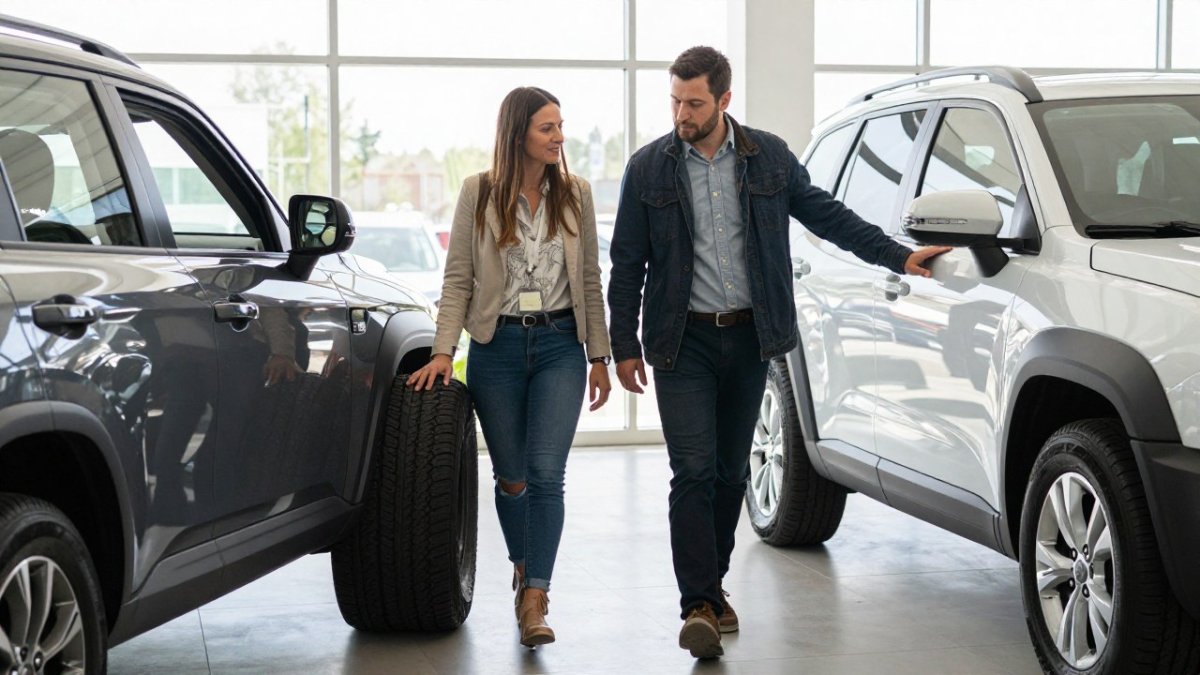 Potential buyer and salesperson inspecting tires and body panels of a used SUV while buying used cars
- Vehicle history report reviewed for accidents, title issues and ownership history
- Service records showing regular maintenance
- Tires, brakes and fluid levels checked
- Body panels and paint inspected for uneven gaps or mismatched colour
- Test drive completed on varied roads, including highway speeds
- Warning lights, electronics and features tested
- Independent pre-purchase inspection arranged where possible
A common mistake is skipping a pre-purchase inspection to save time. A qualified mechanic can spot problems a test drive will not reveal.
Booking Your Next Step: Browse Variety Auto's Used Inventory
If the benefits outlined here fit your situation, the next step is to see the vehicles available today. You can browse used AWD vehicles for sale in Vancouver and compare current prices, mileage, features and models before you visit. Once you find a candidate, you can apply for vehicle financing online to understand your payment options.
Before you finalize a purchase, review our used car inspection and safety guide to know what to check. For buyers who want warranty coverage without the new-car price, our buyer's guide to CPO cars explains the timing and what to look for. Ready to start? Explore our used inventory to see what is available.
Frequently Asked Questions
What are the benefits of buying a used car instead of a new one?
Buying used lets you avoid the steepest part of a vehicle's value loss, since new cars typically lose a large share of their value in the first few years. A lower purchase price also means smaller loan amounts, lower sales tax in dollar terms and often lower insurance premiums. New cars are often more reliable and satisfying to owners, so the trade-off is real. Compare the total cost, not just the sticker price, before deciding.
Is it cheaper to buy a used car or a new car?
The purchase price of a used car is usually lower, but the cheapest option depends on the full picture. Add up the price, financing costs, insurance, expected repairs and how much value the car will keep when you sell it. A used vehicle with a clean history and service records often costs less over five years, while a new car with a manufacturer warranty can reduce repair risk early on. Use a used car buying checklist and get a pre-purchase inspection before committing.
What should I check before buying a used car?
Start with a vehicle history report to confirm accident history, title status and the number of owners. Review service records for regular oil changes and major maintenance. Have an independent mechanic inspect the car, paying attention to brakes, tires, suspension and any signs of leaks or prior bodywork. Test-drive the vehicle on both city streets and highways. Confirm the out-the-door price in writing, including fees, before you finance.
Is it better to buy a certified pre-owned car?
A certified pre-owned vehicle is a used car that has passed a manufacturer or dealer inspection and often includes an extended warranty. This can reduce repair risk compared with a standard used car, though it usually costs more. Check exactly what the certification covers, how long the warranty runs and whether it is transferable. If warranty protection matters most to you, a certified vehicle may be worth the premium. Browse the inventory to compare available options.
