Last Updated: November 8, 2026
Quick Summary
The best third row SUVs for families in 2026 are the Kia Telluride and Hyundai Palisade, which top current editorial rankings, with the Toyota Grand Highlander, Honda Pilot and Volkswagen Atlas close behind. Prioritize a third row adults can tolerate, second-row seats that slide and tilt for access, and confirmed safety features like automatic emergency braking.
- Bring a tape measure and your actual car seats to check bench width, lower anchors and buckle clearance.
- With the third row up, most midsize three-row SUVs fit a stroller or a week of groceries, not both.
- Automatic emergency braking with pedestrian detection has the clearest real-world benefit for family driving.
- Check IIHS ratings for the exact model year, focusing on side-impact and moderate overlap front results.
- A minivan beats a three-row SUV on sliding doors, third-row access and cargo space behind the third row.
Table of Contents
- Why the Third Row Makes or Breaks a Family SUV
- The Best Used Three-Row SUVs for Families in 2026
- SUVs That Fit Three Car Seats: What to Measure Before You Buy
- Third-Row Comfort, Legroom and Cargo Space Compared
- Safety Ratings and Driver-Assistance Features That Matter for Families
- Your Third-Row SUV Buying Checklist for Used Models
- Three-Row SUV vs Minivan for Families: Which Fits Your Life?
- Family Ownership Costs Beyond the Purchase Price
- Book a Test Drive and Bring the Car Seats
- Frequently Asked Questions
Why the Third Row Makes or Breaks a Family SUV
A third row that adults can actually use is the single feature that separates third row SUVs from five-seaters with an extra bench bolted in. Legroom is tight, headroom is worse, and getting in requires folding a second-row seat while balancing a toddler on one hip.
That's why the best third row SUVs for families aren't necessarily the biggest or the newest. They're the ones where the third-row seating works for real people on real trips, and where the second-row access doesn't turn every school run into a gymnastics routine.
Below, we'll break down the models worth shortlisting, what to measure before you commit, and the ownership costs most buyers forget. But first, here's what most guides get wrong: they rank SUVs by cargo volume and horsepower, then mention the third row as an afterthought. For a family, it's the whole point.
The Best Used Three-Row SUVs for Families in 2026
The best used three-row SUVs for families in 2026 are models that pair a genuinely usable third row with strong safety equipment and predictable repair costs. Current editorial rankings from Car and Driver's midsize three-row SUV rankings put the Kia Telluride and Hyundai Palisade at the top, with the Toyota Grand Highlander, Honda Pilot and Volkswagen Atlas close behind.
Here's how the shortlist shapes up before we get into the detail:
| Model | Third-Row Strength | Best For | Watch Out For |
|---|---|---|---|
| Kia Telluride | Comfort and space balance | Families who road-trip often | Popular, so used stock moves fast |
| Hyundai Palisade | Quiet cabin, easy access | Daily driving with kids | Check second-row wear |
| Toyota Grand Highlander | Third-row legroom | Tall teenagers | Fewer used examples |
| Honda Pilot | Reliability record | Long-term ownership | Firmer ride on rough roads |
| Volkswagen Atlas | Adult-friendly third row | Adults in the back | Verify service history |
| Ford Explorer | Towing and cargo flexibility | Active families | Inspect transmission service |
Kia Telluride and Hyundai Palisade: The Comfort Leaders
These two share a platform, and it shows. Both offer a third row that adults can tolerate for a full trip, plus second-row seats that slide and tilt for access.
The Telluride edges ahead on ride quality. The Palisade counters with a quieter cabin and a more upscale feel. If you're shopping used, both hold up well, but check the second-row bench for staining and worn seat tracks, since those are the first things families wear out.
Toyota Grand Highlander and Honda Pilot: The Space and Reliability Picks
That number matters if you regularly carry older kids or adults in the back.
The Pilot takes a different route: it's the pick for buyers who plan to keep the vehicle for a decade. The trade-off is a firmer ride than the Telluride, which you'll notice on patched city streets.
Volkswagen Atlas and Ford Explorer: The Adult-Friendly Third Rows
The Atlas's second-row seats tilt and slide forward, which makes climbing into the back far less awkward.
The Explorer brings towing capacity and a wide trim range. The Atlas suits third-row comfort, while the Explorer suits towing a trailer or hauling gear.
SUVs That Fit Three Car Seats: What to Measure Before You Buy
Three car seats across the second row is possible in several three-row SUVs, but only if the bench is wide enough and the car-seat anchors are placed where you need them. The trick is measuring before you fall in love with a vehicle.
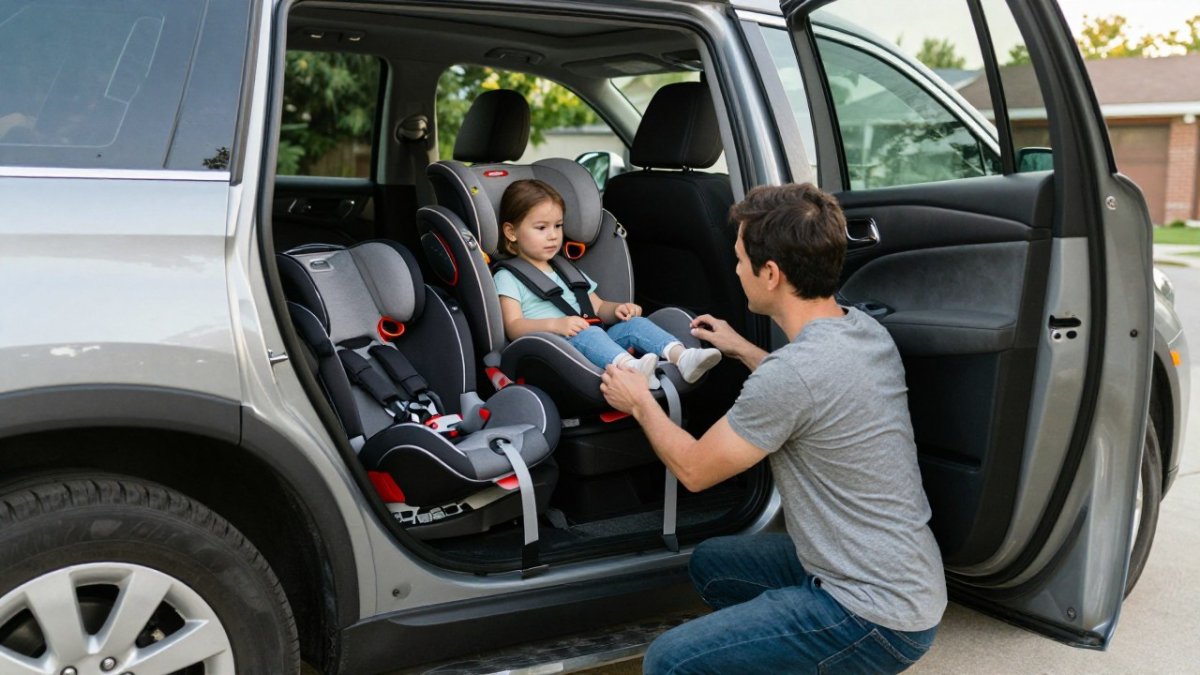 Parent installing a child car seat in the second row of one of the best third row SUVs on a sunny driveway
Bring a tape measure and your actual car seats to the lot. Check these four things:
- Bench width: measure between the seat bolsters, not the door panels.
- Lower anchors: count the dedicated anchor pairs. A three-across setup usually needs the seatbelt for the middle position.
- Buckle clearance: make sure the seatbelt buckles aren't buried under a car seat base.
- Second-row access: with all three seats installed, can anyone still reach the third row?
A common mistake is buying based on the brochure's passenger capacity. A seven-passenger SUV with three car seats in row two leaves the third row reachable only through the trunk or by removing a seat. Measure first.
Third-Row Comfort, Legroom and Cargo Space Compared
Third-row comfort comes down to three numbers: legroom, headroom and how far the second row slides. Cargo space then tells you what's left when all seats are up. Most rankings stop at the spec sheet. For a family, the useful question is what those numbers mean on a Saturday: can a teenager sit back there for two hours, and does the stroller still fit behind them?
Third-row legroom and headroom, model by model
The Grand Highlander offers generous third-row legroom, which is enough for most adults on a medium-length trip. The Telluride and Palisade sit slightly below that but pair it with a taller roofline, so headroom is less of a compromise for taller passengers. The Atlas prioritizes comfort for both kids and adults, largely because its second-row seats tilt and slide far enough forward to open a usable step-in gap. The Pilot and Explorer are closer to the middle of the class: fine for children and short-to-medium adults, tight for a six-footer on a long drive.
Sit in the third row with your feet flat before you judge the legroom number.
Cargo space with the third row up
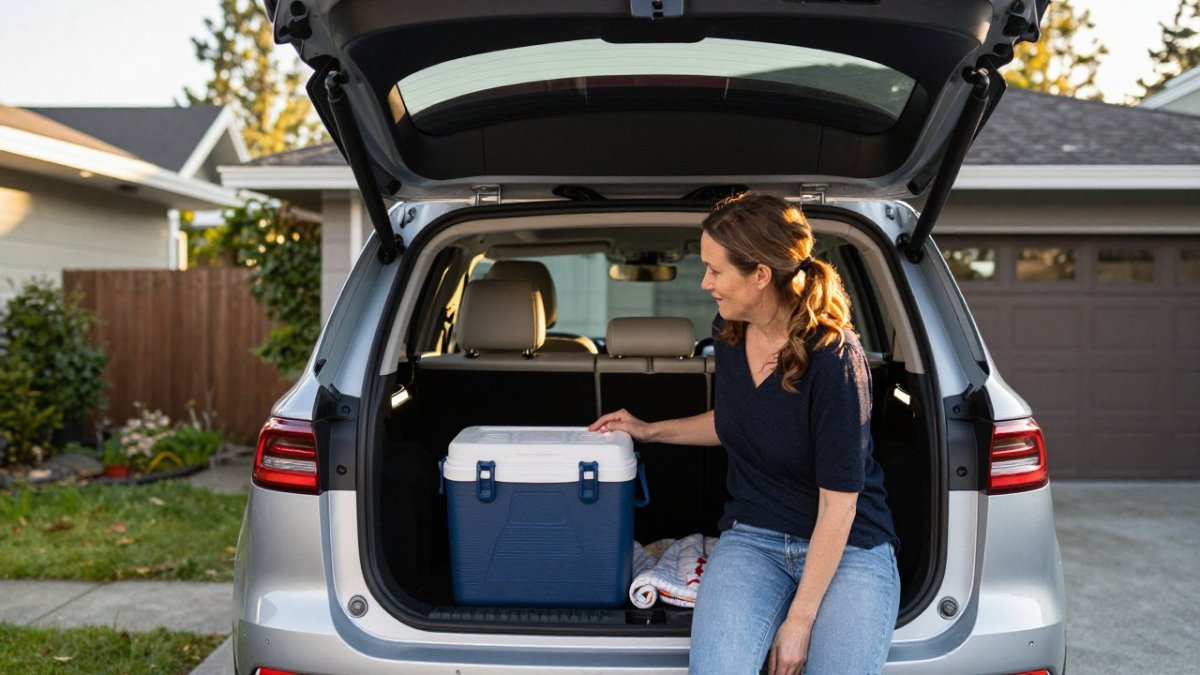
This is where families get surprised. With the third row in use, most midsize three-row SUVs leave room for a stroller or a week of groceries, not both.
Practical packing examples help more than a volume figure:
Fold the third row flat and you get a genuinely useful load floor. Look for split-folding seats (usually 60/40 or 50/50) so you can carry one extra passenger and still haul gear. A flat-folding third row with a low liftover height matters more for strollers and dog crates than a slightly larger volume number.
The features kids actually notice
What most guides miss: rear-seat climate controls and USB charging ports matter more to kids in the third row than a bigger screen up front. Check for both, and check that the third-row vents are fed by the rear HVAC system rather than just a passive duct. A third-row USB-C port and a 12-volt outlet are worth more on a road trip than a larger infotainment display.
Watch out: a third row that folds flat on the spec sheet can still leave a load floor that isn't level with the cargo opening, which makes sliding a stroller in and out harder than the volume figure suggests. Test the fold with the seats you'll actually use.
Safety Ratings and Driver-Assistance Features That Matter for Families
Automatic emergency braking, blind-spot monitoring and forward-collision warnings are the three driver-assistance features that matter most in a family SUV. All three help in the situations families actually face: parking lots, school zones and highway merges. But the feature name on a brochure tells you little about how the system behaves, and on a used vehicle it tells you nothing about whether the car actually has it.
The features worth prioritizing, in order
- Automatic emergency braking with pedestrian detection. This is the one feature that has the clearest real-world benefit in low-speed family driving, and it is the feature most worth confirming is present. On used models, it was often bundled into a package rather than standard.
- Blind-spot monitoring with rear cross-traffic alert. A three-row SUV has large rear quarters, and rear cross-traffic alert is genuinely useful backing out of a driveway or a crowded lot.
- Forward-collision warning. Useful, but pair it with automatic braking; a warning alone depends on the driver reacting.
- Rear-seat reminder and rear occupant alert. Increasingly common and directly relevant to families with young children. Confirm it is present rather than assumed.
- Adaptive cruise control and lane-keeping assist. Road-trip features more than school-run features, but worth having if you tow or take long drives.
How to verify equipment on a used vehicle
When you're shopping used, verify which features are actually on the vehicle, not just on the trim list. Safety packages were often optional, so two identical-looking models can have very different equipment. Check the window sticker or ask for the original build sheet, then confirm on the vehicle itself:
- Look for the camera and radar sensors in the grille and windshield; a missing sensor usually means a missing system.
- Check the instrument cluster and infotainment menus for the driver-assistance settings screen.
- Confirm the rear-seat reminder setting appears in the vehicle menu if the model year offered it.
- Ask whether any of the systems have been recalibrated after windshield replacement; a replaced windshield without recalibration can disable camera-based features.
A used SUV that was in a front-end collision may have sensors that were replaced but not recalibrated. Ask for the repair invoice and confirm recalibration was done.
Crash-test performance
Crash-test performance is worth checking against the Insurance Institute for Highway Safety's ratings, which publishes results by model year. A vehicle that scored well in its year is a safer bet than one with a longer feature list. Pay attention to the side-impact and moderate overlap front results specifically, since those are the tests most relevant to a family vehicle carrying passengers in all three rows. Ratings can change year to year even within the same generation, so check the exact model year you're considering rather than the nameplate.
If two used examples are close in price, the newer model year often has the better standard safety kit, which is worth more than a trim upgrade.
Your Third-Row SUV Buying Checklist for Used Models
Use this checklist on every used three-row SUV you consider. It takes about 30 minutes and catches the problems that show up six months after purchase.
- Confirm the third row folds flat and the release handles work
- Slide and tilt both second-row seats from the outside
- Install your own car seats in the second row
- Check for water stains in the cargo area and headliner
- Test every USB port and rear climate control
- Verify the spare tire, jack and tools are present
- Ask for the service history, especially transmission and coolant work
- Scan for warning lights with the ignition in the run position
- Test drive with the whole family aboard, including the third row
For a deeper walkthrough of the paperwork and inspection side, our used car buying guides cover what to ask before you sign.
Three-Row SUV vs Minivan for Families: Which Fits Your Life?
A minivan beats a three-row SUV on sliding doors, third-row access and cargo space behind the third row. An SUV wins on towing, all-wheel drive and resale appeal. The right answer depends on how you load passengers.
If your kids are young and you're loading car seats daily, a minivan's sliding doors and low floor are hard to beat. If you tow a trailer, face winter roads, or want all-wheel drive, an SUV makes more sense.
You can see both sides in practice by comparing a family-ready Chrysler Pacifica against an eight-passenger Toyota Sienna. For larger families, a passenger van like this Ford Transit offers a third option with far more seating.
Family Ownership Costs Beyond the Purchase Price
Fuel, insurance, tires and scheduled maintenance usually cost more over five years than families expect. The purchase price is only the opening bid.
Budget for these:
- Fuel: a V6 three-row SUV drinks more than a hybrid powertrain, especially in stop-and-go traffic.
- Insurance: larger vehicles and higher repair costs push premiums up. Get a quote before you buy.
- Tires: three-row SUVs chew through tires faster than sedans because of weight.
- Maintenance: timing belts, coolant services and transmission fluid changes are the big-ticket items.
- Repairs: out-of-warranty work on all-wheel drive systems adds up.
A used model with full service records usually costs less to own than a cheaper one with gaps in its history. That's the trade most buyers miss.
Book a Test Drive and Bring the Car Seats
The only test that counts is the one with your family and your car seats in the vehicle. Numbers on a spec sheet won't tell you whether your oldest can buckle themselves in the third row or whether the stroller fits behind them.
At Variety Auto, you can browse our full inventory as a starting point, apply for financing online, and get a trade-in appraisal so you know what your current vehicle is worth. Our team is ready to help you with your next step.
Get started with Variety Auto and find a three-row SUV that fits your family the first time.
The third row is either the reason you buy a vehicle or the reason you regret it. Bring the car seats, test the access, and check the service history before you commit. Variety Auto can help you compare inventory, complete an online finance application, and get a fair trade-in valuation, all before you set foot on the lot.
Frequently Asked Questions
What is the best third row SUV for a family?
There is no single winner, because the right third row SUVs depend on who sits back there. The Kia Telluride and Hyundai Palisade are often ranked near the top of midsize three-row rankings. If adults regularly ride in the third row, the Volkswagen Atlas stands out: Its second-row seats tilt and slide for easier access. If maximum third-row legroom matters, the Toyota Grand Highlander is a strong option.
Can three car seats fit across a three-row SUV?
Sometimes, but it depends on the width of the second-row bench and the seats themselves. Measure the bench between the seatbelt buckles and check that the car-seat anchors are spaced far enough apart for three seats side by side. Narrow convertible seats help. Models with a second row that slides and tilts make loading easier, which matters when you are reaching across two installed seats. Bring your actual car seats to the test drive and install them before you commit.
What should I check when buying a used three-row SUV?
Start with the third row itself: fold and unfold the seats, check the release handles, and look for worn upholstery or bent frames from heavy use. Confirm the second-row seats slide and tilt smoothly, since family use wears these mechanisms. Review the vehicle history for collision repairs, verify safety recall work was completed, and check that driver-assistance features like automatic emergency braking and blind-spot monitoring still function. A prepurchase inspection by an independent mechanic is worth the cost on any used family SUV.
Is a three-row SUV or a minivan better for a family?
Minivans win on sliding doors, low load floors and easy third-row access, which helps with young kids and tight parking. Three-row SUVs win on all-wheel drive, towing capacity and resale value. If you regularly carry three or more children, a minivan is usually easier day to day. If you need winter traction, trailer capacity or simply prefer the driving position, a three-row SUV can cover family duty well. Test both with your car seats installed before deciding.
