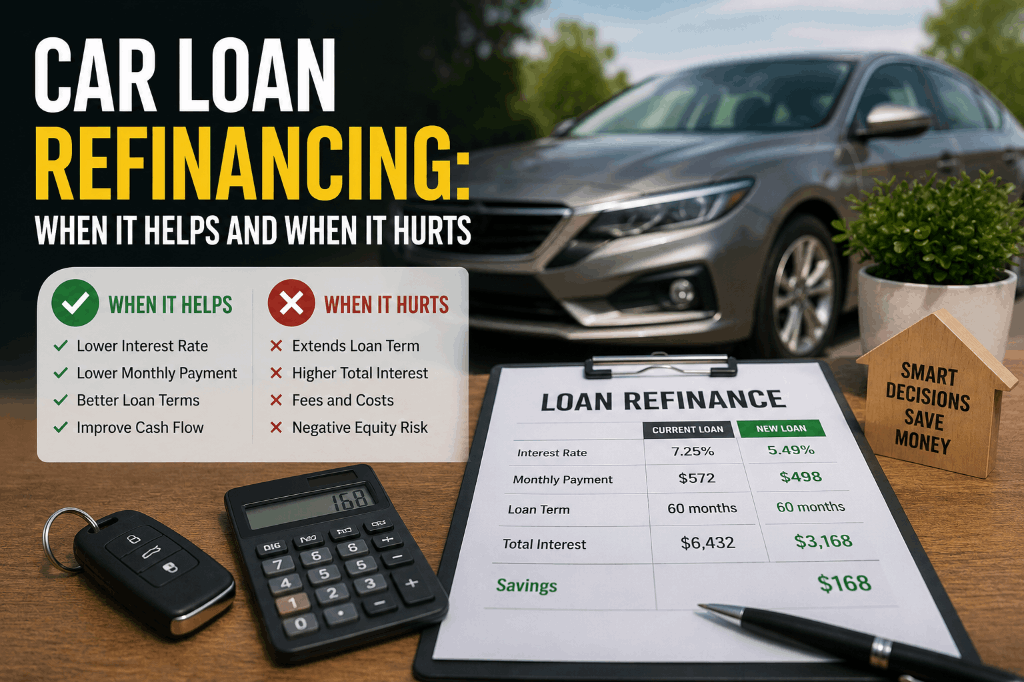
A car loan refinance sounds simple, and it is, right up until the new payment looks better but the math gets worse. If you're trying to keep a used car affordable in Vancouver or anywhere else, this guide breaks down when a car loan refinance can save real money, when it quietly costs more, and how to tell the difference before you sign.
A car loan refinance means replacing your current auto loan with a new one, usually from a different lender. The new lender pays off your old loan, then you repay the new loan under a new rate, term, and monthly payment. Sometimes that helps a lot. Sometimes it just rearranges the bill.
Early on, focus on four things:
- Your current APR
- Your payoff amount
- Your credit score
- The new loan term
- The total cost of the refinance
- Any fees or add-ons
Car Loan Refinancing Basics: What It Is and Why People Do It
Most people look into refinancing for one reason: their current loan feels expensive. Maybe the rate is high, maybe the payment is annoying every month, or maybe the original deal was the best you could get at the time and now you want to clean it up.
That last one is common with used cars. You find a decent vehicle, you need it now, and the used car financing is what it is. Then six months later, your credit is better, your income looks steadier, and you start wondering if you can swap the loan for something less painful. You often can.
The catch is that refinancing is not automatically a win. A lower monthly payment can be helpful, but if it stretches the loan longer or piles on fees, you may end up paying more overall. That is the whole game here: not just getting a different payment, but getting a better deal.
How a Car Loan Refinance Works

The process is pretty straightforward. A new lender approves you for a refinance loan, sends money to your current lender to pay off your existing balance, and your old loan closes out. After that, you make payments to the new lender.
A few terms matter here, and they are not as complicated as they sound. APR is the annual percentage rate, which is basically the cost of borrowing expressed as a yearly rate. Term length means how many months you have to repay the loan, like 36, 48, or 72 months. Your monthly payment is the amount due each month. Total interest is the full amount you pay the lender for borrowing money over the life of the loan.
Here’s the thing: those numbers work together. Lowering your APR can save money. Extending your term can lower your monthly payment. Shortening your term can help you get out of debt faster. But no single number tells the full story by itself.
The Main Reasons People Refinance
The most common reason is simple: to save money. If your credit score improved or your current loan came with a rough rate, refinancing can cut the APR and reduce total interest.
Some people refinance to lower the monthly payment because cash flow matters more right now than long-term savings. That is not a bad reason. If a lower payment helps you avoid late payments, overdrafts, or more expensive debt, it can be the right move.
Others refinance to pay the car off faster by moving into a shorter term. And sometimes the reason is more administrative, like removing a co-signer after your credit improves, or adding one if a lender requires stronger backing.
When Refinancing a Car Loan Helps
Refinancing can absolutely save you real money when the numbers line up. That is not hype. If the new loan has a meaningfully lower APR, reasonable fees, and a term that fits your goal, refinancing is one of the cleaner ways to fix an expensive car loan.
The best cases usually share one thing: something important has improved since the day you bought the car.
Your Credit Score Has Improved Since You Bought the Car
If your credit was rough when you bought the vehicle, your original lender probably priced that risk into the loan. In plain English, they charged you more for borrowing. If your score has gone up since then, you may qualify for a better rate now.
This happens all the time. Maybe you paid down credit cards, fixed a missed payment issue, built up a few months of on-time history, or just got through a messy patch. A lower APR on the remaining balance can save more than people expect, especially if you still have years left on the loan.
Say your used-car loan started at 11.9% and now you qualify for 7.2%. That gap matters. Even if the monthly payment drops by only $40 or $60, the total interest savings across the rest of the loan can be a lot more meaningful.
Interest Rates or Lender Offers Are Better Than Your Current Loan
Sometimes your credit did not change much, but you still find better offers. Lenders price loans differently, and the spread can be surprisingly wide for the same borrower. A credit union may beat a dealership lender. An online lender may beat your bank. Or the lender you used originally may simply not be competitive anymore.
This matters most when you still owe a decent chunk of the loan. If you have 40 months left, a lower rate has time to do its job. If you have 5 months left, the savings usually will not be dramatic enough to justify the hassle.
If you live in Vancouver or shop across nearby markets, this is especially worth noticing. The same borrower, same car, same income can get meaningfully different loan quotes depending on where they apply.
You Need a Lower Monthly Payment Right Now
Sometimes the right answer is not maximizing long-term savings. Sometimes the right answer is breathing room.
If refinancing extends your term and cuts the monthly payment, that can help you stay current, protect your credit, and keep the car. For a lot of households, that is the priority. You cannot drive a future interest calculation to work. You can drive a car you still have.
That said, be honest about what you are buying with that lower payment. Usually, you are buying time, not savings. If the budget is tight and the car is otherwise reliable, that trade can still make sense.
You Want to Pay Off the Car Faster
This is the opposite move, and it can be a smart one. If your income is more stable now and you want out of car debt sooner, refinancing into a shorter term can reduce total interest and get the title in your name faster.
This works best when the new APR is lower than your current one, or at least not much higher, and when the payment still fits your budget comfortably. If the shorter term turns your car payment into a monthly stress test, it is not a win.
But if you can handle it, this is one of the cleanest ways to stop dragging a car loan around longer than necessary.
When Refinancing Hurts More Than It Helps

This is where people get tripped up. The refinance offer looks neat, the payment looks smaller, and the loan officer says all the right things. But the real cost hides in the term length, the fees, and the details you only notice once the paperwork is done.
A good refinance solves a problem. A bad one just hides it.
You Stretch the Loan Too Long
A lower payment can feel great in the moment, but if you restart the clock with a much longer term, the total cost can climb. Think of it like taking smaller grocery trips all month and somehow spending more than you would have on one planned shop. Each trip feels manageable. The final bill tells a different story.
For example, if you have 24 months left and refinance into a fresh 60-month loan, your payment may drop a lot. But you may now be paying interest for three extra years. That is expensive relief.
The trick is to compare total remaining cost on your current loan with the total cost of the refinance, not just the monthly payment.
Fees, Penalties, or Added Products Eat the Savings
Some loans come with prepayment penalties, though they are less common than they used to be. There can also be title transfer fees, lien fees, application fees, or state and provincial registration costs depending on where you live.
Then there are the extras. GAP coverage, extended warranties, service contracts, and other add-ons may be offered again during refinancing, or rolled into the new balance. Sometimes that is useful. Often it just makes the loan bigger.
If the refinance saves you $18 a month but adds a few hundred dollars in fees or products you did not plan to buy, the deal is not as pretty as it looks.
You Owe More Than the Car Is Worth
This is negative equity, also called being upside down on the loan. It means your loan balance is higher than the car’s market value.
That can make refinancing harder because lenders do not love backing a loan that is already underwater. It shows up a lot with used vehicles that dropped in value quickly, or loans that started with a small down payment, high fees, or rolled-in extras from the start.
If you owe $18,000 on a car worth $14,000, some lenders will decline. Others may offer terms that are not especially attractive. In that situation, paying the balance down first can put you in a much better spot.
Your Credit Got Worse, Not Better
If your score dropped since you bought the car, refinancing may not help much. A weaker credit profile can mean a higher APR, tighter conditions, or a loan that only looks helpful because the term gets stretched way out.
This is one of those moments where waiting can be smarter than acting. If you can spend a few months fixing missed payments, lowering card balances, or stabilizing income, you may qualify for a much better offer later.
Approval alone is not the goal. A better loan is the goal.
The Numbers to Check Before You Refinance
Before you apply anywhere, get clear on the current loan and the actual cost of a replacement. This part is less exciting, but it is where good decisions happen.
Compare Monthly Payment vs. Total Loan Cost
The lowest monthly payment is not automatically the best deal. In fact, it often is not.
Take the current loan and ask one question: if you keep it exactly as it is, how much more will you pay from today until it is gone? Then compare that with the refinance offer: monthly payment times number of months, plus any fees.
That side-by-side view cuts through the sales pitch fast. If the refinance saves $55 a month but costs $1,900 more overall, you should know that before signing.
Check Your Current Loan Payoff Amount
Your payoff amount is not always the same as the balance showing on your last statement. It is the amount required to fully pay off the loan by a certain date, including any interest accrued up to that point.
Lenders usually provide a payoff quote that is valid for a limited window. Get that number directly from your current lender before you compare refinance offers. Otherwise, you are using fuzzy math.
This matters because the new lender is paying off the old loan in full, not just taking over your rough estimate.
Review Your APR, Remaining Term, and Vehicle Value
You need a handful of numbers before shopping. Your current APR, the number of months left, your monthly payment, the vehicle’s mileage, model year, and estimated market value all matter.
Older used cars can run into refinance limits. Some lenders cap mileage, set minimum loan amounts, or refuse vehicles beyond a certain age. So if your car has a lot of kilometers or miles on it, check the lender rules early instead of wasting an application.
How to Tell if Refinancing Makes Sense for Your Situation
This decision is not abstract. It usually comes down to a few everyday cases you can recognize pretty quickly.
If You Bought a Used Car at a High Rate
A lot of people get into a used car with the financing available to them at the time, then revisit the loan later. That is often smart. If the original rate was high because you needed the car immediately, refinancing later can be a cleanup move that lowers the cost without changing the vehicle.
This is especially true if you have made on-time payments for several months and improved your credit since purchase. Lenders like a track record, even a short one.
If You’re in Vancouver or Shopping Across Different Markets
Wherever you live, do not assume the first approval is the best one. Banks, credit unions, dealership-connected lenders, and online lenders can price the same borrower differently. That is true in Vancouver, in smaller towns, and across different lending markets.
The practical takeaway is simple: compare. A lender that is weak on one used-car profile may be great on another. Same car, same applicant, different math.
If You Plan to Keep the Car for a While
Refinancing tends to work best when you plan to keep the vehicle long enough to benefit from the savings. If you are going to sell or trade it in soon, the payoff math gets less attractive.
Why? Because the savings from a lower APR usually build over time. If you only keep the car another six months, there may not be enough runway for the refinance to pay off, especially if there are fees involved.
How to Refinance a Car Loan Step by Step
This process is not hard, but it does go more smoothly when you have your numbers ready before you start.
Check Your Credit and Gather Loan Details
Pull together the basics first: your credit score, current lender information, payoff amount, VIN, mileage, registration, proof of income, and details about the car itself. It sounds like a pile, but it is really just a small stack of documents and a few account screenshots. I have definitely put this off over one missing login before.
Also check your current loan terms so you can compare offers properly. If you do not know your APR, months remaining, and payoff amount, every quote will feel more confusing than it needs to.
Shop Rates From Banks, Credit Unions, and Online Lenders
Do not stop after one quote. Shop around.
Local banks may have decent offers. Credit unions are often very competitive on auto loans, especially for used vehicles. Online lenders can also be worth a look because the applications are usually quick and the pricing can be sharper than expected.
Try to gather a few offers close together in time. That makes comparison easier and can limit how drawn out the process feels.
Apply, Review the Offer, and Read the Fine Print
Once you choose a lender, you complete the full application and provide documents. After approval, review the actual offer, not just the headline payment.
Check the APR, term length, total amount financed, fees, and whether any add-ons were included. If something appears that you did not ask for, pause and get it clarified before signing. This is where people accidentally agree to a bigger, messier loan than they intended.
Confirm the Old Loan Gets Paid Off
After the refinance closes, make sure the old lender actually receives the payoff and marks the loan as paid. Do not assume it happened just because the new loan is active.
Then update autopay, confirm where future payments go, and keep an eye on title or registration details if your area requires updates. One missed step here can create a very annoying month.
Can You Refinance With Bad Credit or a Used Car?
Yes, sometimes. But the standards get tighter, and the deal still has to be better in a way that matters.
Refinancing With Less-Than-Great Credit
You can refinance with weaker credit, but the lender has to see enough reason to approve the loan. That might mean solid recent payment history, steady income, or a car that still fits their value and age rules.
The mistake is treating approval as the finish line. If the new loan only lowers the payment by dragging the term out and adding cost, it is not helping much. Focus on total cost and whether the refinance actually improves your situation.
Lender Rules for Older Cars and Higher Mileage
Used-car refinancing often comes with limits around model year, mileage, loan size, and vehicle condition. One lender may happily refinance a seven-year-old car with moderate mileage, while another draws the line much sooner.
This matters a lot for shoppers financing older vehicles. Before you get invested in a quote, check the lender’s basic eligibility rules. It saves time and cuts down on unnecessary credit pulls.
What to Do if You Don’t Qualify Yet
If you do not qualify now, that does not mean the idea is dead. It usually means the timing is off.
Pay down the balance if you can. Improve your credit by making every payment on time and lowering revolving debt. Gather stronger proof of income. Then try again in a few months. Small improvements can change the offer more than people expect.
Common Mistakes People Make When Refinancing
The biggest refinancing mistakes are not complicated. They usually happen because the lower payment feels like enough proof on its own.
Focusing Only on the Monthly Payment
This is the classic trap. A lower payment is nice, but if the term gets much longer, the deal can cost more overall.
Always compare the total remaining cost of your current loan with the total cost of the new one. That one habit will filter out a lot of bad refinance offers fast.
Applying Too Soon After Buying the Car
Some lenders want to see a few months of payment history before they refinance a loan. And in some cases, the original loan is still too new for a refinance to make much difference.
If you just bought the car last month, it may be worth waiting until you have a little history and, ideally, a stronger credit profile. Timing matters more than people think.
Ignoring Insurance or GAP Changes
Refinancing can affect GAP coverage, warranties, or other add-ons tied to the original loan. If your new balance and the car’s value are far apart, review whether GAP still makes sense, or whether you need to replace cancelled coverage.
It is not the flashiest part of the process, but ignoring it can leave you paying for the wrong thing or missing coverage you actually wanted.
A Simple Checklist to Decide This Week
If you want a clear answer without spending hours on it, keep it simple. Check your current APR. Get your payoff amount. Look up your credit score. Then get two or three refinance quotes and compare total cost, not just payment size.
That is enough to tell you whether this is a smart cleanup move or just a shinier bill. Try one thing this week: request your payoff quote and get one comparison offer. Then share back what you found.