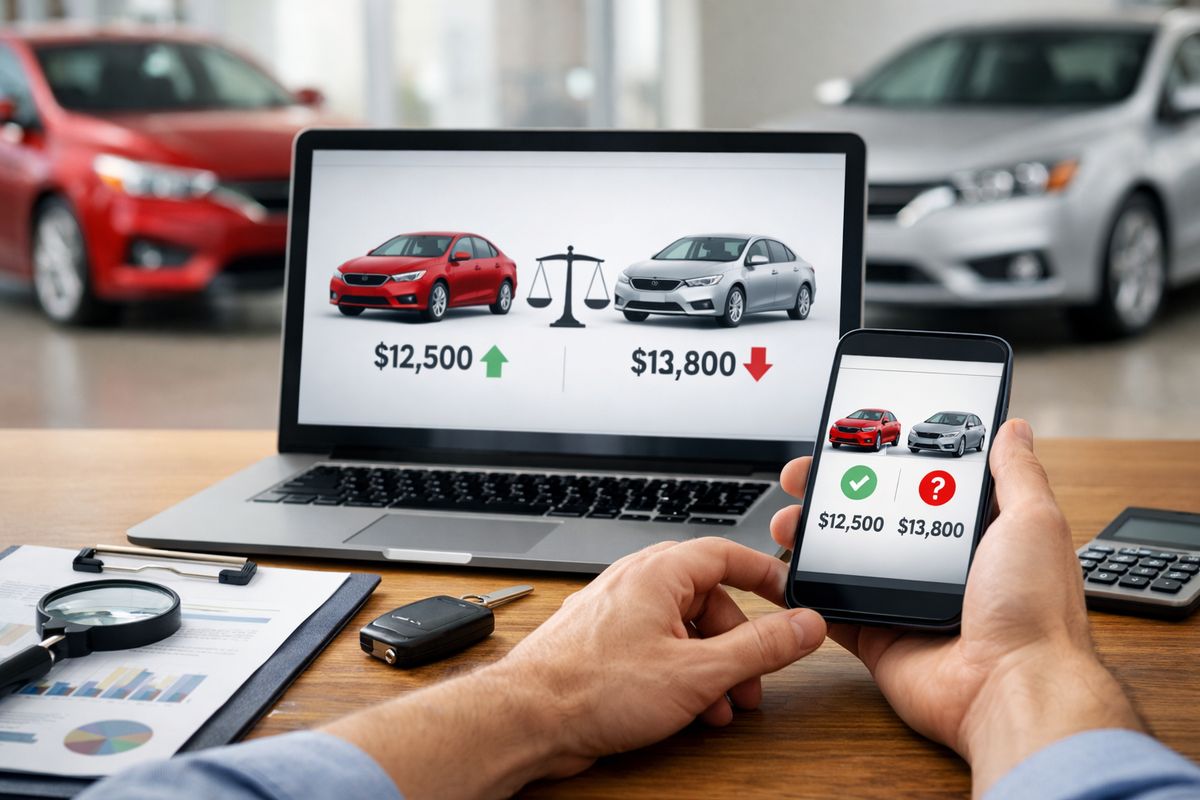
If you have ever looked at one used car listing in Vancouver and then another five minutes later, you already know how messy car value comparison can get. Two cars can look almost identical on your phone screen, then turn out to be thousands apart for reasons that are easy to miss. Here’s how to compare used car values the right way, so you can spot a fair deal before you make the trip to Richmond, Surrey, or anywhere else in the Lower Mainland.
What you'll need before you start
A good comparison starts before you open pricing tools. If you skip the setup, every number after that gets fuzzy.
Use this quick checklist:
The full vehicle listing
Year, make, model, and trim
Mileage
VIN
Asking price
Drivetrain and transmission
Accident and claim history
Service records, if available
Two or three pricing tools
At least one local marketplace and dealership search
Once you have those pieces in front of you, the rest gets much easier.
Your must-have details from the listing
Pull every detail you can from the ad before you compare anything. You want the year, make, model, trim, mileage, engine, transmission, drivetrain, asking price, and any notes about condition or damage. If the ad says “loaded” or “great condition” but leaves out trim or accident history, treat that as missing information, not a small detail.
The trick is simple: value comes from specifics. A 2019 Mazda CX-5 GS AWD with 92,000 kilometers is not the same car, value-wise, as a 2019 CX-5 GX FWD with 92,000 kilometers. Same badge family, very different market price.
Your comparison tools and local sources
Use a mix of sources instead of leaning on one website. Start with valuation tools, then compare those numbers against local private seller listings and dealer inventory across Vancouver, Burnaby, Richmond, Surrey, and Coquitlam. Add a vehicle history report to catch accidents, title issues, and ownership patterns.
Local numbers matter more than broad averages. A car that looks cheap in a Canada-wide guide can still be overpriced in the Lower Mainland, or the other way around.
Step 1: start with the exact vehicle, not just the model name
This is where a lot of overpaying starts. If you compare only by model name, you can talk yourself into a bad deal fast.
Copy the exact year, make, and model from the ad.
Confirm the trim level.
Check the drivetrain, engine, and transmission.
Verify mileage.
Save the listing so you can compare details later.
Success here looks boring, honestly. You should have a precise vehicle description, not just “used CR-V” or “used Corolla.”
Match the trim, drivetrain, and major options
Check badges in the photos, read the description carefully, and run the VIN if needed. Look for trim clues like LX, EX, Touring, GS, XLE, or GT. Also confirm AWD versus FWD, because that can change value a lot in the Lower Mainland where mountain trips and wet weather keep AWD in demand.
A Honda CR-V EX-L AWD in Richmond should not be priced against an LX FWD just because both say CR-V. Same goes for hybrid versus gas, turbo versus non-turbo, cloth versus leather, or basic safety tech versus a full driver-assist package.
Confirm mileage and condition claims
Write down the odometer reading exactly as listed. Then note the claimed condition in plain terms: clean, average, rough, recently detailed, smoker smell, paint chips, curb rash, worn tires. Fancy wording is cheap. Condition is not.
Mileage matters, but not by itself. If you want a better sense of how to think about distance versus age, it helps to understand how kilometers and model year pull value in different directions.
Step 2: build a realistic value range from pricing tools
One number is not the market. A range is.
Enter the exact vehicle details into two or three pricing tools.
Save both private-party and dealer estimates.
Write down the low, middle, and high end of the results.
Use that as your starting window, not your final answer.
If one tool says $21,500 and another says $23,800, that does not mean one is wrong. It means you need context.
Check private-party and dealer values separately
Always separate private sale values from dealer retail prices. Dealer numbers are usually higher because reconditioning, overhead, warranty offers, and convenience get baked in. A dealer car that is $2,000 to $4,000 above a private listing is not automatically overpriced.
The catch is that some sellers use dealer listings to justify private-sale pricing. That is where the comparison breaks. If you are buying private, compare mostly against private values, then use dealer prices as an upper boundary.
Adjust for mileage, condition, and accident history
Now start nudging the range up or down. Higher mileage pushes value down. Visible wear pushes it down. Collision claims usually push it down too, sometimes a little, sometimes a lot depending on severity. Strong records, clean condition, and new tires can support the higher end.
This does not have to be perfect. You are building a realistic range, not pretending the market runs on a spreadsheet.
Step 3: compare local listings in vancouver and the lower mainland
This is where the real market shows up. Asking prices nearby will tell you whether your tool-based range actually matches what sellers are trying to get.
Search the same model in local marketplaces.
Filter by close model years, trim, and mileage.
Save at least five comparable listings.
Note city, asking price, mileage, and visible condition.
Ignore obvious outliers until the end.
If you cannot find five near-matches right away, widen the year by one model year in each direction before you start widening everything else.
Search comparable listings within your area
Look across Vancouver, Burnaby, New Westminster, Richmond, Surrey, Coquitlam, Langley, and nearby areas. Stay close on mileage too. A 65,000-kilometer car and a 145,000-kilometer car should not be treated as direct comparables just because the trim matches.
This is also a good time to notice market pockets. Some practical commuter cars get snapped up faster in dense urban areas, while SUVs and AWD models can hold firmer pricing farther out. If fuel cost is part of your decision, compare your shortlist against efficient daily-driver options people actually buy around Vancouver.
Separate fresh listings from stale ones
A listing that appeared yesterday tells you one thing. A listing that seems to have been sitting for five weeks tells you something else.
Stale listings often point to overpricing, hidden issues, or unrealistic expectations. Not always, but often enough to matter. If three similar cars are listed at $18,500 and one has been hanging around at $21,900, that expensive one is not proof the market supports $21,900. It may just be proof that nobody wants it.
Watch for seasonal and regional price patterns
Season matters more than a lot of shoppers expect. AWD crossovers and trucks can look stronger heading into winter. Small fuel-sippers can stay in demand year-round, especially with long commutes running through Vancouver, Burnaby, and Surrey.
Regional habits matter too. A car that makes sense for ski trips, rainy highway driving, or a downtown parking routine can get priced accordingly. That local texture is why national guides should never be your only reference.
Step 4: read the vehicle history like a price adjustment sheet
A history report is not just for spotting disaster. It is also for pricing the car correctly.
Run the VIN through a history report.
Read every line, not just the summary.
Note accidents, insurance claims, title status, and registration pattern.
Match report details against the seller’s description.
Lower your value range when the history adds risk.
At this stage, you are not asking, “Is the car okay?” You are asking, “Is this price still justified?”
Check for accidents, claims, and rebuilt status
Collision claims matter even when the title is clean. Pay attention to claim amounts, repeated damage entries, airbag mentions, and any rebuilt or salvage branding. A clean title does not cancel out a rough history.
If rebuilt status shows up anywhere, stop treating the car like a normal comparable. That is a separate pricing category entirely. Before going further, read through what rebuilt history can mean for value and risk in Vancouver.
Review ownership, registration, and service records
Fewer owners and consistent local history can support a stronger price. So can regular oil changes, brake service, and scheduled maintenance with dates that make sense. Frequent ownership transfers, long record gaps, or abrupt moves between provinces deserve a closer look.
For a deeper breakdown of what these reports actually reveal, including the stuff people miss on the first pass, check how BC history records can change your buying decision.
Step 5: inspect the car’s real condition against the price
This is the moment where polished photos stop helping. You need to line up what you see in person with the value range you already built.
Walk around the exterior slowly.
Check the interior for wear and smells.
Inspect tires and glass.
Test every major feature.
Compare what you find against the asking price.
A seller can clean a car in 45 minutes. Condition still leaves clues.
Check the exterior, interior, and tires
Look for paint mismatch, uneven panel gaps, rust spots, windshield chips, curb rash, seat tears, sagging trim, and wet floor mats. Then check the tires. Uneven wear can point to alignment or suspension issues, and old tires with weak tread are a near-term cost, not a minor footnote.
Little flaws add up like extra items tossed into a shopping cart. One scratch is one thing. Worn tires, curb damage, cracked trim, and a peeling steering wheel together tell a bigger story.
Test the features that affect resale value
Turn on the air conditioning. Pair your phone. Try the backup camera, heated seats, windows, locks, lights, parking sensors, and driver-assist features. If the car advertises a feature, make sure it works.
This is not nitpicking. Broken convenience features affect value because fixing modern electronics can get expensive fast.
Take a thorough test drive
Drive on city streets, faster roads, and rougher pavement if possible. Listen for suspension clunks, brake vibration, wheel bearing hum, and transmission hesitation. Notice whether the steering tracks straight and whether the engine feels smooth from a stop.
If you want a more detailed checklist for this part, it helps to review what to look at before you get attached to the car.
Step 6: get an independent inspection before you commit
A pre-purchase inspection is where loose impressions turn into dollar amounts.
Book an inspection with an independent mechanic.
Choose a shop familiar with the make if possible.
Ask for written notes on urgent repairs and upcoming maintenance.
Compare repair costs against your value range.
Recalculate your max offer.
Success here looks like clarity. Even if the report is not perfect, you should know whether the car is solid, overpriced, or not worth chasing.
Book a mechanic who knows the vehicle type
Try to use a shop that sees that brand often. A general mechanic can still help, but a specialist is more likely to spot common trouble areas on certain engines, transmissions, hybrids, or AWD systems.
If you are still debating whether this step is worth paying for, especially on a cheaper car, read when a pre-purchase check saves more than it costs.
Turn inspection findings into dollar adjustments
Translate the report into money right away. If brakes, tires, a battery, and fluid service are due soon, those costs belong in your comparison. If the inspection turns up accident repairs, leaks, or suspension work, lower your number accordingly.
A car that needs $2,000 soon is not a $20,000 car just because the seller says it runs great.
Step 7: compare the total cost, not just the sticker price
Sticker price is only the start. The better buy is often the car that costs less to own over the next year, not the one with the cheapest ad.
Add taxes and any fees.
Get an insurance quote.
Estimate fuel use.
Budget for immediate maintenance.
Compare total first-year cost between options.
That slightly pricier car with better records and fresh tires can easily win.
Factor in taxes, fees, insurance, and fuel
In BC, taxes can shift the math quickly. Insurance can too, especially if you are comparing a small sedan against a newer SUV or a turbocharged model. Fuel costs are worth estimating honestly, especially if your weekly routine includes Highway 1, downtown traffic, or regular bridge crossings.
This matters even more when deciding between body styles. A practical breakdown of which shape usually fits a tighter Vancouver budget better can help if you are torn between an SUV and a sedan.
Estimate near-term maintenance and repairs
Think ahead six to twelve months. Tires, brakes, battery age, fluid service, and scheduled maintenance all count. A car that looks cheaper upfront can become the expensive one surprisingly fast.
This is also where ownership habits matter. A model with simple, predictable upkeep often beats a fancier option that drains your budget in small annoying chunks.
Step 8: use your comparison to negotiate with confidence
By now, you should have enough to make a clean, fact-based offer. No guessing, no vibes, no getting talked into a number because the car is shiny and parked under nice lighting.
Write down your target price range.
Set your max number before the conversation starts.
Gather your comps, inspection notes, and history points.
Make a calm offer tied to evidence.
Leave if the numbers stop making sense.
That last step matters more than most people want to admit.
Show the seller your comparable prices
Keep it simple. Point to local listings, your pricing range, any accident history, and inspection findings. You do not need a speech. A few clear facts usually land better than a long argument.
If you want a sharper approach for the actual conversation, it helps to see how a solid Vancouver used-car offer is usually built.
Know your walk-away number
Decide your ceiling before you meet. Not in the driveway. Not after the test drive. Before.
That rainy Vancouver-afternoon feeling is real. A car can seem perfect when you are standing there with your keys in your pocket and somebody else booked to see it next. Your walk-away number keeps the decision sane.
Common mistakes that throw off car value comparison
Most pricing mistakes are not dramatic. They are small misses that stack up.
Comparing unlike-for-like vehicles
This is the biggest one. Different trim, drivetrain, engine, mileage band, or history can make similar-looking cars worth very different amounts. A higher trim with clean records and fresh tires can deserve more. A base trim with accident history definitely does not.
If two comparables are not close in the ways that matter, throw them out.
Trusting one price source too much
No single tool sees the whole market. Valuation websites are useful, but they are only the first draft. Local listings, history, condition, and inspection findings are what turn that draft into a real number.
A range beats a single estimate every time. Full stop.
Ignoring local market quirks
Vancouver and the Lower Mainland have their own habits. Commute patterns, fuel prices, weather, and weekend mountain driving all shape demand. National guides can miss that.
If your local comparables disagree with the broad pricing tools, take the disagreement seriously and find out why.
Troubleshooting: what to do if the numbers do not line up
Sometimes every source points somewhere different. That does not mean the process failed. It means you need to weigh the inputs properly.
If pricing tools are lower than local listings
Start by checking whether the local listings are actually selling or just sitting. If most of the local market is stale, sellers may simply be aiming high. If good cars disappear quickly at those prices, local demand may really be stronger than the guides suggest.
The market is not what people ask. It is what solid cars move for.
If the seller says the car is worth more because of upgrades
Some upgrades matter a little. Most matter much less than sellers hope. Factory options usually hold value better than aftermarket parts. Nice tires, a quality hitch, or recent brakes can support price somewhat. Oversized wheels, tint, loud exhaust, and custom stereo gear usually do not add much.
Treat upgrades like toppings on pizza. Pleasant if you wanted them already, but not a reason to pay a lot extra.
If there are not enough comparable listings nearby
Expand carefully. Start with nearby cities, then widen the year range by one model year. If needed, compare against the same generation and adjacent trims, but only after adjusting for feature differences.
The goal is to stay close enough that your range still means something. Once the comparables get too loose, the number stops being useful.
What a good result looks like and what to do next
A good result is not finding the absolute cheapest listing. It is ending up with a realistic value range, a few solid local comparables, and a firm offer number that still makes sense after history, inspection, and total cost are factored in.
Try one thing right away: take your top listing and compare it against three local alternatives before you contact the seller. That one small pause can save you a lot of money and a very annoying weekend.
Frequently asked questions
How many comparable listings should you use for a car value comparison?
Aim for at least five close comparables if the market gives you enough choices. Fewer can still work, but your range gets less reliable, especially if one listing is overpriced or missing details.
Is asking price the same as market value?
No. Asking price is just the seller’s number. Market value is what similar vehicles in similar condition can realistically command in your area after you account for mileage, history, and condition.
How much should accident history lower a used car’s value?
There is no fixed amount, because claim size, repair quality, and vehicle type all matter. Minor damage may only trim value a little. Major claims, repeated damage, or structural repairs should lower value much more.
Do dealer prices always mean a car is worth more?
Not always. Dealer pricing often includes reconditioning, overhead, and sometimes limited warranty coverage. That can justify some premium, but it does not automatically make every dealer listing fair.
What matters more, age or mileage?
Neither wins by default. A newer car with very high mileage can be less appealing than an older car with moderate mileage and strong service history. The best comparison looks at age, mileage, condition, and maintenance together.
Should you compare cars outside vancouver if local options are limited?
Yes, but do it carefully. Expand into nearby Lower Mainland cities first, then nearby model years or closely related trims. Keep the comparison as like-for-like as possible so your pricing range stays grounded.