Last Updated: October 25, 2026
Quick Summary
Used hybrid cars in Vancouver are available through local dealerships like Variety Auto, Clutch, OpenRoad Auto, and North Shore Auto Mall, with popular models including the Toyota RAV4 Hybrid, Honda CR-V Hybrid, Toyota Corolla Hybrid, and Honda Civic Hybrid. Models from 2020 onward offer the best balance of modern features and value, with fuel consumption ranging from 4.5 to 6.5 L/100 km depending on the vehicle.
- Toyota RAV4 Hybrid and Honda CR-V Hybrid are the most popular choices for families needing cargo space and all-weather capability.
- Toyota Corolla Hybrid and Honda Civic Hybrid offer the best fuel efficiency at 4.5-5.0 L/100 km for budget-conscious urban drivers.
- Hybrid battery replacement costs between $3,000 and $8,000, so request a battery health diagnostic report before purchasing.
- Toyota and Honda typically warranty hybrid batteries for 8 years or 160,000 kilometres, which can significantly reduce your risk.
- Request complete service records, a clean title, and a vehicle history report to verify reliability and accident history.
Table of Contents
- Where to Find Used Hybrid Cars for Sale Locally
- Top Used Hybrid Models Available in the Vancouver Area
- What Makes Reliable Used Hybrid Cars Stand Out
- Choosing the Best Second-Hand Hybrid Cars for Your Needs
- Understanding Used Hybrid Car Battery Health
- Used Hybrid Car Inspection Checklist Before You Buy
- Total Cost of Ownership for Used Hybrids in BC
- Start Your Search at Variety Auto Today
- Frequently Asked Questions
Where to Find Used Hybrid Cars for Sale Locally
Finding used hybrid cars in the Vancouver area requires knowing where to look. Local dealerships, online marketplaces, and certified pre-owned programs all stock inventory, but they differ in selection, transparency, and buying experience.
Variety Auto offers a curated selection of used hybrid vehicles with straightforward online browsing and financing options. You can view inventory from home, complete a finance application online, and arrange a test drive at your convenience. The platform includes trade-in appraisal services, so you can understand your current vehicle's value before committing to a purchase.
Beyond Variety Auto, other local options include Clutch's Vancouver hybrid listings, which displays specific models, mileage, and pricing for comparison. OpenRoad Auto's used hybrid inventory page and North Shore Auto Mall also maintain dedicated hybrid sections. CarGurus' Vancouver hybrid search tool aggregates listings across multiple dealers and private sellers, making it easy to compare options side by side.
When browsing any platform, focus on these details: model year, mileage, trim level, asking price, and service history. Used hybrids in the 2020-2025 range tend to offer the best balance of modern features and value.
Top Used Hybrid Models Available in the Vancouver Area
Several hybrid models consistently appear in local used-car inventories. The comparison below focuses on what actually matters for local driving: real-world fuel consumption, cargo space, whether the vehicle is a self-charging hybrid or a plug-in hybrid (PHEV), and the kind of used pricing you can expect to see advertised. Treat the figures as shopping benchmarks to verify against the specific listing, not as guarantees.
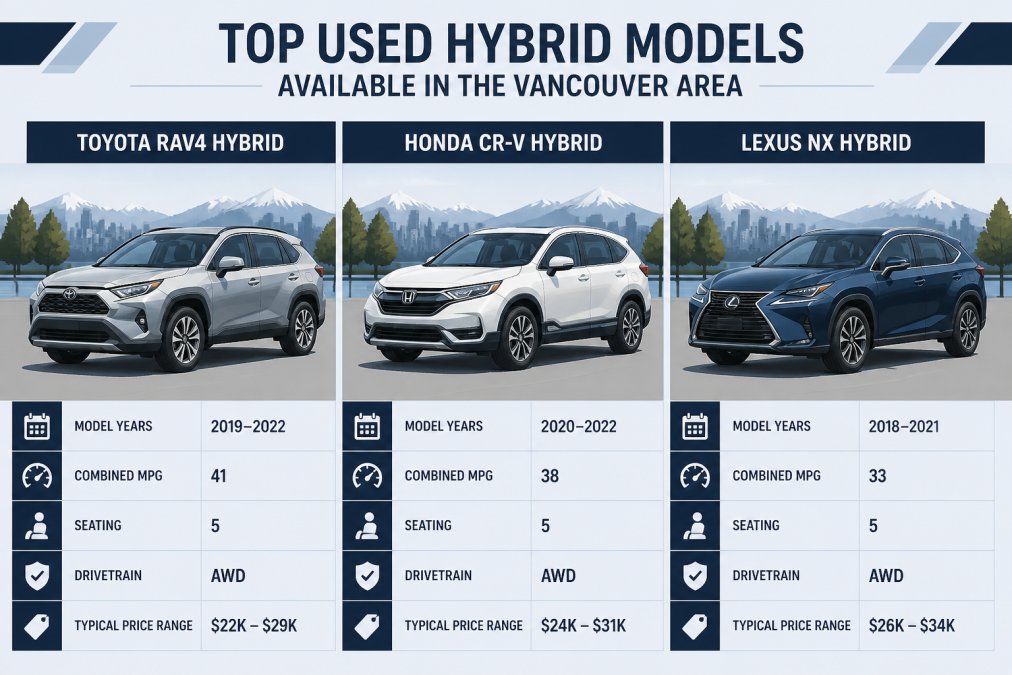 Row of three used hybrid vehicles parked side by side on a sunny day, displaying a Toyota RAV4 Hybrid in silver, Honda CR-V Hybrid in white, and Lexus NX Hybrid in dark blue, showing their distinct profiles and modern styling under natural daylight
Toyota RAV4 Hybrid (self-charging)
The RAV4 Hybrid is the default choice for many local shoppers because it blends SUV practicality with strong fuel economy. Natural Resources Canada rates recent front-wheel-drive RAV4 Hybrid models in roughly the 5.8-6.0 L/100 km combined range, with all-wheel-drive versions slightly higher. Cargo volume behind the second row is in the neighborhood of 1,000 L, and the rear seats fold to open up roughly double that.
For used shopping, 2020 and newer examples are the sweet spot: they carry the current-generation hybrid system and updated cabin technology. Earlier versions still run well, but expect older infotainment and fewer driver-assistance features. When comparing listings, check whether the vehicle is FWD or AWD, confirm the trim (LE, XLE, XSE, Limited), and ask for the service history. A well-maintained RAV4 Hybrid commonly runs well past 200,000 km.
Honda CR-V Hybrid (self-charging)
The CR-V Hybrid is the closest direct alternative to the RAV4 Hybrid, with a slightly roomier interior and a reputation for smooth, quiet operation. Natural Resources Canada combined ratings for recent CR-V Hybrid models sit in roughly the 6.0-6.5 L/100 km range depending on drivetrain and model year. Cargo space is competitive with the RAV4, and the rear seat is comfortable for adults.
Honda's hybrid system is proven and requires little beyond standard maintenance. Used examples from 2020 onward are widely available locally. When comparing, note that some CR-V Hybrid trims add features like a power tailgate and heated rear seats; confirm which trim a listing actually is rather than assuming from photos.
Lexus NX Hybrid (self-charging and plug-in variants)
The NX Hybrid appeals to buyers who want upscale appointments without stepping up to a larger SUV. Recent NX 350h models are rated by Natural Resources Canada in roughly the 6.0-6.5 L/100 km combined range, while the NX 450h+ plug-in hybrid offers a meaningful electric-only range for owners who can charge at home or at work.
Lexus vehicles tend to command higher used prices, but they often arrive with lower mileage and meticulous maintenance records. If budget allows and you prioritize luxury features, leather seating, and advanced infotainment, the NX Hybrid justifies its cost. For plug-in variants, confirm charging capability and ask for the battery health report.
Toyota Corolla Hybrid (self-charging)
The Corolla Hybrid is an excellent choice for budget-conscious buyers and first-time car owners. Natural Resources Canada rates recent Corolla Hybrid models in roughly the 4.5-5.0 L/100 km combined range, making it one of the most efficient used hybrids you can buy. It is smaller than the RAV4, which makes it easier to park and maneuver in tight urban streets.
Used Corolla Hybrids are plentiful and competitively priced. With proper maintenance, they are known for lasting well beyond 200,000 km. If you prioritize low fuel costs and straightforward, reliable transportation over cargo space or luxury features, this is the model to shortlist.
Honda Civic Hybrid (self-charging)
The Civic Hybrid delivers sporty handling and responsive performance compared with other hybrids on this list. Recent Civic Hybrid models are rated by Natural Resources Canada in roughly the 4.5-5.0 L/100 km combined range, with a sedan body style that suits urban driving.
Used Civic Hybrids are less common than RAV4s or Corollas, which can mean better pricing if you find the right example. The Civic's smaller size and nimble feel make it popular with urban drivers navigating downtown and residential streets. When shopping, confirm whether the listing is a sedan or hatchback, and check for the trim level, since feature content varies significantly.
Plug-in hybrids worth considering
If you have reliable access to charging, a plug-in hybrid can cut fuel use further. Common used PHEVs in local inventories include the Toyota Prius Prime (rated by Natural Resources Canada around 4.3 L/100 km combined on gas, with an electric-only range of roughly 40-60 km depending on model year), the Hyundai Ioniq Plug-in Hybrid, and the Kia Niro Plug-in Hybrid. These make sense if your daily driving fits within the electric range and you can charge overnight. If you cannot charge regularly, a self-charging hybrid is usually the more practical choice.
Quick comparison for local driving
| Model | Hybrid type | Approx. combined fuel use (L/100 km) | Cargo strength | Best for |
|---|---|---|---|---|
| Toyota RAV4 Hybrid | Self-charging | ~5.8-6.0 (FWD) | High | Families, all-weather driving |
| Honda CR-V Hybrid | Self-charging | ~6.0-6.5 | High | Comfort-focused families |
| Lexus NX Hybrid | Self-charging / PHEV | ~6.0-6.5 (350h) | Medium | Luxury buyers |
| Toyota Corolla Hybrid | Self-charging | ~4.5-5.0 | Low | Budget commuters |
| Honda Civic Hybrid | Self-charging | ~4.5-5.0 | Low-medium | Urban drivers who want handling |
| Toyota Prius Prime | Plug-in | ~4.3 (gas) + electric range | Low | Owners with home charging |
Use this table as a starting point, then verify the exact figures for the model year and trim you are considering against Natural Resources Canada's fuel consumption ratings and the vehicle's own documentation.
What Makes Reliable Used Hybrid Cars Stand Out
Reliable used hybrid cars share several hallmarks. First, they show consistent service records, regular oil changes, fluid checks, and scheduled maintenance performed on time. Owners who maintain their hybrids properly typically keep them for many years, so a vehicle with documented history is a strong signal of reliability.
Second, the battery system should show no warning lights or error codes. While hybrid batteries degrade gradually, a well-maintained battery can last 150,000 to 200,000 kilometres or longer. Ask the dealer or seller about battery health diagnostics.
Third, test-drive performance matters. A reliable hybrid should shift smoothly between electric and gas power without hesitation, acceleration should feel responsive, and the regenerative braking system should engage consistently. Any strange noises, warning lights, or sluggish performance during a test drive warrants further inspection.
Fourth, transparency about accident history and title status is non-negotiable. A clean title and no major accident damage indicate the vehicle was cared for and hasn't suffered structural compromise. Request a vehicle history report before making an offer.
Choosing the Best Second-Hand Hybrid Cars for Your Needs
Selecting the right used hybrid depends on your specific situation. Start by defining your priorities: budget, size, fuel efficiency, features, and driving patterns.
If you drive mostly in the city with occasional highway trips, a smaller hybrid like the Corolla or Civic makes sense. Their lighter weight and efficient engines excel in stop-and-go traffic. If you need cargo space for family outings or weekend adventures, the RAV4 or CR-V Hybrid provides versatility without sacrificing efficiency.
Budget is equally important. RAV4 and CR-V Hybrids command higher prices due to demand, while Corolla and Civic Hybrids offer entry-level pricing. Lexus models cost more but arrive with premium features and often lower mileage.
Your Complete Roadmap to Buying Used Cars in Vancouver Canada(page:3) walks you through the entire selection process, from comparing models to negotiating terms and finalizing paperwork. This guide complements your model research and helps you make a confident decision.
Consider your driving environment too. Vancouver's mild winters and frequent rain mean rust protection and traction control matter. All modern hybrids handle wet conditions well, but checking undercarriage condition and rust spots during inspection is wise.
Understanding Used Hybrid Car Battery Health
The hybrid battery is the most expensive component to replace, so assessing its condition is critical before buying. A typical hybrid battery costs between $3,000 and $8,000 to replace, depending on the model and whether you choose OEM or aftermarket options.
Most hybrid batteries degrade gradually and predictably. They lose efficiency over time and mileage, but rarely fail suddenly. A battery showing 70-80% capacity after 150,000 kilometres is normal and acceptable. Batteries at 50% capacity or lower suggest the vehicle may need replacement within a few years.
Ask the dealer or seller for a battery health diagnostic report. Many dealerships offer this service, and the cost is minimal compared to the peace of mind it provides. Battery diagnostics measure voltage, capacity, and cell balance to estimate remaining lifespan.
If buying from a private seller, consider paying for an independent pre-purchase inspection that includes battery diagnostics. This investment protects you from inheriting a vehicle requiring imminent battery replacement.
Some used hybrids still carry manufacturer battery warranties. Toyota and Honda typically warrant hybrid batteries for 8 years or 160,000 kilometres, whichever comes first. If the vehicle is within warranty, battery replacement would be covered, which significantly reduces your risk.
Used Hybrid Car Inspection Checklist Before You Buy
Before committing to a used hybrid purchase, follow this inspection checklist to verify mechanical condition and avoid costly surprises.
Battery and Electrical System:
- Request a battery health diagnostic report
- Check for any hybrid system warning lights on the dashboard
- Verify battery warranty status and remaining coverage
Engine and Transmission:
- Listen for unusual noises during startup and acceleration
- Check for smooth shifting and responsive acceleration
- Verify the engine runs smoothly at idle and under load
Braking System:
- Test brakes during the test drive for smooth, responsive stopping
- Check brake pads and rotors for remaining life
- Verify regenerative braking engages smoothly
Suspension and Steering:
- Listen for clunks or squeaks over bumps
- Verify steering feels responsive and centered
- Check tire tread depth and condition
Body and Paint:
- Inspect for rust, dents, and paint imperfections
- Check undercarriage for corrosion or damage
- Verify all doors, windows, and locks operate smoothly
Interior and Features:
- Test climate control, heating, and air conditioning
- Verify all gauges and warning lights function
- Check that infotainment and connectivity systems work
Documentation:
- Request complete service records and maintenance history
- Verify the vehicle title is clean with no liens
- Obtain a vehicle history report showing accident history
Learn what to check before buying a used car(page:2) provides detailed guidance on each inspection point, helping you identify potential issues and negotiate confidently.
Total Cost of Ownership for Used Hybrids in BC
Calculating total cost of ownership helps you compare used hybrids fairly and budget for years ahead. Beyond the purchase price, factor in fuel, maintenance, insurance, registration, and potential repairs. The goal is not a single number but a repeatable method you can apply to any listing.
Fuel costs
Fuel is the largest variable cost and the main reason to buy a hybrid. A self-charging hybrid typically uses meaningfully less fuel than a comparable gas-only vehicle, and the gap is largest in stop-and-go city driving where regenerative braking and electric assist do the most work. To estimate annual fuel cost for a specific listing, multiply the vehicle's combined L/100 km rating (from Natural Resources Canada) by your estimated annual kilometres, divide by 100 to get litres, then multiply by the current pump price in dollars per litre. For example, a vehicle rated at 5.5 L/100 km driven 15,000 km per year uses about 825 L; at $1.70/L that is roughly $1,400 per year. Run the same calculation for a gas-only alternative and the difference is your annual fuel savings.
Plug-in hybrids can reduce fuel cost further, but only if you charge regularly. If you cannot charge at home or at work, treat a PHEV like a conventional hybrid for budgeting purposes.
Maintenance and repairs
Routine maintenance for a hybrid is comparable to a gas vehicle: oil changes, air filters, fluid checks, and tire rotations. Hybrid-specific items include brake fluid flushes and periodic battery diagnostics. One often-overlooked advantage is that regenerative braking reduces wear on conventional brake pads, so brake jobs can be less frequent than on a gas-only vehicle.
Major repairs beyond warranty coverage are uncommon in the first 150,000 km, but the hybrid battery is the one component to plan for. Replacement costs vary widely by model and whether you choose OEM or aftermarket options; get a battery health report before purchase and budget a contingency fund rather than assuming the battery will last forever.
Insurance
Insurance rates for used hybrids are generally competitive with gas vehicles of similar age and value. Some insurers offer modest discounts for hybrid ownership, but savings vary by provider and by driver profile. Get quotes for the specific make, model, trim, and year before you commit, because trim and repair costs can move premiums more than the hybrid label does.
Registration, taxes, and incentives
Registration and licensing follow standard provincial vehicle procedures. There are no special provincial taxes or fees tied to hybrid ownership, but the usual purchase costs apply: provincial sales tax on private sales, GST on dealer sales, and the standard registration and plate fees. Municipal parking incentives and HOV lane access vary by location and by whether the vehicle carries a qualifying decal, so confirm current rules with the relevant municipality or provincial ministry before relying on them.
Incentives for used hybrids are narrower than for new vehicles. Federal and provincial programs have changed over time, and eligibility often depends on vehicle type (battery-electric vs. plug-in hybrid vs. self-charging hybrid) and on whether the vehicle is new. Before you buy, check the current federal incentive program and the provincial clean-vehicle program directly, and confirm with the dealer or seller whether any incentive has already been claimed on the vehicle.
Putting it together
A practical approach is to build a simple spreadsheet for each shortlisted vehicle with columns for purchase price, estimated annual fuel cost, estimated annual maintenance, insurance quote, and registration and tax. Add a contingency line for potential battery or major repairs. Comparing three or four listings this way makes the trade-offs obvious: a cheaper older hybrid with a weaker battery can cost more over five years than a slightly pricier newer example with a strong battery health report.
Financing options and costs(page:4) breaks down the financial side of buying used cars in Vancouver, helping you understand total monthly costs and available financing solutions.
Start Your Search at Variety Auto Today
Finding the right used hybrid car in Vancouver starts with access to quality inventory and transparent information. Variety Auto simplifies that process by offering a curated selection of used hybrid vehicles with online browsing, simplified financing, and trade-in appraisal services.
Our team helps you navigate the hybrid car market with confidence. Whether you're a first-time buyer intimidated by the process, upgrading from an older vehicle, or trading in your current car, we guide you toward the right choice without pressure or hidden fees.
Browse used cars for sale in Vancouver(page:1) to explore available hybrid options, compare models and pricing, and schedule a test drive that fits your schedule. Start your search today and discover how straightforward buying a used hybrid can be.
Frequently Asked Questions
What should I look for when buying a used hybrid car?
Focus on battery health first: request service records and ask about warranty coverage. Check the vehicle history for accident damage and regular maintenance. During your inspection, listen for unusual noises from the engine or electric motor, test the hybrid system's smooth transitions, and verify that the regenerative braking feels responsive. Have a certified mechanic inspect the transmission, cooling system, and electrical components. Compare fuel-consumption ratings against the model's specifications to ensure the hybrid system is performing normally.
How can I check the battery health of a used hybrid car?
Request the vehicle's service records to see if the hybrid battery has been serviced or replaced. Ask the seller or dealer directly about battery age and remaining warranty. A diagnostic scan can reveal the battery's state of charge and health status. Most hybrid batteries are warrantied for 8-10 years or 160,000 kilometres; if the vehicle is approaching or past that threshold, factor replacement costs into your decision. Test-drive the vehicle to confirm smooth electric-motor engagement and responsive acceleration, which indicate a healthy battery.
Are used hybrid cars more expensive to maintain than conventional vehicles?
Used hybrid cars typically cost less to maintain because they use the electric motor for low-speed driving, reducing wear on the traditional engine and brakes. Hybrid brakes last significantly longer due to regenerative braking. However, if the hybrid battery requires replacement outside warranty, costs can be substantial. Routine maintenance, oil changes, air filters, coolant, remains similar to conventional cars. Choose a reliable used hybrid model with a strong service history, and verify any remaining warranty coverage to protect yourself against unexpected hybrid-system repairs.
What is the most reliable used hybrid car to buy?
Toyota and Honda hybrids consistently rank among the most reliable used hybrids available. The Toyota RAV4 Hybrid, Toyota Corolla Hybrid, and Honda CR-V Hybrid are known for durability and strong resale value. Lexus hybrids, which share Toyota's hybrid technology, also offer excellent reliability. Check individual vehicle history reports and maintenance records rather than relying on brand alone; a well-maintained used hybrid from any of these manufacturers will outperform a neglected one.
How do I know if a used hybrid is a good deal in Vancouver?
Compare asking prices across multiple local listings for the same model, year, and mileage. Check online marketplaces to see the typical price range for that vehicle. Factor in fuel savings: a used hybrid with strong fuel efficiency can offset a slightly higher purchase price through lower fuel costs over time. Verify the vehicle history for accidents, title issues, and service records. Request a pre-purchase inspection from an independent mechanic. Variety Auto offers transparent pricing and trade-in appraisals, making it easy to understand the true value of your potential purchase.
