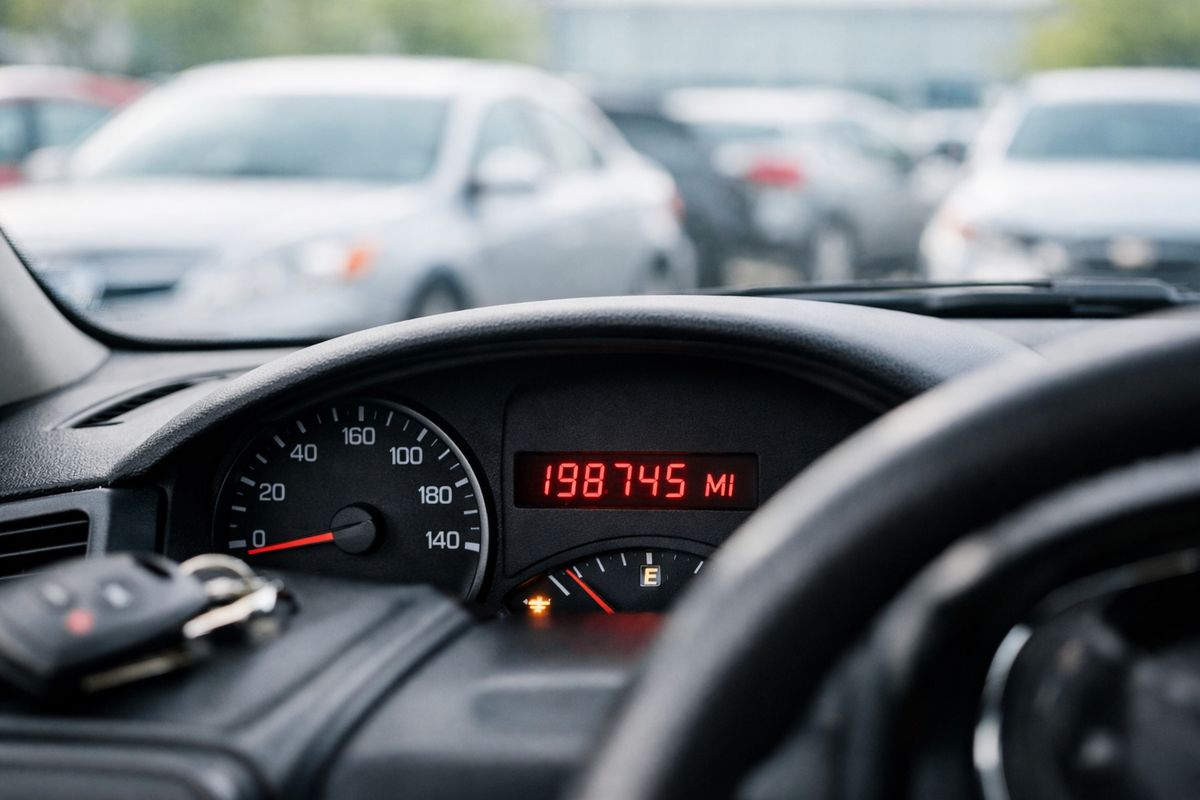
A used car with high miles is not automatically a bad buy, and that is the real answer to what mileage is too high. The number on the odometer matters, but it only tells part of the story, which becomes obvious the moment you spot a clean-looking car for sale near Kingsway, like the price, and then notice 168,000 miles staring back at you.
What mileage is too high for a used car?
There is no single mileage number that means a used car is too high-mileage for every situation. A car becomes “too high” when the miles are out of step with its age, condition, maintenance history, and asking price.
That distinction matters because shoppers often use mileage as a shortcut. It feels simple. Lower is better, higher is worse. But cars are not that neat. A carefully maintained sedan with 130,000 miles can be a better buy than a neglected one with 80,000. If you want a deeper look at that tradeoff, it helps to understand how age and miles interact on a used car.
Why mileage matters in the first place
Mileage matters because it gives you a rough picture of how much use a car has seen. More miles usually means more wear on the engine, transmission, suspension, brakes, wheel bearings, and all the small rubber and plastic parts that age quietly until something starts leaking, rattling, or failing.
But mileage is not a health score.
Think of it like looking at running shoes. If a pair has been worn for 500 miles, you know something about the wear. You still need to look at the soles, the shape, and how they were used. Cars work the same way.
What the odometer number actually tells you
The odometer is the gauge that records how far a car has been driven. So mileage is really just distance traveled. It tells you use, not care.
A car with 100,000 highway miles may be in better shape than a car with 70,000 miles of short trips, cold starts, potholes, and stop-and-go traffic through Vancouver. Highway driving is usually easier on the engine, brakes, and transmission because the car spends more time at steady speeds. City driving tends to create more wear because the car is constantly braking, turning, idling, and shifting.
That is why mileage should always be read with context, not panic.
Why mileage affects price, repairs, and resale
Mileage affects value in three big ways. First, it changes what you pay today. Lower-mileage cars usually cost more because buyers assume there is more life left in them. Second, it changes what you may need to fix. As miles climb, bigger maintenance items start showing up more often. Third, it affects resale. If you plan to sell the car in a few years, a high-mileage vehicle can be harder to move and easier for future buyers to argue down.
This is also where a lot of shoppers overpay. A lower-mileage listing can look safer than it really is. Before saying yes to a price, it helps to know how to spot when a used car is priced too high.
So, what mileage is “too high”?
What mileage is too high? Usually, it is the point where the mileage is high for the car’s age, the condition does not support the number, or expensive maintenance is due soon and the price does not leave room for it.
That is the practical answer.
For many mainstream used cars, 100,000 miles is not scary anymore. Even 120,000 or 150,000 miles can be fine if the car has been serviced properly. The catch is that once you get into those ranges, you need proof that the car has been cared for. If the records are thin and the price is not a bargain, the miles matter a lot more.
A simple rule of thumb by age
A useful benchmark is about 12,000 to 15,000 miles per year. It is not a hard rule, but it gives you a quick way to judge whether a car’s mileage is low, average, or high for its age.
A 5-year-old car with 60,000 to 75,000 miles is roughly in the normal range. If it has 95,000 miles, that is high for its age, though not automatically bad. A 10-year-old car with 120,000 to 150,000 miles may be perfectly normal. An older vehicle with 180,000 miles might still make sense if the price is right and the condition is unusually solid.
The trick is to compare the odometer to the calendar, then compare both to the condition.
When high mileage stops being a dealbreaker
High mileage stops being a dealbreaker when the car has a strong maintenance history, drives well, and is priced honestly. That is the line.
Maintenance history beats a pretty odometer reading every time. A seller who can show oil changes, brake service, fluid changes, and major repairs is giving you something far more useful than a low number on the dash. If you are weighing this exact question, judging a higher-mileage car without panic helps keep the decision grounded.
Mileage ranges and what they usually mean
Under 60,000 miles, you are usually looking at a newer car with fewer wear-related issues, a higher price, and less immediate repair risk. Still, neglect can show up even here.
From 60,000 to 100,000 miles, you are in the sweet spot for a lot of used-car buyers. The first owner already absorbed the steepest depreciation, but the car may still have plenty of life left.
From 100,000 to 150,000 miles, condition and records become much more important. Expect more wear items, maybe suspension work, possibly cooling system repairs, and major scheduled maintenance depending on the model.
Over 150,000 miles, the price has to make sense. At that point, you are not just buying transportation. You are buying transportation plus a certain level of upkeep risk. That can still be a smart move, especially if you are shopping for affordable used cars around Vancouver, but only if you go in with clear eyes.
What matters more than mileage
Mileage matters, but several things matter more. Condition, maintenance history, driving style, and model reputation tell you whether the odometer number is just a number or a warning.
Service records and maintenance history
Service records are gold because they show what actually happened, not what a seller says happened. Oil changes, transmission service, brake jobs, coolant flushes, spark plugs, timing belt replacement, water pump work, and tire rotations all help build the real story.
Proof matters more than promises. “Always maintained” means very little without receipts, stamps, or invoices.
This becomes even more important once a car gets into six-figure mileage. If major maintenance is coming due, you want to know whether you are paying for a car or paying for somebody else’s delay.
How the car was driven
Not all miles are equal. A car used for long highway commutes usually wears differently than a car used for short urban trips. In Lower Mainland traffic, constant braking, potholes, damp roads, and low-speed crawling can be harder on brakes, tires, suspension, and transmissions.
A commuter car that spent years moving steadily down Highway 1 may age better than a similar car that spent every weekday inching through Broadway traffic. That is one reason some of the better daily-driver choices for Vancouver traffic hold up well even with miles that look a little higher on paper.
Reliability of the make and model
Some vehicles simply handle age and mileage better than others. That does not mean chasing a logo. It means looking up known problems, common repair patterns, and whether parts are easy to source without turning every repair into a treasure hunt.
A model with a strong reputation for engine and transmission durability can still be a safe buy at 130,000 miles. A model known for transmission issues at 90,000 miles deserves a lot more caution. Mileage only means something when attached to a specific vehicle.
Climate, rust, and local driving conditions
Vancouver and the Lower Mainland add another layer. Rain, moisture, road grime, and year-round outdoor parking can do slow damage underneath a car even when the paint still looks good.
Rust is sneaky. You may not see much from ten feet away, then find corrosion on brake lines, suspension components, or the underbody once the car is on a lift. A vehicle from a dry interior area can age very differently from one parked outside near the coast for years. That is why a visual check is never enough.
Signs a high-mileage used car is still a good buy
A higher-mileage car can still be a smart buy if the basics are strong and the price leaves room for normal upkeep. You are not looking for perfection. You are looking for honesty, consistency, and signs that the car has not been ignored.
Green flags to look for
Good signs tend to show up as small patterns. The car starts easily. It idles steadily. The transmission shifts smoothly. The tires wear evenly, which suggests the suspension and alignment have not been neglected. Fluids look clean instead of burnt or sludgy. The dashboard is free of warning lights.
A recent inspection helps a lot too. If you want a sharper sense of what mechanics usually look for, this guide to what to check before buying in Vancouver is worth keeping in mind before a test drive.
Questions to ask before you buy
Good questions are simple and direct. Ask whether major services have been done. Ask what parts have been replaced recently. Ask whether the car has accident history. Ask why it is being sold.
Pay attention to the answers, but also to how easily those answers come. Clear details are a good sign. Vagueness usually is not. If the seller keeps circling back to “it runs great” without specifics, that is not much help.
Red flags that mean the mileage is probably too high
A car’s mileage is probably too high for you when the number is paired with neglect, hidden problems, or a price that leaves no room for repairs. That is usually how “too high” shows up in real life.
Warning signs during a walkaround and test drive
Watch for smoke from the exhaust, rough idle at a stop, delayed or harsh shifting, clunks over bumps, steering vibration at highway speed, uneven braking, fluid leaks, or strange noises on startup. Mismatched tire wear, worn pedals with suspiciously low mileage, and a cabin that feels far more used than the odometer suggests can also point to trouble.
None of these signs guarantee disaster on their own. But when several show up together, the car is telling you a story. Listen.
When the records Don’t match the story
Missing records, inconsistent mileage, unclear ownership history, and vague answers are where a lot of bad used-car deals begin. A history report can help uncover accident records, registration changes, and other useful details, though it is not the whole picture. It helps to know what a BC vehicle history report can and cannot tell you.
If the mileage seems oddly low for the age, be careful. Low miles can sound great, but long periods of sitting can create problems too, and odometer issues do happen. If the story feels slippery, walk away.
How mileage affects different types of used cars
Not every vehicle should be judged the same way. A compact commuter car, a family SUV, a work truck, and a hybrid all wear differently, even if the odometer shows the same number.
Sedans, SUVs, trucks, and hybrids
Compact sedans often live easy lives compared with larger vehicles. Many rack up commuter miles without towing, heavy hauling, or oversized tires stressing the suspension. SUVs can see more suspension wear simply because of weight and the roads they get driven on. Trucks may have towing wear, harder use, and more strain on brakes and transmissions. Hybrids add another consideration: battery health.
That does not mean one type is always safer. It means the same 140,000 miles means different things depending on the job the vehicle spent those miles doing.
If you only need a car for a few years
Your timeline changes the answer. If you only need a car for two or three years, a well-kept higher-mileage vehicle can be a smart budget move. If you want something to keep for the next decade, starting with lower miles usually gives you more breathing room.
Here’s the thing: buying used is partly about matching the car to your plan. If your budget is tight and your goal is simple, reliable transportation for a shorter stretch, a high-mileage car may be perfectly reasonable.
A smart way to judge mileage before you buy
The best way to judge mileage is to stop treating it like a pass-or-fail number. Instead, compare mileage, age, condition, price, and service history together.
Compare mileage, age, condition, and asking price together
A documented, clean-driving car with 120,000 miles at a fair price can easily be a better buy than an 80,000-mile car with poor maintenance, hidden rust, and a seller asking top dollar.
That is why your comparison should always include the whole package. Age tells you how quickly the miles piled up. Condition tells you how the car was treated. Price tells you whether the risk is being discounted properly. Mileage is just one part of that math.
Get a pre-purchase inspection
A pre-purchase inspection is one of the smartest small expenses in used-car shopping. A good independent mechanic can spot leaks, rust, worn suspension parts, weak brakes, tire issues, and signs of past neglect that are easy to miss in a driveway.
This matters even more in the Lower Mainland, where years of wet driving can hide underbody problems until the car is lifted. If you are debating the cost, this breakdown of why an inspection before buying can save you money makes the case pretty clearly.
Use one simple test before you commit
Try one filter before you commit: imagine the odometer is covered. Would you still feel good about the car based on its condition, records, price, and how it drives?
If the answer is yes, the mileage may not be too high after all. If the answer is no, the number probably is not the real problem.
Frequently asked questions
Is 100,000 miles too high for a used car?
No. For many modern cars, 100,000 miles is just the point where maintenance history starts to matter more than the number itself. If the car has been serviced properly and the price reflects the mileage, 100,000 miles can be completely reasonable.
Is 150,000 miles too much for a used car?
It can be, but not automatically. At 150,000 miles, a car needs strong service records, solid condition, and a price that leaves room for repairs. Without those three things, the risk goes up fast.
Is low mileage always better on an older used car?
Not always. An older car with unusually low mileage may have spent long periods sitting, which can lead to dried seals, weak batteries, old tires, and stale fluids. Low mileage is nice, but only if the car was still maintained.
How many miles should a used car have per year?
A rough benchmark is 12,000 to 15,000 miles per year. That gives you a quick way to judge whether a car is below average, average, or above average for its age. It is a guide, not a rule.
Should you buy a high-mileage used car from a private seller?
You can, but caution matters more. Ask for records, check the history, and get an inspection. A private sale can be a good value, but it also gives you less backup if something was hidden.
What matters more, age or mileage?
Condition and maintenance history matter most, but if you have to choose between age and mileage, neither wins on its own. A newer car with hard miles can be worse than an older car with steady care. Always judge the full picture.
The real number to watch
The real number to watch is not just the odometer. It is the repair bill waiting behind it.
If you remember one thing, make it this: high mileage is fine, neglected mileage is not. On your next listing or test drive, try that one filter and judge the car as a whole. It will save you from walking away from good cars, and from saying yes to the wrong ones.