
Finding a used car for under $5000 in Canada is still possible, but buyers need to be realistic.
At this budget, the goal is usually simple: find something practical, dependable, and affordable to keep on the road. Many vehicles in this price range are older, have higher mileage, or come with limited history. Some are still solid budget buys. Others look cheap but quickly become expensive once repairs start.
A good used car under $5000 is usually not perfect. It may have cosmetic wear, basic features, and some age on it. What matters more is condition, maintenance history, repair risk, and whether the car makes sense for your daily needs.
In this guide, we look at which types of used cars often make the most sense under $5000, which models are worth considering, what buyers should avoid, and how to shop more carefully when every dollar matters.
Can You Still Buy a Good Used Car for Under $5000 in Canada?
Yes, but you need to be selective.
There are still decent used cars under $5000 in Canada, but buyers have to look more carefully than before. Most vehicles in this range are older, have higher kilometres, or need closer inspection.
A good used car at this budget does not mean perfect cosmetics or modern features. It usually means something more practical:
- dependable enough for daily use
- in reasonable mechanical condition
- free from major red flags
- affordable to maintain
- realistic for your needs and climate
That is why price alone is not enough. A well-kept older Civic, Corolla, Mazda3, or Elantra can still be a smart buy, while a cheaper car with rust, warning lights, or poor history can become more expensive fast.
The Canadian market also varies by region. Rust exposure, winter use, road conditions, and local demand all affect what $5000 can actually buy.
So yes, a good used car under $5000 is still possible. The key is to focus on condition, ownership history, and long-term value rather than the lowest asking price.
What Buyers Should Realistically Expect Under $5000
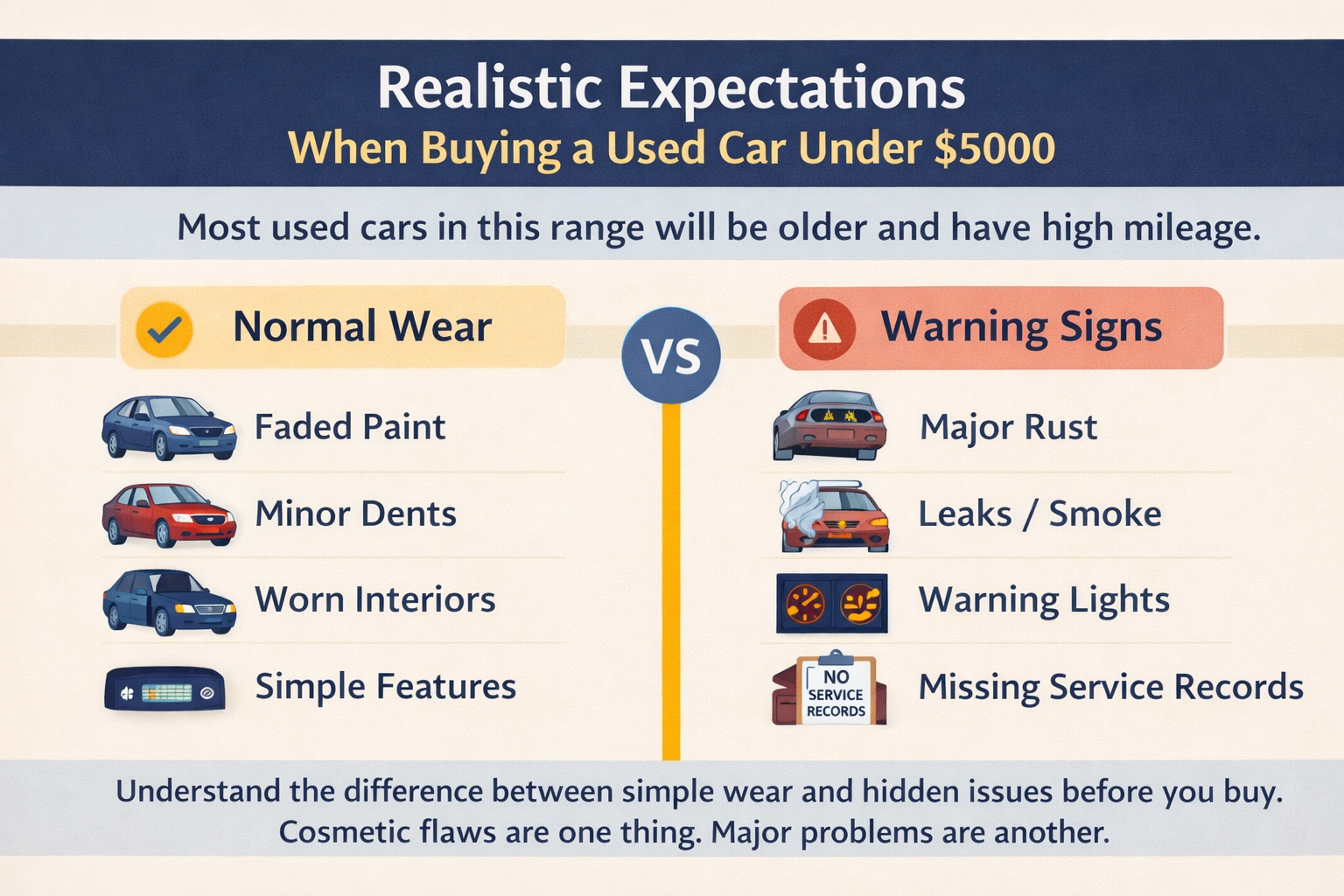
Buyers in this range need realistic expectations. Under $5000, you are usually buying age, mileage, and simplicity.
Most vehicles in this price range will be older and many will have well over 150,000 kilometers. Cosmetic wear is normal. Faded paint, dents, worn interiors, and missing modern features are common and not always a problem by themselves.
What matters is knowing the difference between normal wear and real warning signs. Cosmetic flaws are one thing. Major rust, leaks, warning lights, rough shifting, overheating, or missing service history are something else.
You Are Usually Buying Age and Mileage, Not Modern Features
Under $5000, many vehicles are basic. No backup camera, no touchscreen, and no advanced features is common.
That is not always a bad thing. Simpler older vehicles can be easier and cheaper to maintain. For many buyers, reliable starting, decent fuel economy, and affordable parts matter more than extra features.
Cosmetic Flaws Are Often Normal in This Price Range
A decent budget car may not look impressive. Scratches, worn trim, and a tired interior are common.
In this market, appearance can be misleading. A clean-looking car may still have mechanical issues, while a rougher-looking car may be the better buy if it has been maintained properly.
A Clean, Simple Car Can Be a Better Buy Than a Loaded Trim
Higher trims and extra features are not always an advantage on older vehicles. More equipment can mean more things to repair.
A simpler trim with fewer complications is often the safer budget choice. In this price range, boring can be a strength.
Some Immediate Maintenance Should Be Expected
Even a decent car under $5000 may need something soon after purchase. Tires, brakes, battery, fluids, filters, or small suspension items are all common.
That is why it helps to leave some room in your budget after buying. A slightly cheaper car with a repair cushion can be smarter than spending the full amount and having nothing left.
Why the Cheapest Listing Is Not Always the Best Deal
A low asking price does not always mean low cost.
At the lower end of the used market, the cheapest listing often comes with more risk. That risk may be worn brakes, old tires, suspension issues, leaks, rust, warning lights, or missing history. The car looks affordable, but the real cost shows up later.
The goal is not to buy the cheapest car. The goal is to buy the most sensible car your budget can support.
Cheap Upfront Can Become Expensive Fast
A bargain stops being a bargain once repair bills start. A cheaper car that immediately needs tires, brakes, battery, or suspension work can quickly cost more than a better-kept car with a slightly higher asking price.
That is why buyers should not treat a low price as proof of value.
Deferred Maintenance Changes the Real Value
Some older cars are sold with a backlog of maintenance. The vehicle may still run, but several items may be due at once.
That changes the real value. A $5000 car that is up to date on basic maintenance may be a better buy than a $4000 car that needs major work right away.
A Better-Documented Car May Justify a Higher Price
Service records, receipts, and clear answers from the seller reduce uncertainty. They do not guarantee a perfect car, but they can help separate a cared-for vehicle from one with too many unknowns.
Under $5000, spending more carefully is often smarter than simply spending less.
Best Types of Used Cars to Focus On at This Budget
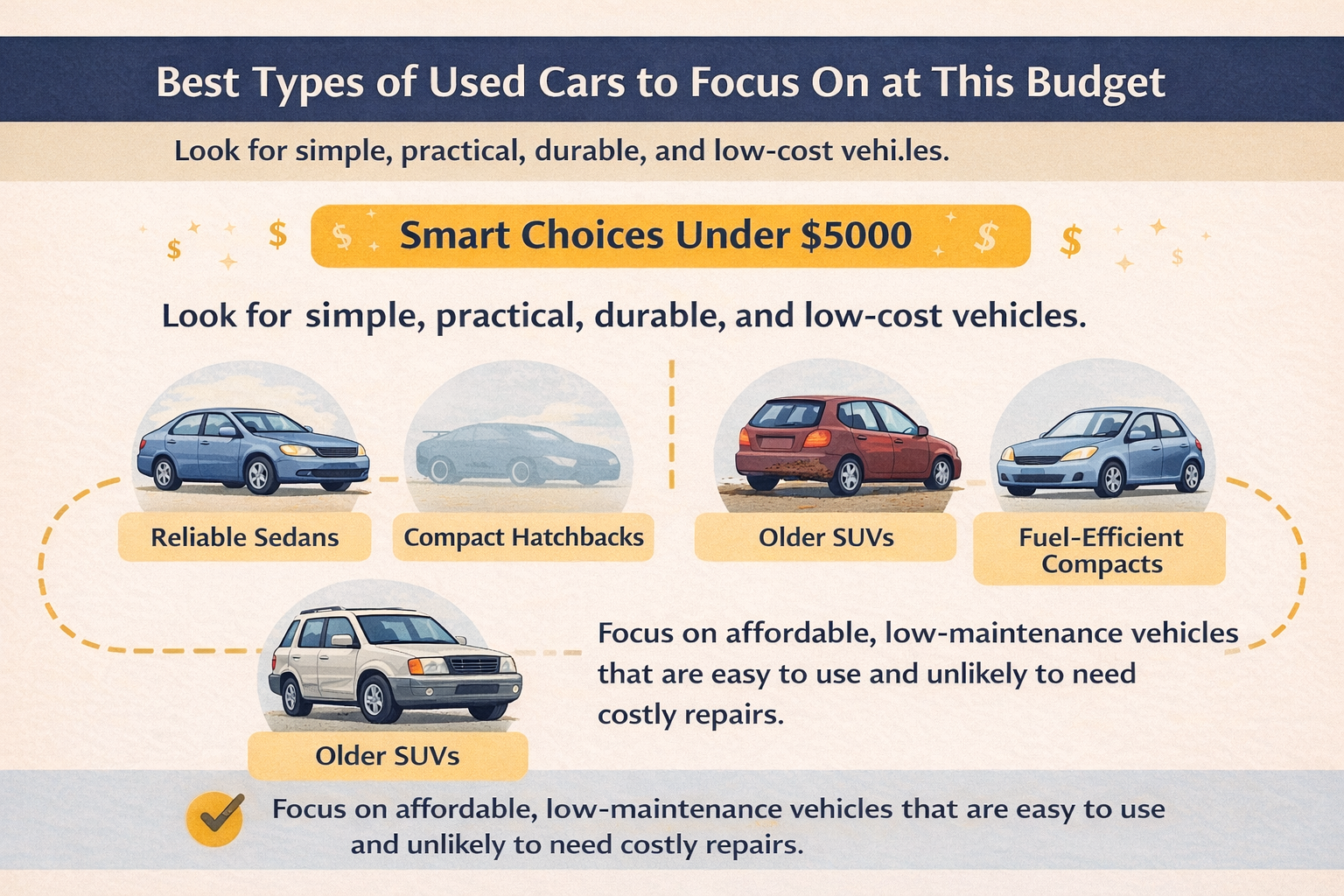
When your budget is under $5000, the safest strategy is usually to focus on simple, practical vehicles. This is not the price range where most buyers should chase luxury, performance, or complicated drivetrains. The goal is to find something affordable to own, reasonably reliable, and easy to maintain.
Compact Sedans
Compact sedans are often one of the strongest choices under $5000. Cars like the Honda Civic, Toyota Corolla, Hyundai Elantra, and some Mazda3 models are popular for a reason. They are usually better on fuel, easier to park, and often cheaper to maintain than larger vehicles.
They also tend to make sense for the kind of buyer searching in this range: commuters, first-time buyers, students, and small households that need basic transportation without big running costs.
Hatchbacks
Hatchbacks can offer excellent value in this budget range. They give you many of the same benefits as a compact sedan, but with more cargo flexibility. That makes them useful for groceries, small family use, work gear, or general daily life.
Models like the Toyota Matrix, Pontiac Vibe, and Honda Fit are worth watching because they combine practicality with relatively simple ownership. A hatchback can be a smart choice for buyers who want a small car but need more usable space.
Older Midsize Sedans
Some older midsize sedans can also be worth considering, especially for buyers who want more room or a more comfortable ride. In some cases, older domestic sedans can offer a lot of space for the money.
The trade-off is that they may use more fuel, feel larger to drive, and come with more age-related wear. They are not always the best fit for every buyer, but a clean, maintained midsize sedan can still be a practical option if comfort matters more than efficiency.
Why Many SUVs and Luxury Vehicles Become Riskier at This Price Point
This is where many buyers get tempted.
An SUV or luxury badge at under $5000 may look appealing, but the risk often goes up quickly. Older SUVs can bring higher fuel costs, more drivetrain wear, more suspension wear, and more expensive repairs. Older luxury cars may feel like a bargain, but parts and labour can be much more expensive than buyers expect.
At this budget, a basic compact car is often a safer bet than a cheap SUV or luxury model. It may not look as exciting, but it usually makes more financial sense.
Why Simple Front-Wheel-Drive Vehicles Often Make the Most Sense
For many buyers, an older front-wheel-drive car is the most practical path.
These vehicles are usually lighter, more fuel efficient, and less complex than AWD or 4x4 options. That simplicity matters when repair budget is limited. In many cases, a well-maintained front-wheel-drive sedan or hatchback with proper winter tires is a more sensible buy than a worn-out AWD vehicle with unknown issues.
That is the bigger pattern in this price range. The best-value cars are often the simplest ones: compact, practical, fuel-efficient, and easier to keep on the road.
Best Used Cars Under $5000 in Canada
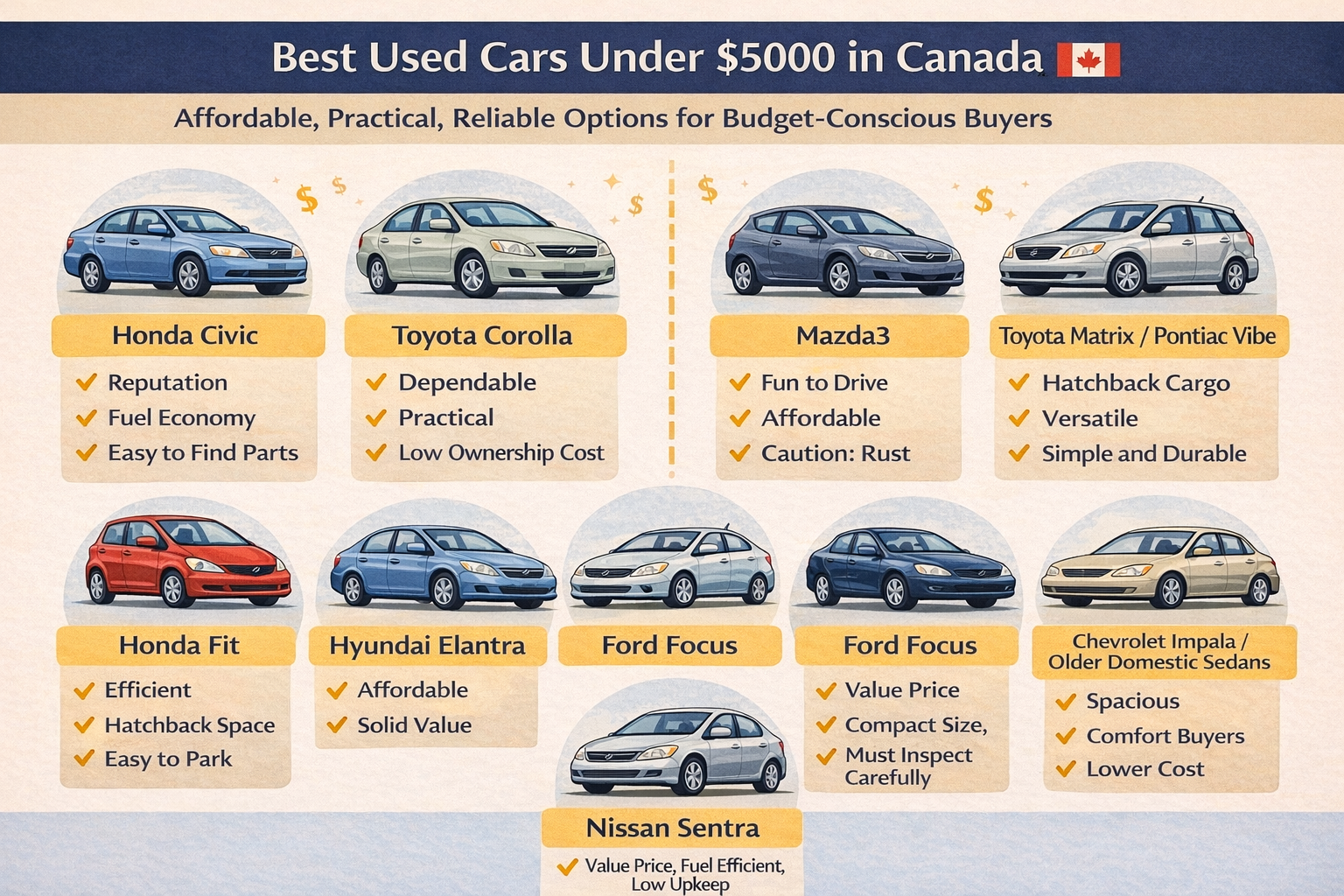
At this budget, no model is automatically a good buy just because of its reputation. Condition still comes first. But some used cars tend to make more sense than others because they are practical, easier to live with, and more realistic to maintain.
Honda Civic
The Honda Civic is one of the first cars many buyers look for under $5000, and for good reason. It has a strong reputation, good fuel economy, and broad parts availability.
The problem is that many older Civics in this price range are heavily used, modified, or priced higher than their condition deserves. A clean, stock Civic can still be a strong buy, but buyers should inspect carefully and not assume every Civic is worth a premium.
Toyota Corolla
The Toyota Corolla is another common budget favourite. It is known for being practical, predictable, and generally easy to own.
Like the Civic, older Corollas often hold value because of their reputation. That can make good examples worth considering, but it also means some sellers ask too much for rough cars. If you find one with decent history and solid condition, it is often a smart option.
Mazda3
The Mazda3 can be a good choice for buyers who want something affordable but still pleasant to drive. It often feels a bit less plain than some rivals, which adds to its appeal.
The main caution is rust on older examples, especially in Canadian climates. A Mazda3 can offer good value, but only if the body and undercarriage have held up well.
Toyota Matrix or Pontiac Vibe
These two are often worth grouping together because they offer similar practicality. They give you hatchback flexibility, useful cargo space, and everyday simplicity.
They can be excellent for commuters, students, or small families who need a practical vehicle without moving into SUV territory. As always, condition matters, especially because many older hatchbacks were used hard.
Honda Fit
The Honda Fit is small on the outside but very practical inside. It is efficient, easy to park, and surprisingly usable for daily life.
A clean Fit under $5000 can be a very smart buy for the right person. The challenge is availability. Good examples can be hard to find at this price, so buyers may need patience.
Hyundai Elantra
The Hyundai Elantra can be a good value choice because it is often priced below comparable Honda and Toyota models. That can make it appealing for buyers who want basic transportation without paying a brand premium.
The key is to judge it carefully by year, maintenance history, and condition. A well-kept Elantra may offer better value than an overpriced competitor with a stronger badge.
Ford Focus
The Ford Focus sometimes shows up at attractive prices, which is why budget buyers often notice it. Some older examples can work well, especially if the car is clean, simple, and well maintained.
Still, this is a model where buyers need to be selective. It makes more sense as a careful pick than a default recommendation. Good condition matters more here than the name itself.
Chevrolet Impala or Older Domestic Sedans
Older domestic sedans like the Chevrolet Impala can offer a lot of space and comfort for the money. They may suit buyers who want a roomier car and are less focused on fuel economy.
These cars can make sense in the right condition, but buyers should weigh fuel costs, age-related wear, and overall maintenance needs. They are often better as practical comfort buys than as the cheapest possible option.
Nissan Sentra
The Nissan Sentra can look appealing because of price, but it is a model where buyers should be more cautious. Some examples may be fine, while others may not be worth the risk depending on year, transmission, and maintenance.
It is better to treat the Sentra as a case-by-case option rather than a safe automatic pick.
What These Cars Have in Common
The better options under $5000 usually share a few traits: they are simple, practical, fairly common, and easier to maintain than more complicated alternatives. They may not be exciting, but they often make the most sense.
That is the pattern to follow in this price range. Shop for condition, maintenance history, and realistic ownership costs first. Then use the model name as a guide, not a guarantee.
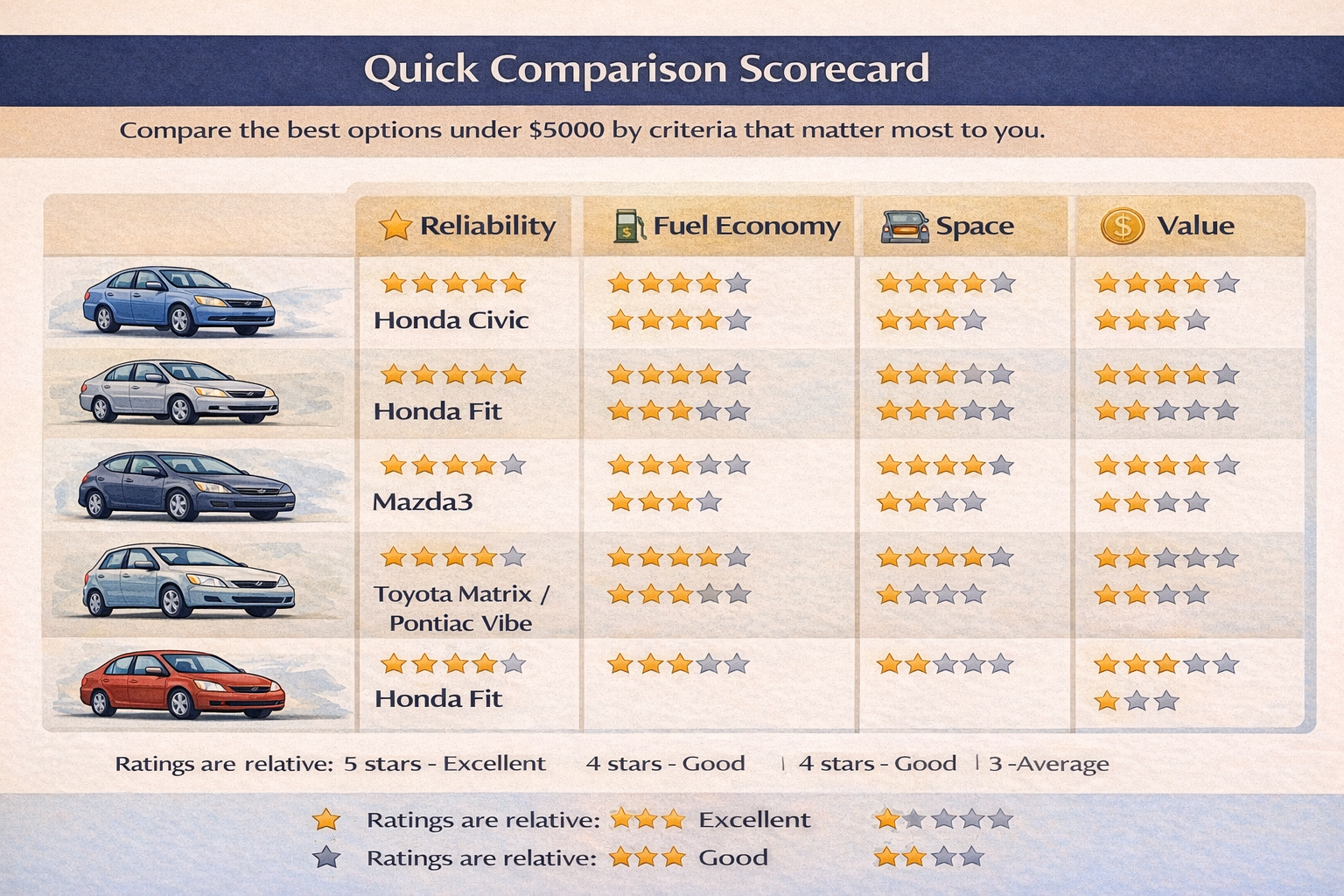
Quick Comparison of the Best Options
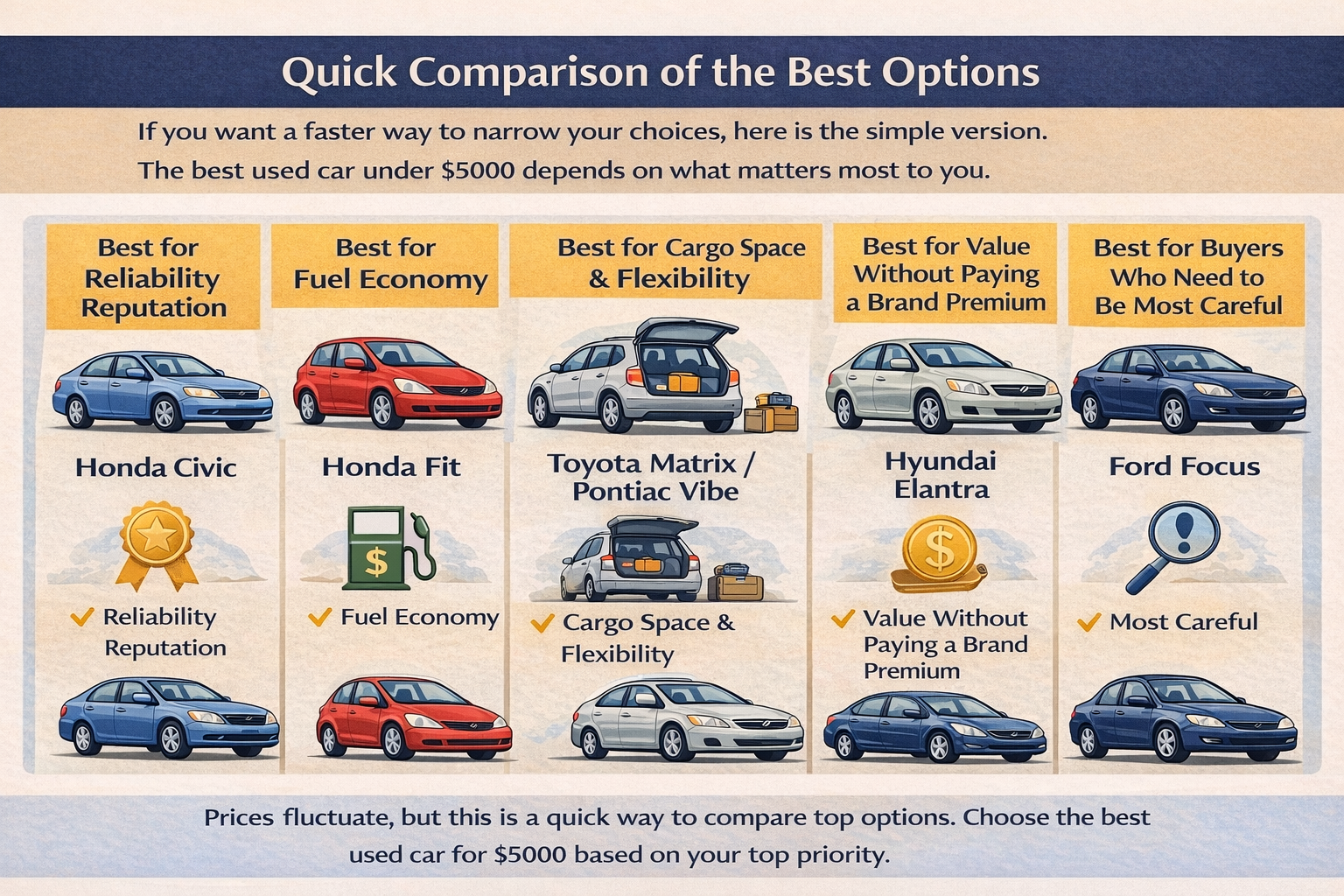
If you want a faster way to narrow your choices, here is the simple version. The best used car under $5000 depends on what matters most to you.
Best for Reliability Reputation
The Honda Civic and Toyota Corolla usually lead here. They have long-standing reputations for being dependable, practical, and relatively easy to keep on the road. That does not make every example a good buy, but they are often strong places to start.
Best for Fuel Economy
The Honda Fit, Honda Civic, Toyota Corolla, and some Hyundai Elantra models are often the better picks if lower fuel costs matter most. For daily commuting, this can make a real difference over time.
Best for Cargo Space and Flexibility
The Toyota Matrix, Pontiac Vibe, and Honda Fit stand out here. They give buyers more usable space than a typical compact sedan without pushing them into a larger, more expensive-to-own vehicle.
Best for Value Without Paying a Brand Premium
The Hyundai Elantra and some older domestic sedans can offer decent value when priced fairly. They may not carry the same reputation as Honda or Toyota, but in some cases that lower market demand can work in the buyer’s favour.
Best for Comfortable Everyday Driving
Older midsize options like the Chevrolet Impala can appeal to buyers who want more room and a softer ride. They can be practical for the right person, as long as fuel economy and age-related wear are part of the decision.
Best for Buyers Who Need to Be Most Careful
The Ford Focus and Nissan Sentra can sometimes look attractive on price, but they are more case-by-case choices. They should be judged very carefully by year, condition, and maintenance record rather than assumed to be safe picks.
The Most Practical Overall Pattern
For many buyers under $5000, the safest overall direction is still a simple compact sedan or hatchback with front-wheel drive, decent service history, and manageable ownership costs. In this range, the best car is usually the one that feels the least risky, not the most impressive.
Which Cheap Used Cars Deserve Extra Caution?
Not every cheap used car is a bad buy. But some types of vehicles carry more risk at this price point and deserve closer inspection before you commit.
Older Luxury Cars
This is one of the biggest traps in the under-$5000 market. A luxury badge at a low price can look tempting, but repairs, parts, and labour can be much more expensive than many buyers expect.
Even if the purchase price looks affordable, the ownership cost may not be. In many cases, a basic Civic, Corolla, or Elantra makes more financial sense than an aging luxury car with more complexity.
High-Mileage AWD Vehicles With Unknown History
AWD can sound like a bonus, especially in Canada, but at this budget it often comes with more wear and more repair risk. Older AWD vehicles may have extra drivetrain issues, more suspension wear, and higher running costs.
If service history is weak or the vehicle feels tired, buyers should be careful. A simple front-wheel-drive car with proper winter tires is often the safer choice.
Heavily Modified Cars
Modified cars deserve caution, especially if the changes suggest hard driving or poor-quality work. Suspension changes, exhaust modifications, tuning, aftermarket wheels, or cosmetic add-ons do not automatically make a car bad, but they often raise more questions.
In this price range, stock is usually safer than modified. A simple, unmodified car is often easier to judge and less likely to come with hidden problems.
Cheap Cars With Warning Lights or Missing Records
A low price does not make warning lights less serious. If the check engine light is on, the ABS light is on, or the seller has no records and vague answers, buyers should slow down.
That does not always mean the car is unusable, but it does mean the risk is higher. Under $5000, hidden issues can wipe out your budget quickly.
Vehicles Being Sold Urgently With Little Explanation
Some urgent sales are completely legitimate. But rushed listings with limited details, weak answers, or pressure to buy fast deserve extra caution.
If the seller cannot clearly explain the condition, history, or reason for sale, that is a sign to be more careful. A good budget buy should still make sense on paper, not just feel rushed in the moment.
The bigger rule is simple: if a cheap car also feels uncertain, incomplete, or hard to verify, the risk usually goes up. In this budget, peace of mind has real value.
What Mileage Is Acceptable for a Car Under $5000?
There is no perfect number, but high mileage is normal in this price range. Many used cars under $5000 in Canada will have well over 150,000 kilometres, and some will be much higher than that.
The key is not to judge the car by kilometers alone.
Why Kilometers Do Not Tell the Full Story
A lower-mileage car is not always the better buy. If it was poorly maintained, sat for long periods, or shows signs of neglect, it may still be a weak choice.
On the other hand, a higher-mileage car with steady maintenance, cleaner condition, and a smoother drive can be the smarter option. Service history, overall condition, and how the car feels on the road matter just as much as the number on the odometer.
When a Higher-Mileage Car Can Still Make Sense
A higher-mileage car can still be worth considering if it has been looked after properly. That means reasonable service records, no major warning signs, and no obvious signs of heavy neglect.
For practical models like a Civic, Corolla, Matrix, or Fit, buyers will often come across higher-kilometer examples. That is not unusual. The question is whether the car still feels solid, consistent, and realistic to own.
Signs Condition Matters More Than Mileage
At this budget, condition often tells you more than kilometers. Buyers should pay attention to things like:
- how the engine starts and idles
- how the transmission shifts
- brake feel
- tire condition
- rust underneath
- suspension noises
- fluid leaks
- maintenance records
If those things check out reasonably well, a higher-mileage car may still offer decent value. If they do not, even lower mileage may not save the deal.
The practical takeaway is simple: under $5000, do not search for the lowest kilometers. Search for the best overall condition your budget can find.
Canada-Specific Factors That Change Value
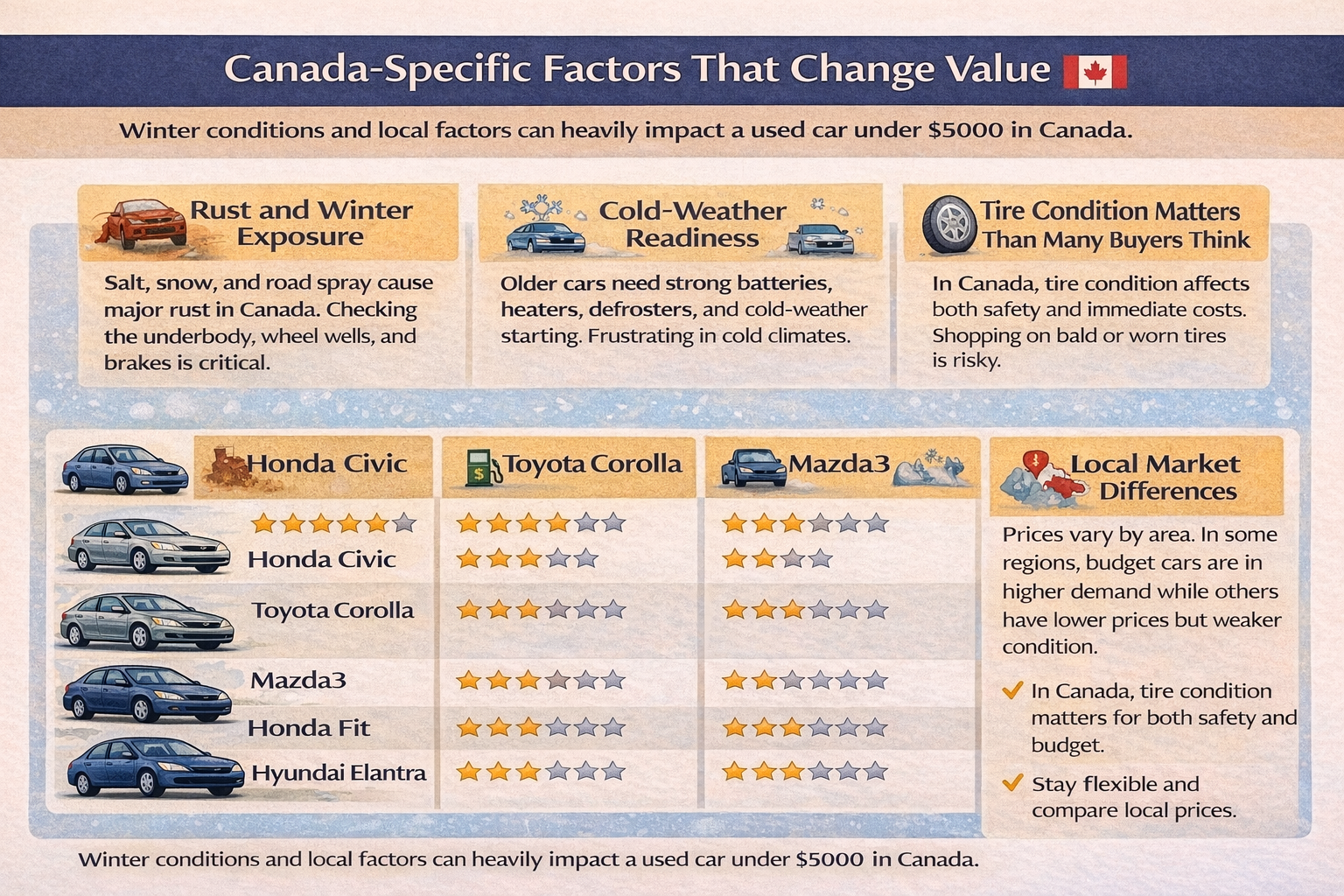
A used car under $5000 should not be judged by price alone, especially in Canada. Climate and regional conditions can change what a cheap car is really worth.
Rust and Winter Exposure
Rust is one of the biggest value factors in Canada. A car may look fine from the outside but still have serious rust underneath from road salt and winter driving.
That is why buyers should look beyond paint and body panels. Underbody condition, wheel wells, rocker panels, and brake or suspension corrosion matter a lot at this budget.
Cold-Weather Readiness
Older cars in Canada need to handle cold starts and winter use. Battery strength, heater performance, defroster function, and overall starting behaviour matter more here than they would in milder climates.
A cheap car that struggles in cold weather can become frustrating very quickly.
Tire Condition Matters More Than Many Buyers Think
Tires are a bigger part of the value equation than many buyers realize. If a vehicle will soon need tires, that cost can change the deal right away.
In Canada, tire condition matters for both safety and budget. A car with decent tires can be a much smarter buy than a slightly cheaper one that needs immediate replacement.
Local Market Differences
The same $5000 budget can buy very different cars depending on where you shop. In some areas, demand is stronger and clean budget cars sell quickly. In others, prices may be lower but condition may be weaker.
That is why buyers should stay flexible. The value of a budget car depends not just on the model, but also on where it has been driven, how it was used, and what shape it is in now.
In short, a cheap used car in Canada should be judged through a local lens. Rust, winter readiness, tires, and regional condition all affect whether a low-priced car is actually a good buy.
What It Really Costs to Own a Car Under $5000
The purchase price is only part of the cost. With older used cars, what happens after you buy matters just as much.
Budget for Immediate Maintenance
Even a decent car in this price range may need something soon. That could be brakes, a battery, fluids, filters, wipers, or minor suspension work.
That is why it helps to leave some money aside after the purchase instead of spending your full budget on the car itself.
Insurance, Registration, and Taxes Still Matter
A cheap car is not automatically cheap to put on the road. Buyers still need to think about insurance, registration, taxes, and any transfer-related costs.
Those costs can change the real affordability of the purchase, especially if your budget is already tight.
Fuel Economy Affects Your Monthly Cost
Monthly running cost matters. A larger or older vehicle with worse fuel economy may seem affordable to buy, but it can cost more to live with over time.
For many buyers, a simpler compact car makes more sense because it keeps fuel costs lower.
Keep a Repair Cushion
This is one of the smartest things a budget buyer can do. Even if the car seems fine at purchase, older vehicles can still surprise you.
A small repair buffer can reduce stress and help you handle normal post-purchase issues without turning a cheap car into a financial problem.
The main takeaway is simple: under $5000, the real cost of the car is not just the sale price. It is the sale price plus what it takes to keep the vehicle safely and reliably on the road.
What to Check Before Buying a Used Car in This Price Range
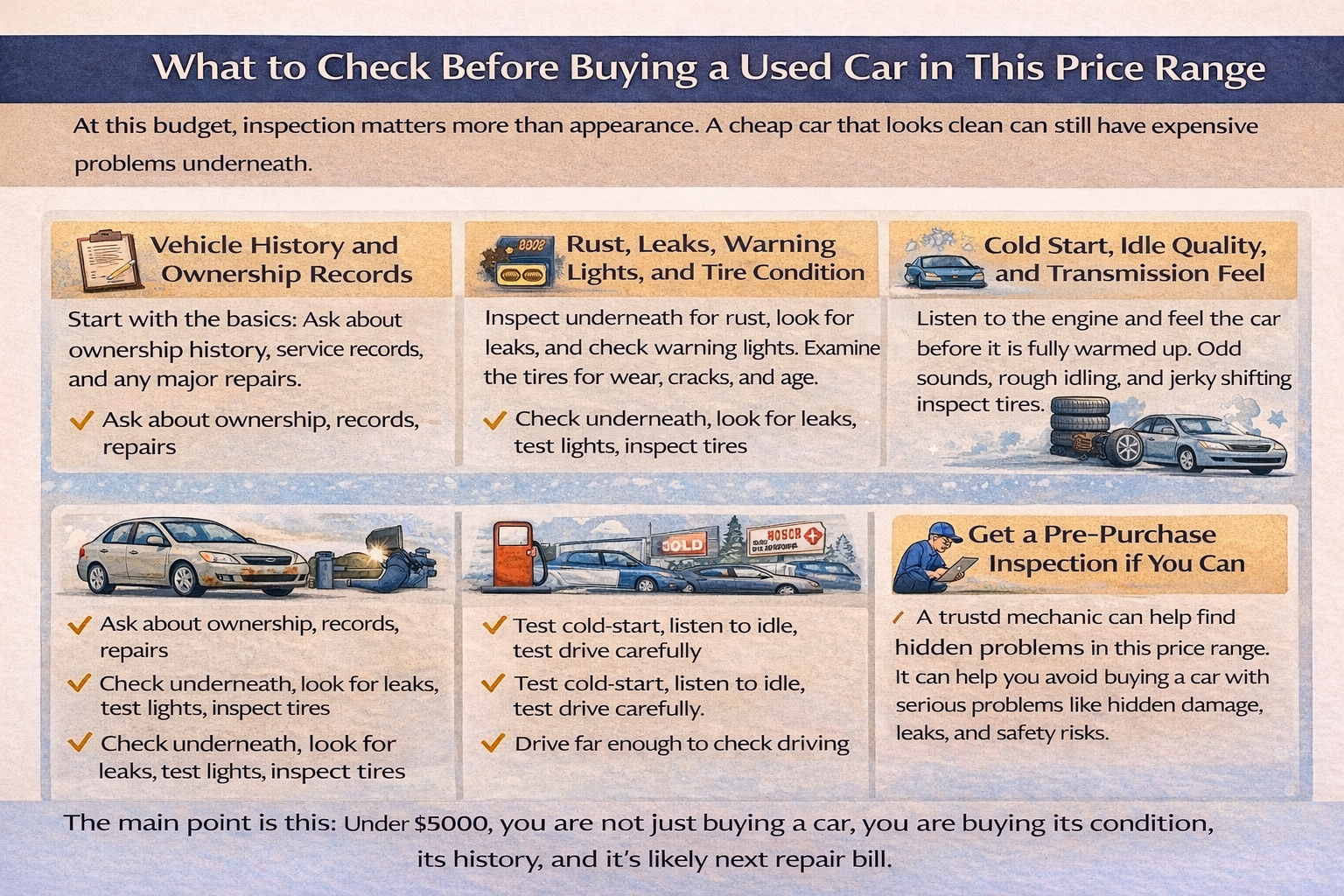
At this budget, inspection matters more than appearance. A cheap car that looks clean can still have expensive problems underneath.
Vehicle History and Ownership Records
Start with the basics. Ask about ownership history, service records, and any major repairs. A seller who can explain the car clearly is usually easier to evaluate than one who gives vague answers.
Records do not guarantee a perfect car, but they can help you understand how it was maintained.
Rust, Leaks, Warning Lights, and Tire Condition
These are some of the biggest red flags in the under-$5000 market. Check for rust underneath, fluid leaks, dashboard warning lights, and worn tires.
Any one of these can change the real value of the car quickly.
Cold Start, Idle Quality, and Transmission Feel
Try to judge the car before it has been fully warmed up. Cold-start behavior can reveal problems that do not show up later.
Pay attention to how it starts, how it idles, how it shifts, and whether anything feels rough, delayed, or noisy.
A Short Test Drive Is Not Enough
A quick spin around the block does not tell you much. The car should be tested long enough to check steering, braking, acceleration, transmission behaviour, ride quality, and any unusual noises.
If something feels off, do not ignore it just because the price looks good.
Get a Pre-Purchase Inspection if You Can
One of the smartest things a buyer can do is get the car checked by a mechanic before committing. That is especially helpful in this price range, where hidden problems can wipe out your budget fast.
A pre-purchase inspection will not remove all risk, but it can help you avoid the worst surprises.
The main point is simple: under $5000, you are not just buying a car. You are buying its condition, its history, and its likely next repair bill.
For a more complete step-by-step inspection approach, see our guide on how to inspect a used car before you buy.
Questions Buyers Should Ask the Seller
A few simple questions can tell you a lot about a used car and the person selling it.
How Long Have You Owned the Car?
A clear answer helps you understand the ownership story. If the seller has only had the car for a very short time, it is worth asking why.
What Recent Maintenance or Repairs Were Done?
This helps you see whether the car was looked after or just cleaned up for sale. Recent work on brakes, tires, battery, fluids, or suspension can make a real difference.
Are There Any Known Issues Right Now?
Ask directly. A trustworthy seller should be able to mention current problems, even minor ones. Vague answers are a reason to be more careful.
Do You Have Service Records or Receipts?
Records help back up the story. Even a few receipts can give you more confidence than a seller who has nothing to show.
Why Are You Selling It?
This question is simple, but often helpful. The answer may not prove anything on its own, but it can reveal whether the seller sounds transparent and consistent.
The goal is not to interrogate the seller. It is to reduce uncertainty before you commit. Under $5000, clear answers and basic documentation can make a big difference.
Dealer vs Private Seller for Cars Under $5000
Both options can work, but they come with different trade-offs.
Where Private Sale May Save Money
A private seller may offer a lower price because there is less overhead involved. For buyers who are comfortable checking the car carefully, handling the paperwork, and verifying the details themselves, private sale can sometimes lead to a better upfront deal.
The downside is that more of the responsibility falls on the buyer. If something is unclear, incomplete, or poorly documented, you may have less structure to rely on.
Where a Dealer May Offer More Structure
A dealership may not always be the cheapest option on paper, but it can offer more process and clarity. That can include clearer paperwork, a more organized buying process, and a more direct path if you have questions before making a decision.
For some buyers, especially first-time buyers or people who want a more guided process, that extra structure can matter.
Paperwork and Transparency Matter Either Way
The bigger point is that trust should come from the process, not simply from whether the seller is private or a dealer. Buyers should still pay attention to condition, history, records, and how clearly the vehicle is being represented.
At this budget, a well-documented car from either source can be a better buy than a cheaper car with too many unknowns.
If you are still weighing the full buying process, our main guide on how to buy an affordable used car in Vancouver walks through the bigger picture step by step.
Is Financing Even Worth Considering for a Car Under $5000?
Sometimes yes, but buyers should be careful.
At this price point, financing is not always the best fit. If the vehicle is very old, has high mileage, or carries more repair risk, borrowing money for it may not make much sense. The monthly payment may look manageable, but the total cost can become harder to justify once interest and possible repairs are added.
That said, some buyers still need payment flexibility. In those cases, it can be worth comparing the full picture instead of focusing only on the sticker price. Sometimes spending a bit more on a stronger vehicle can make more sense than financing the cheapest option available.
The key is to think beyond approval alone. Ask whether the vehicle is solid enough to justify the total cost, and whether the monthly payment still leaves room for insurance, fuel, and maintenance.
If financing is part of your decision, it helps to understand your options before you shop too narrowly. Our guide to used car financing in Vancouver explains the process in more detail.
How to Shop Smarter When Your Budget Is Under $5000
A tight budget does not leave much room for mistakes. The better approach is to shop carefully, stay flexible, and avoid getting attached too early.
Expand Your Model List
If you only search for one or two popular models, you may end up overpaying or settling for poor condition. A wider list gives you more chances to find a cleaner, better-kept car.
Shop for Condition, Not Image
At this price point, a simple car in decent condition is usually a better buy than a more impressive-looking vehicle with more risk. Focus on how the car has been maintained, not just how it looks in photos.
Leave Room for Repairs and Running Costs
Do not spend every dollar on the purchase itself. Insurance, registration, fuel, and small repairs still matter, and older cars often need attention sooner rather than later.
Act Carefully, Not Emotionally
Cheap listings can create pressure, especially when the car seems like a bargain. But rushing usually increases the risk. Ask questions, inspect properly, and be ready to walk away if something does not feel right.
Be Ready When a Good Car Appears
Good budget cars do sell quickly. The solution is not to rush blindly. It is to know your budget, know what you are looking for, and be prepared to move once the car checks out.
In this range, smart shopping usually beats fast shopping. The buyers who do best are often the ones who stay patient, think clearly, and focus on overall value.
Who This Budget Range Makes Sense For
A used car under $5000 is not for every buyer, but it can make sense in the right situation.
First-Time Buyers
For someone buying their first car, this price range can be a practical starting point. The goal is usually simple transportation, lower upfront cost, and manageable ownership.
Students and Budget-Conscious Households
If the priority is basic daily driving without a large financial commitment, this range can still offer workable options. The key is to stay realistic and leave room for maintenance.
Temporary or Short-Term Transportation Needs
Some buyers do not need a long-term vehicle. They just need something usable for commuting, work, or family responsibilities for a period of time. In those cases, a simple older car can make sense.
Buyers Who Care More About Function Than Features
This budget tends to suit people who want value, not status. If you are comfortable with an older, basic vehicle and care more about reliability than image, this range may work well for you.
The main point is simple: this budget range makes the most sense for buyers who are practical, flexible, and clear about what matters most.
Final Thoughts
It is still possible to find a decent used car under $5000 in Canada, but the smartest buyers usually approach this price range with patience and realistic expectations.
The best options are often not the flashiest ones. They are the simple, practical cars with reasonable condition, manageable ownership costs, and fewer unknowns. That is why it helps to focus less on the lowest price and more on the overall value of the vehicle in front of you.
A good budget car does not have to be perfect. It just has to be sensible for your needs and budget. If the condition is solid, the history is reasonably clear, and the car fits your real needs, it can still be a worthwhile purchase.
And if you want to shop more confidently, it helps to understand the bigger process too — from inspection to financing to choosing the right type of vehicle for your budget.
If you are still comparing your options, explore our full guide on how to buy an affordable used car in Vancouver for a broader step-by-step approach.
Take the Next Step With Confidence
Once you have a clearer idea of what to look for, the next step is to turn that research into action.
You can
- Browse our current used car inventory,
- Explore financing options,
- Contact our team with questions,
- Or book an appointment or test drive.
Whether you are still comparing options or feel ready to move forward, taking the next step with a clear process can help you buy with more confidence and less guesswork.
FAQ
What is the most reliable used car under $5000 in Canada?
There is no single best answer, because condition matters more than the badge alone. That said, models like the Honda Civic, Toyota Corolla, and Toyota Matrix usually stay near the top of the list because they are practical, common, and generally easier to maintain.
Can you still get a good used car for under $5000?
Yes, but buyers need to stay realistic. At this budget, you are usually looking at older vehicles with higher mileage, so the goal is not perfection. The goal is to find the best balance of condition, history, and affordability.
Is a Honda Civic or Toyota Corolla better under $5000?
Both can be strong options. In most cases, the better buy is simply the one in better condition with a clearer maintenance story. Buyers should compare the actual car, not just the model name.
How many kilometers is too much for a $5000 used car?
There is no fixed number that automatically makes a car bad. Many vehicles in this range will have well over 150,000 kilometres. What matters more is how the car was maintained, how it drives, and whether it shows signs of neglect.
Should I buy a used car under $5000 from a dealer or a private seller?
Either can work. Private sale may offer a lower price, while a dealer may offer more structure and clearer paperwork. The better choice depends on the specific car, the documentation, and how comfortable you are checking everything yourself.
What repairs should I expect after buying a used car in this price range?
Even a decent car under $5000 may need routine items soon after purchase. Common examples include brakes, tires, battery, fluids, filters, or small suspension work. That is why it helps to keep some money aside after the sale.
Is it worth financing a car under $5000?
Sometimes, but buyers should be careful. Financing an older vehicle with more repair risk does not always make sense. It is better to look at the full cost, not just the monthly payment.
What documents should I check before buying?
At minimum, buyers should look for ownership documents, service records if available, and any paperwork that helps explain the vehicle’s history. The more clearly the seller can document the car, the easier it is to judge the risk.
Are cheap SUVs worth considering under $5000?
Sometimes, but they usually carry more risk than a simple compact car. Older SUVs can bring higher fuel costs, more wear, and more expensive repairs. In many cases, a basic front-wheel-drive sedan or hatchback is the safer budget choice.
What is better under $5000: lower mileage or better maintenance history?
Better maintenance history is usually more valuable. A lower-mileage car can still be a poor buy if it was neglected. A higher-mileage car that was cared for properly is often the smarter option.
Is rust a deal-breaker on an older used car in Canada?
Not always, but serious rust should never be ignored. Surface rust may be manageable on an older vehicle, but deeper rust underneath can affect safety, repair cost, and overall value.
How much extra money should I keep aside after buying?
There is no perfect number, but buyers should try to keep a repair cushion if possible. Even a small buffer can help with immediate maintenance and reduce stress after purchase.