
Quick Summary
Used electric vehicles are often more affordable than comparable new models because much of their depreciation has already been taken, and they cost less to run per kilometre with fewer routine maintenance items. The main drawbacks are battery condition, charging access and reduced winter range, so check the battery and your charging options before you buy.
- Depreciation already taken can make a used EV more affordable than a comparable new model.
- Electricity is usually cheaper per kilometre than gasoline, and there are no oil changes.
- Ask for a battery state of health reading or report before buying.
- Confirm charging access at home, in your strata or at your rental before committing.
- Cold weather and short trips reduce range, so plan for less than the sticker figure.
Table of Contents
- Why Used Electric Vehicles Are Drawing Vancouver Buyers
- The Main Advantages of a Used Electric Vehicle
- The Drawbacks to Weigh Before You Buy
- Used Electric Vehicle Battery Health: What to Check
- Used EV Battery Warranty: What Coverage to Confirm
- Charging Options for a Used Electric Car in Vancouver
- Used Electric Vehicle Costs Compared With a Gas-Powered Car
- Used Electric Vehicle Inspection Checklist Before Purchase
- Deciding Whether a Used Electric Vehicle Fits Your Driving
- Frequently Asked Questions
Why Used Electric Vehicles Are Drawing Vancouver Buyers
Many buyers look at used electric vehicles because the purchase price has dropped as new models have arrived. A vehicle that was expensive when new can now sit in a more affordable range. That shift opens the door to electric driving for households that could not justify a new car.
Interest also reflects day-to-day habits. Shorter commutes and frequent stop-and-go driving suit electric drivetrains well. A used EV can fit a routine built around home charging and predictable trips.
The Main Advantages of a Used Electric Vehicle
The biggest advantage is often the price. A used EV has already taken much of its depreciation, which can make it more affordable than a comparable new model.
Running costs are the second advantage. Electricity is usually cheaper per kilometre than gasoline, and EVs have fewer routine maintenance items. There are no oil changes, and brake wear tends to be lower because regenerative braking does much of the slowing.
The driving experience is a real plus. Instant torque makes city merging easy, and the cabin tends to be quiet. For daily driving, those differences are noticeable from the first week.
The main advantages of a used electric vehicle come down to price, running costs and the driving experience.
| Advantage | What the article says | Note |
|---|---|---|
| Price | Depreciation already taken | Often more affordable than a comparable new model |
| Running costs | Electricity usually cheaper per km than gasoline | Fewer routine maintenance items |
| Maintenance | No oil changes | Regenerative braking lowers brake wear |
| Driving | Instant torque and a quiet cabin | Noticeable from the first week |
The Drawbacks to Weigh Before You Buy
The catch is the battery. Its condition determines how far the car will travel and how much it will be worth later. A battery that has lost capacity can cut range enough to change how you use the car.
Charging access is the second drawback. Buyers who rent or live in strata buildings may find it hard to install a home charger. Without reliable charging nearby, a used EV can become frustrating quickly.
Winter range is another factor. Cold weather reduces range, and short trips with the heater running can reduce it further. Plan for less range than the sticker figure suggests, especially on rainy or cold days.
Insurance, collision repair and parts availability can also cost more for some models. Check these before committing, because they affect ownership costs long after the purchase.
Used Electric Vehicle Battery Health: What to Check
The battery is the most important inspection item on a used EV. Ask the seller for a battery health report if one exists, and ask a qualified technician to read the battery's state of health during a pre-purchase inspection.
Look at the vehicle's service history and any warning messages on the dashboard. Ask whether the battery has been replaced or repaired. A replacement battery can be a good sign, but only if the paperwork supports it.
Reading State of Health and Range Loss
State of health (SOH) shows how much usable capacity the battery retains compared with its original capacity. A battery that retains most of its capacity is in better shape than one that has lost a large share. Ask for the SOH figure and compare it with the range the car achieves on a familiar route.
A quick range check helps. Charge to full, drive a known distance, and note how much range is used. Compare that with the advertised range for the same conditions. A large gap can signal battery wear. Keep in mind that weather, speed and driving style all affect the result, so use the test as a guide rather than a final verdict.
Used EV Battery Warranty: What Coverage to Confirm
Most new EVs carry a separate battery warranty, and that coverage can transfer to a used buyer. Confirm the remaining years and kilometres before you sign. Ask for written terms that show what the warranty covers and what it excludes.
Pay attention to capacity thresholds. Some warranties cover the battery only if capacity falls below a set level. Others cover defects. Knowing which type applies helps you judge the protection you actually have. Ask the dealership to show you the warranty in writing rather than relying on verbal assurances.
Charging Options for a Used Electric Car in Vancouver
Charging access is the single biggest factor that separates a used EV that works well from one that becomes a daily frustration. The right question is not "does the car charge?" but "where will this car charge while I sleep, and what does it take to get there?"
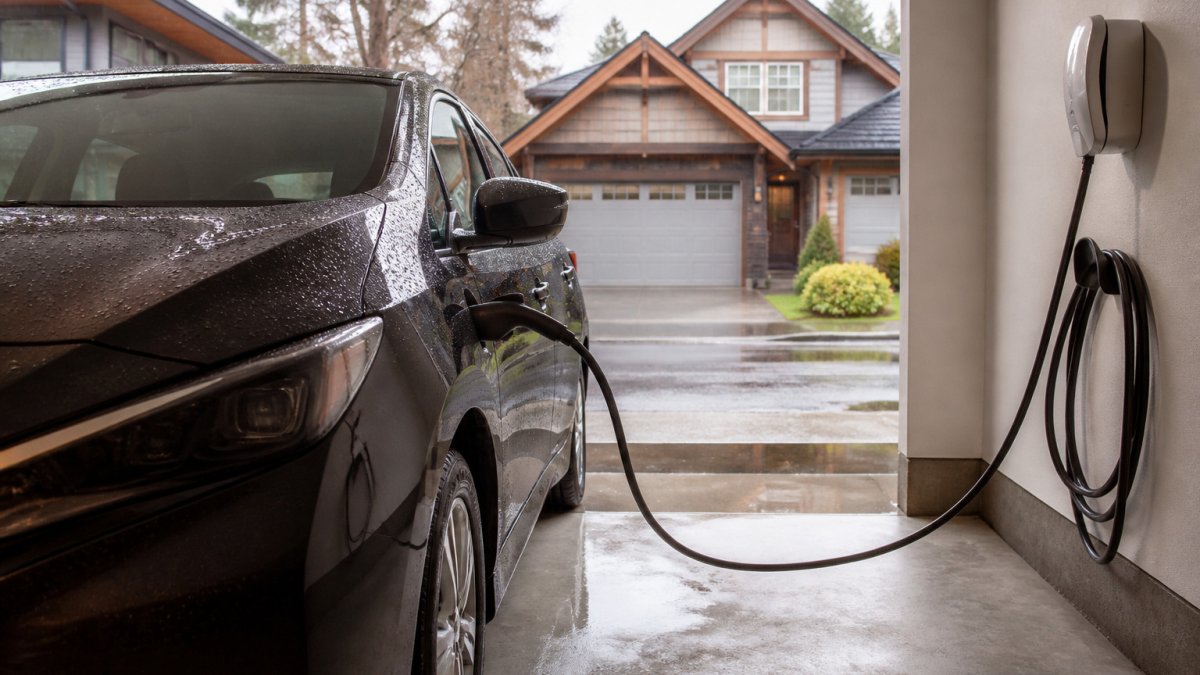 Used electric vehicle charging at a residential home charger in rainy Vancouver
Home Charging for Detached Homes
A detached home with a private driveway is the easiest case. A Level 2 charger running on a 240-volt circuit adds meaningful range overnight and is the cheapest way to own an EV. Installation usually requires a licensed electrician, a permit from the local municipality, and enough capacity in the panel. Get a quote from a licensed electrician before you buy the car, because panel upgrades can be a significant cost in the setup.
A standard 120-volt wall outlet works for low daily mileage but adds range slowly. It is fine as a stopgap, not as a long-term plan for a household that drives much each day.
Strata and Condo Buildings
This is where many buyers get stuck. In a strata corporation, installing a charger in a shared or limited-common-property parking stall usually requires approval, and the process varies by building. Some strata councils are supportive and have already adopted an EV charging policy; others require a formal request, an electrical assessment, and a decision at a council meeting. Ask the strata manager for the current policy in writing before you buy the car, not after.
Key questions to ask:
- Does the building already have a charging policy or an installed charger?
- Is your stall on limited common property, and what approval is needed?
- Who pays for the electrical work, the meter and the ongoing electricity?
- Are there capacity limits on the building's electrical service?
- Is there a shared-charger option instead of a dedicated one?
If the answer is "no policy yet," budget time for the approval process and do not assume it will be quick.
Renters and Shared Parking
Renters face a similar problem. A landlord may allow a charger, may refuse, or may allow only a shared unit. If you cannot charge where you park, map the public charging you would actually use on a normal week, including the walk or detour from home. A car that needs a 20-minute detour every few days is a different ownership experience than one plugged in overnight.
Public Charging
Public charging fills the gaps. Level 2 public stations suit destination charging while you shop or work. DC fast chargers add a large amount of range in a short stop and are the right tool for longer trips. Check that the networks you would rely on have stations near your home, your workplace and your usual routes, and confirm that your payment method or account works with them. Connector standards matter too: confirm the used car's connector type and whether an adapter is needed for the stations you plan to use.
Match the Car to the Charging You Actually Have
Before you commit, write down your realistic weekly charging plan: where, how often, and how long. If most of it happens at home overnight, a used EV with a modest range can work well. If most of it depends on public fast charging, weigh the time cost and the higher per-kWh price of fast charging against the fuel savings you were counting on.
You can browse the current inventory at Variety Auto to see which vehicles suit your budget and charging situation before you decide which model fits your setup.
Used Electric Vehicle Costs Compared With a Gas-Powered Car
Purchase price is only the first number. The useful comparison is total cost of ownership over the years you plan to keep the car, and that means working through electricity or fuel, maintenance, insurance, repairs, incentives and resale value with local figures rather than national averages.
Start With Your Annual Kilometres
Commuters drive a wide range of annual kilometres, so pick a number that reflects your routine. Pick a number that reflects your routine, because every cost below scales with it. For the worked example here, use 15,000 km a year.
Electricity Versus Gasoline
Use the residential electricity rate on your bill, not a headline number. Residential electricity rates are often tiered, and the marginal rate you pay can depend on how much electricity your household already uses. A common pattern is that off-peak overnight charging keeps the effective cost per kWh lower than daytime use, especially if you are on an optional time-of-use plan. Check your own bill to find the rate for the extra kilowatt-hours the car will add.
For gasoline, use the posted price at the pump on the day you run the comparison, and use the combined fuel consumption rating for the gas car you would otherwise buy. Multiply litres per 100 km by annual kilometres, divide by 100, and multiply by the pump price.
A simple EV estimate: take the car's efficiency in kWh per 100 km (often shown on the window sticker or in the owner's manual), multiply by annual kilometres, divide by 100, then multiply by your marginal electricity rate.
Maintenance and Repairs
EVs avoid oil changes, spark plugs, transmission fluid and exhaust work, and regenerative braking usually extends brake life. They still need tires, cabin filters, brake fluid, coolant for the battery thermal system, and suspension work. Tire wear can be higher on heavier EVs driven enthusiastically. Budget for those items on both sides of the comparison so the gap is realistic rather than flattering.
Insurance and Registration
Get a quote for the specific used EV you are considering and for the gas car you would otherwise buy. Insurance is priced on the vehicle, the driver and the coverage, so a generic assumption is not reliable. Registration and plate fees apply to both, and any difference is usually small.
Incentives That Change the Actual Price
Incentive programs change over time, and eligibility rules can differ between new and used vehicles. Before you finalize a budget, check the current official program information for your situation and confirm the eligibility terms. A dealer or the program's own website is the authoritative source; do not rely on a number you saw in an old article.
Depreciation and Resale
Used EV prices can move quickly as new models arrive and incentive rules change. That can favor buyers, but it also means resale value is less predictable than for a long-established gas model. If you plan to keep the car five years or more, depreciation matters less per year. If you might sell in two or three years, check recent private-sale listings for the same model and battery size before you commit.
A Worked Example
Substitute your own efficiency figures, electricity rate, fuel price and annual mileage into the steps above; the mechanism matters more than any example numbers.
You can compare used vehicles in the current Variety Auto inventory to see which options fit your budget.
Used Electric Vehicle Inspection Checklist Before Purchase
Use this checklist before you buy:
- Ask for the battery state of health reading or a battery report
- Confirm the remaining battery warranty in writing
- Check the charging port and cable for damage
- Test the range on a known route if possible
- Review the service and repair history
- Confirm the vehicle has no open recall work
- Ask whether a qualified technician has inspected the high-voltage system
- Get a full pre-purchase inspection from an independent shop
A professional pre-purchase inspection costs far less than an unexpected battery repair. Many buyers find it worth arranging, especially on a vehicle with an unclear history.
Deciding Whether a Used Electric Vehicle Fits Your Driving
A used EV suits buyers whose daily routine matches its range and charging needs. If you commute a moderate distance, can charge at home and value a quieter ride, it can be a strong choice. If you take frequent long trips, lack reliable charging or want a very low-risk purchase, a gas or hybrid car may fit better.
The right answer depends on your driving pattern. List your typical trips, your charging options and your budget. Then compare the advantages and drawbacks against that list. Variety Auto's team can help you review used vehicles that match those needs. Browse the current inventory and ask about the condition of any vehicle you are considering.
Frequently Asked Questions
What are the pros and cons of buying a used electric vehicle?
The main advantages are a lower purchase price than a new EV, depreciation that has already occurred, and lower fuel and routine maintenance costs than many gas-powered cars. The drawbacks include uncertainty about battery health, shorter real-world range in cold weather, limited charging access for some residents, and a battery warranty that may be shorter or transfer differently than buyers expect. Compare these points against your daily driving distance and home charging situation before deciding.
How can you check the battery health of a used EV?
Ask for a battery state-of-health report or diagnostic printout where the vehicle's software provides one, and compare the estimated range on a full charge with the original rated range. Review the vehicle history for fast-charging frequency and any past battery service. A pre-purchase inspection by a qualified technician can confirm the reading. Expect some gradual range loss with age, and be cautious if the reported range is far below what similar vehicles of the same age achieve.
Is it worth buying a used electric car with an older battery?
It can be, if the battery still holds enough range for your daily driving with a margin for cold weather. A commuter who drives 60 kilometres a day may accept reduced range that a longer-distance driver would not. Confirm the remaining warranty coverage and the cost of a replacement battery, since that cost is the main financial risk of an older vehicle. Weigh the lower purchase price against the chance of needing a costly battery repair.
Can you charge a used electric vehicle at home?
Most used electric vehicles can charge at home, but the speed depends on the onboard charger and the circuit. A Level 2 charger, installed by a licensed electrician, typically adds substantially more range overnight than a standard household outlet. Check whether your residence has off-street parking or a building charging option before buying, because lack of home charging is a common reason used EV owners find ownership harder than expected.
Browse our inventory online, complete a secure finance application, and ask about trade-in appraisals for your current vehicle. Visit our full inventory to see which used vehicles fit your plans.
