Last Updated: November 7, 2026
Quick Summary
Yes, you can sell a car with expired registration. Selling a vehicle is a transfer of ownership, not a driving privilege, so what matters is proof of ownership, a signed transfer document, and full disclosure to the buyer. The car simply can't be driven on public roads until the buyer registers it in their name.
- Registration is a permit to use public roads, while ownership is a record of who holds title to the vehicle.
- A vehicle with no active registration at all can still be sold if you can prove ownership and complete a proper transfer.
- Any lien must be discharged before or at the point of sale, and buyers can check for liens through their province's registry service.
- Disclose the expired registration in writing on the bill of sale and keep copies of everything for at least a year.
- Never let a buyer drive an unregistered, uninsured car on public roads, since liability questions depend on your circumstances.
Table of Contents
- Can You Sell a Car With Expired Registration?
- Can You Sell a Car Without Registration at All?
- Documents Needed to Sell a Car With Lapsed Plates
- How to Transfer Vehicle Ownership Step by Step
- Do Unpaid Renewal Fees and Penalties Follow the Car?
- Test Drives and Transport When the Car Can't Be Driven
- Should You Renew Before Selling, or Sell As-Is?
- Private Sale vs. a Dealer Trade-In Appraisal
- Get Your Trade-In Appraised Before You List It
- Frequently Asked Questions
Can You Sell a Car With Expired Registration?
Yes, you can sell a car with expired registration. Selling a vehicle is a transfer of ownership, not a driving privilege. What matters is proof of ownership, a signed transfer document, and full disclosure to the buyer.
Below, we'll walk through the paperwork, the penalties, and the safest way to complete the deal. But first, here's what most guides get wrong: they treat expired registration as a legal barrier. It isn't. It's a disclosure and logistics problem.
Selling a vehicle is the legal transfer of ownership from one party to another. It is separate from registering that vehicle for road use.
That distinction is the whole game. Keep reading, because the details decide whether your sale goes smoothly or stalls at the registry.
Selling Is Not the Same as Driving
The clearest way to think about it: registration is a permit to use public roads. Ownership is a record of who holds title to the vehicle.
An unregistered vehicle can still change hands. It just can't be driven on public roads until the buyer registers it in their name.
A common mistake is assuming a lapsed registration voids the sale. It doesn't. It only limits how the car can be moved and tested.
So the seller's job is simple:
- Prove you own the vehicle
- Complete the transfer documents correctly
- Be upfront that the plates are expired
Do those three things and the sale stands on solid ground.
What Your Province Actually Requires
Rules for registration, transfer, and plates are set at the provincial level, so the exact steps vary.
The core pattern is consistent. The seller signs the ownership document over to the buyer. The buyer then registers the vehicle.
Check your province's official motor vehicle agency page before you list the car. The provincial vehicle registration guidance is the source of truth, not a forum thread.
Can You Sell a Car Without Registration at All?
Yes. A vehicle with no active registration at all can still be sold, provided you can prove ownership and complete a proper transfer.
The catch is documentation. If the plates lapsed months ago, you still hold the title or ownership permit. That document is what transfers the car.
What you cannot do is sell a car you don't legally own, or sell one with an unresolved lien. A lien is a legal claim against the vehicle by a lender or another party (Risks associated with car liens).
If a lien exists, it must be discharged before or at the point of sale. Buyers can check for liens through their province's registry service.
The process is the same: prove ownership, sign the transfer, hand over the keys.
Documents Needed to Sell a Car With Lapsed Plates
The documents needed to sell a car come down to proof of ownership, a signed transfer, and a clear record of the deal. Missing paperwork is the number one reason a sale falls apart at the registry.
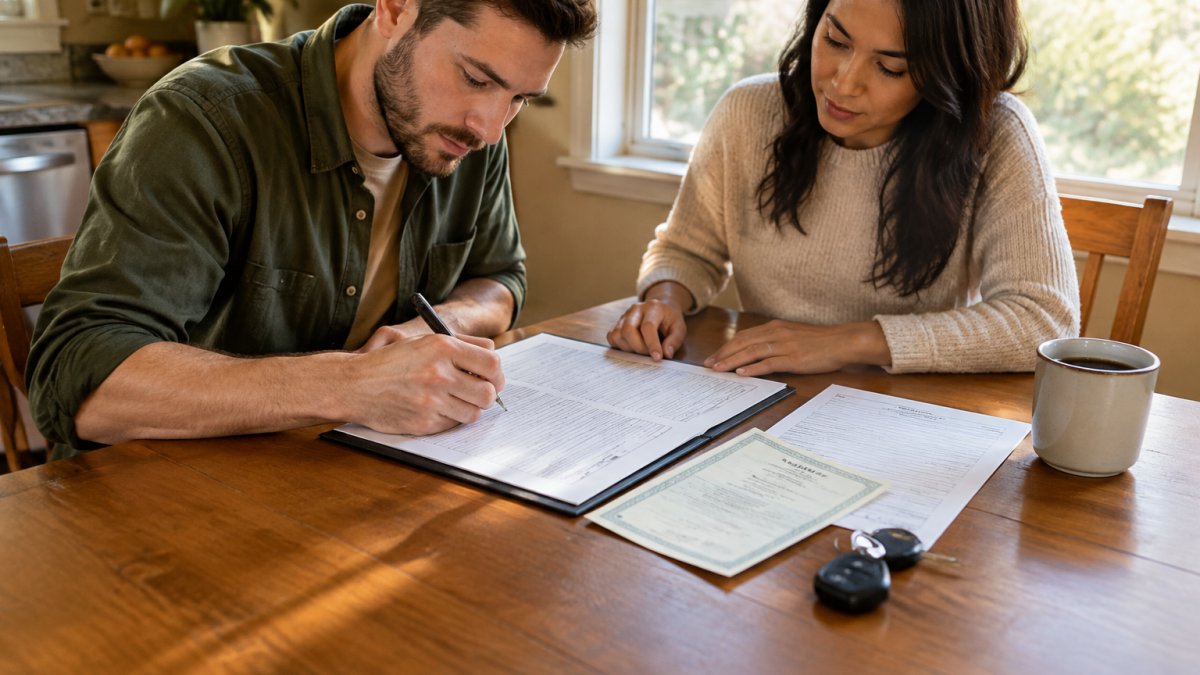 Flowchart illustrating the document process for selling a car with an expired registration to a new buyer.
The Core Paperwork Checklist
Here is the practical list. Use it as a checklist before you meet the buyer:
- Vehicle ownership permit or title, signed on the back by the registered owner
- Bill of sale showing date, price, buyer and seller details, and the vehicle identification number
- Lien release, if any loan was secured against the car
- Vehicle identification number verified against the ownership document
- Bill of sale copy kept for your records
- Plate removal plan, since plates usually stay with the seller
The vehicle identification number is the 17-character code stamped on the vehicle and printed on the ownership document. It must match everywhere.
A bill of sale doesn't need to be fancy. Keep a copy, because the buyer will need it to register.
Situations That Change the List
Some ownership situations add paperwork:
- Estate sale: you'll need probate or executor documents proving authority to sell
- Leased vehicle: the leasing company must approve and release the car
- Joint ownership: every owner on the permit must sign
- Repossessed or salvage vehicle: additional disclosure may apply
If you're in one of these situations, contact your provincial motor vehicle agency before listing.
How to Transfer Vehicle Ownership Step by Step
Transferring vehicle ownership follows a predictable sequence. Do it in order and the sale closes cleanly.
- Confirm you are the registered owner and that no lien is outstanding.
- Prepare the ownership document and sign the transfer section.
- Write a bill of sale with the date, price, both parties' details, and the vehicle identification number.
- Disclose the expired registration in writing on the bill of sale.
- Hand over the keys and documents once payment clears.
- Remove your plates unless your province requires them to stay with the vehicle.
- Notify your provincial agency of the sale if required.
- Keep copies of everything for at least a year.
The buyer then registers the vehicle in their name.
Watch out: if you skip the seller notification step where it's required, you may remain liable for certain charges tied to the vehicle.
Here is the sequence the article lays out for transferring ownership of a car with lapsed plates.
| Step | What to do |
|---|---|
| 1 | Confirm you are the registered owner and no lien is outstanding |
| 2 | Prepare the ownership document and sign the transfer section |
| 3 | Write a bill of sale with date, price, parties, and VIN |
| 4 | Disclose the expired registration in writing on the bill of sale |
| 5 | Hand over keys and documents once payment clears |
| 6 | Remove your plates unless your province requires them to stay |
| 7 | Notify your provincial agency of the sale if required |
| 8 | Keep copies of everything for at least a year |
Do Unpaid Renewal Fees and Penalties Follow the Car?
Unpaid renewal fees are generally tied to the registered owner rather than the vehicle, so settling your own fees before you sell is the safest approach.
The practical move: settle your own renewal fees before you sell. It removes any chance of a registry hold blocking the buyer's transfer.
If you're unsure what you owe, contact your provincial motor vehicle agency for an account summary.
Test Drives and Transport When the Car Can't Be Driven
An unregistered car can't legally be driven on public roads, which complicates test drives and delivery. You have three workable options, but each has practical limits that decide whether the sale closes or stalls.
Temporary permit. Some provinces offer a short-term permit that allows a vehicle to be driven on public roads for a set window. Check your province's motor vehicle agency page for the available permit types, eligibility, and requirements before you promise a buyer a test drive.
Private property test drive. A buyer can drive the car on private land with the owner's permission. This is legal because registration and insurance requirements apply to public roads, not private property. The catch is practical: most sellers don't have a large private lot, and a low-speed drive around a driveway tells a buyer very little about the vehicle's road behavior. If you use this option, be clear with the buyer that it is not a substitute for a proper pre-purchase inspection.
Towing or delivery. Hiring a tow truck or flatbed to move the car to the buyer or to a pre-purchase inspection shop is the cleanest legal route. Confirm the tow operator's insurance covers your vehicle before towing. For a private-party sale where the buyer wants an inspection, towing to the shop can be a simple path.
A further option is a buyer-arranged permit, where the buyer applies for a temporary permit in their own name and insures the vehicle before driving it. Confirm with your provincial agency whether a permit can be issued to a non-owner.
Watch out: never let a buyer drive an unregistered, uninsured car on public roads. Liability questions depend on your circumstances, so confirm the details with your insurer and provincial agency.
For transport after the sale, confirm who is responsible for the vehicle in transit. If the buyer arranges towing, get it in writing that they assume responsibility once the vehicle leaves your property. If you deliver, confirm your insurance covers the trip and that the buyer's permit or registration is in place before you hand over the keys.
Should You Renew Before Selling, or Sell As-Is?
Renewing before you sell can make sense if the car is roadworthy and you want a higher price. Selling as-is with full disclosure is a simpler route for many sellers.
Here's the trade-off. A renewed, road-ready car is easier to test drive and appeals to more buyers. But you pay the renewal fee and any inspection costs upfront.
An as-is sale means the buyer accepts the vehicle in its current condition. It suits project cars, older vehicles, and anything heading to a dealer or recycler.
Ask yourself:
- Is the car roadworthy and likely to pass inspection?
- Will a renewal fee be recovered in a higher sale price?
- Do you have time for inspections and paperwork?
If the answer to any of these is no, sell as-is and disclose the expired registration clearly. Full disclosure is a sound approach.
Private Sale vs. a Dealer Trade-In Appraisal
A private sale can bring a higher price, while a dealer trade-in appraisal reduces the paperwork and test drives. The right choice depends on your priorities.
A dealer trade-in appraisal is a valuation a dealership gives your vehicle toward a purchase. You hand over the car, they handle the transfer, and the expired registration stops being your problem.
With a private sale, you manage the listing, the buyers, the bill of sale, and the registry steps yourself. That's fine if you have time and patience.
A dealer appraisal wins when:
- The registration has lapsed and test drives are awkward
- You want the transfer handled for you
- You're buying your next car from the same dealer
You can get a trade-in appraisal from Variety Auto by telling us about your vehicle. If you want the full walkthrough first, our guide on how to sell my car trade-in covers valuation, documents, and getting a fair offer.
Get Your Trade-In Appraised Before You List It
An appraisal can give you a reference number to compare against private-sale offers.
At Variety Auto, our trade-in appraisal service provides a valuation on your current vehicle. You can browse our used vehicle inventory online, and read our Google reviews feedback.
Get started with Variety Auto to explore your next upgrade.
Frequently Asked Questions
Can you transfer ownership of a car with expired registration?
Ownership transfer is generally handled through the vehicle registration and transfer forms at your provincial motor vehicle agency, and check your province's specific requirements before the buyer arrives. What can block it is missing paperwork: an unsigned transfer form, a lien on the vehicle, or a name mismatch between the seller and the registered owner. Check your province's specific requirements before the buyer arrives, and confirm whether any outstanding renewal fees must be cleared at the counter before the transfer is processed.
Can a buyer drive the car home if the registration has expired?
Not on the expired plates. Driving an unregistered vehicle on public roads is not permitted, so confirm your options before pickup. Options can include having the buyer register and insure the vehicle first, checking whether your province offers a temporary permit, or moving the car by tow truck or trailer. Agree on the transport method before money changes hands so the buyer isn't stuck at your driveway with no legal way to leave.
What documents do you need to sell a car with expired registration?
Typical documents include the vehicle title or permit showing you as the registered owner, a signed ownership transfer form, a bill of sale, a lien release if money is still owed on the car, and a vehicle identification number that matches the paperwork. Confirm the exact requirements with your provincial agency. Keep a copy of everything for your records, and photograph the signed documents before the buyer leaves.
Is it better to sell an unregistered car privately or to a dealer?
A private sale can bring a higher price, but you handle the listing, test drives, paperwork and no-shows yourself. A dealer trade-in appraisal can reduce the paperwork and time involved. Get an appraisal first so you have a real number to compare against private offers, then decide whether the extra effort of a private sale is worth the difference.
