
Finding the best used cars under $10000 is not really about chasing the lowest price. For most buyers, the better question is which vehicles are most likely to stay dependable, affordable to maintain, and useful for years after the purchase. That matters even more when every dollar counts and one unexpected repair can change the whole picture.
Long-Term Value Matters More Than a Cheap Asking Price
At this price point, a used car does not need to be perfect to be a smart buy. It does need to make sense. A vehicle with a strong reliability record, reasonable parts costs, and a solid maintenance history will usually serve you better than a more stylish option with hidden risks.
The used cars that last the longest are often the ones that are simpler, well cared for, and easier to keep on the road.
A cheap listing can look attractive at first, especially when the photos are clean and the price feels just within reach. But a low asking price does not always mean low ownership cost.
Older luxury models, neglected SUVs, and vehicles with known transmission or rust issues can quickly become expensive to live with. On the other hand, some mainstream sedans, hatchbacks, and compact SUVs continue to offer very good long-term value, even when they already have higher mileage.
What “Last the Longest” Really Means at This Budget
For budget-conscious buyers in Canada, longevity should be viewed in practical terms. It is not just about whether a car can reach high mileage. It is about whether it can keep delivering reliable transportation without becoming financially draining.
A used car that can realistically stay useful past 250,000 or even 300,000 kilometers, with normal maintenance and manageable repair costs, is often a much better buy than a more impressive vehicle that becomes hard to afford after purchase.
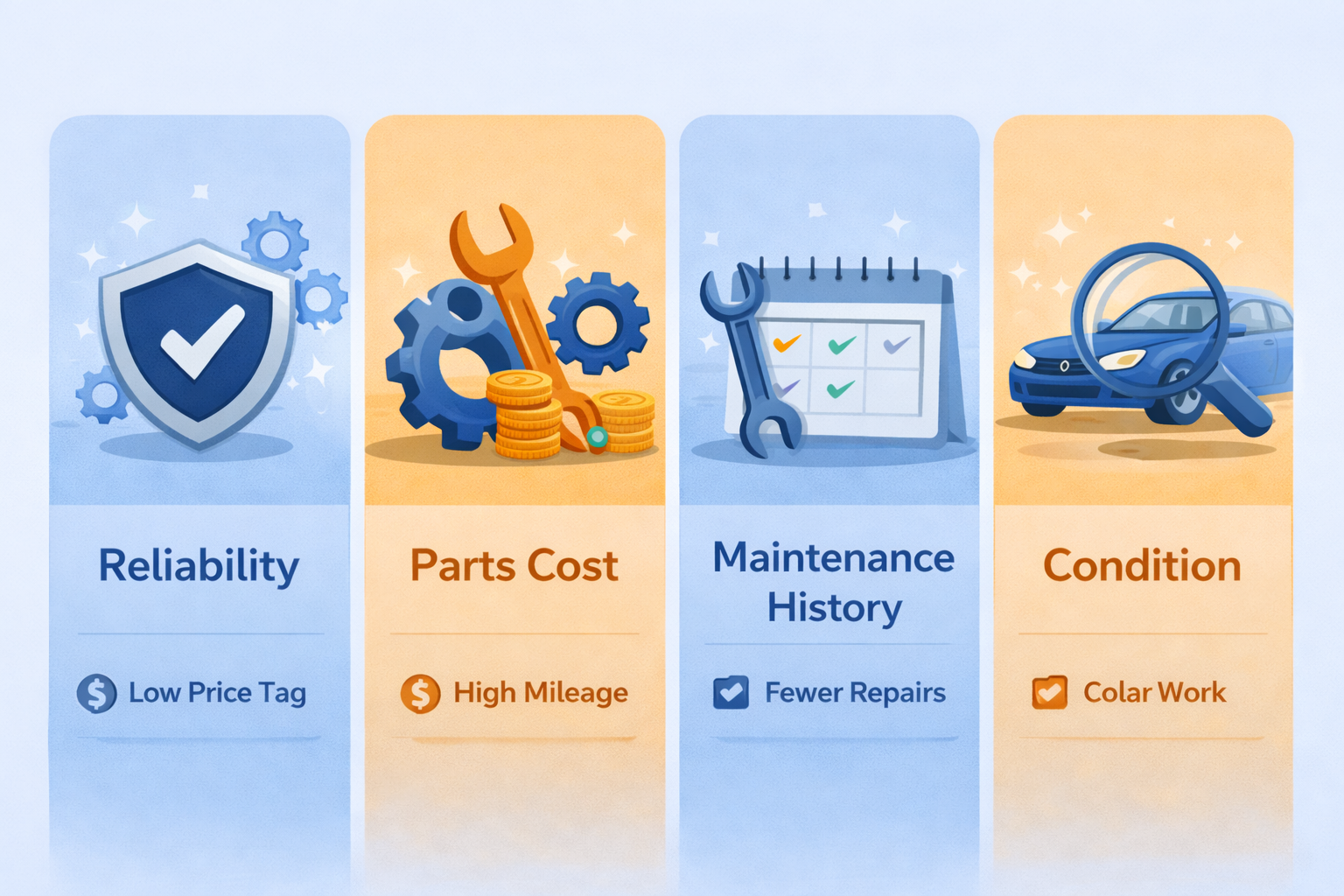
At this budget, long-term value usually comes down to four things:
- a strong record for reliability
- affordable and widely available parts
- a believable maintenance history
- condition that matches the asking price
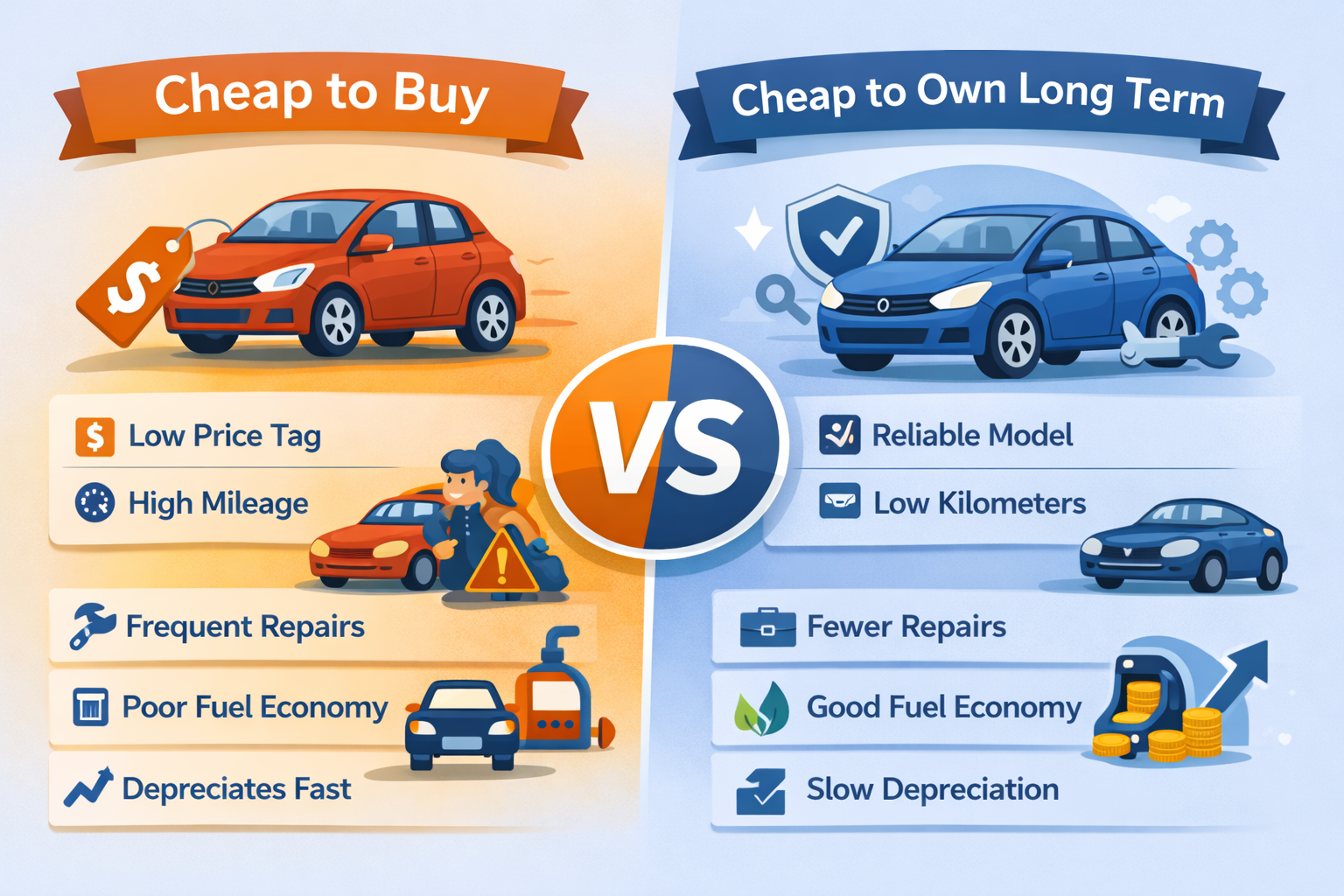
Quick Comparison: Cheap to Buy vs Better to Own
FocusCheap to BuyBetter to Own Long TermAsking priceVery low upfront costReasonable for the conditionRepair riskOften higherUsually more predictableMaintenance historyMissing, vague, or incompleteClearer service recordOwnership costCan rise quickly after purchaseEasier to budget forBest outcomeShort-term savingsLower long-term stressThis guide focuses on more than reputation alone. Some nameplates are well known for durability, but condition, service history, and previous ownership still matter just as much. The goal is to help you narrow your search toward vehicles that make sense in the real world, not just on paper. If you want the broader buying process from budget to inspection and final decision, start with our complete guide to buying an affordable used car in Vancouver.
What Makes a Used Car Last a Long Time?
Some vehicles earn a strong reputation for durability, but reputation alone is not enough. At this budget, the cars that last the longest are usually the ones that combine a solid design with good maintenance, reasonable repair costs, and fewer high-risk weaknesses.
Two examples of the same model can lead to very different ownership experiences. One may give you years of dependable use. Another may become expensive almost immediately because of rust, neglect, overdue maintenance, or a weak transmission.
Longevity Is About More Than Mileage
Many buyers focus too heavily on the odometer. Mileage matters, but it should never be judged in isolation.
A car with higher highway mileage, consistent service history, and signs of careful ownership can be a better long-term buy than a lower-mileage vehicle that has been neglected, driven hard in the city, or left sitting for long periods.
What matters more is the overall picture:
- how the vehicle was maintained
- whether major services were done on time
- whether it drives smoothly now
- whether there are signs of rust, leaks, or deferred repairs
A high-mileage car is not automatically a bad choice. A low-mileage car is not automatically a safe one.
Why Simpler Cars Often Age Better
In the under-$10,000 market, simpler mainstream vehicles usually make the safest long-term choices. That does not mean basic cars are always better in every way. It means they are often easier to repair, cheaper to maintain, and less likely to surprise you with expensive problems.
This is one reason older compact sedans, hatchbacks, and practical midsize cars appear on so many reliability shortlists. Their parts are widely available, more mechanics know how to work on them, and repair costs are often easier to manage.
By contrast, older luxury vehicles can become difficult to keep on the road even when they seem like a bargain upfront. Extra electronics, premium parts, and higher labour costs can quickly erase the value of a low purchase price.
Repair Costs Matter Almost as Much as Reliability
A car can have a decent reliability reputation and still be a poor long-term budget choice if repairs are too expensive when something does go wrong.
For buyers shopping under $10,000, true durability should include:
- manageable routine maintenance costs
- common parts that are easy to source
- repair jobs that do not immediately exceed the value of the car
- a model with a long history of being kept on the road in Canada
This is where many Toyota, Honda, Mazda, and similar mainstream models stand out. They are not perfect, but they tend to offer a better balance of dependability and ownership cost than vehicles that are more complex or less common.
Rust, Transmission Health, and Deferred Maintenance Matter Most
If you want a used car to last, there are a few issues that matter much more than cosmetic flaws.
Pay close attention to these life-shortening factors:
- rust underneath the vehicle or around key structural areas
- rough, delayed, slipping, or noisy transmission behaviour
- oil leaks or coolant leaks
- overdue fluid changes and missing service records
- worn brakes and poor tire condition
- warning lights that the seller downplays
A car can survive faded paint or small cosmetic wear. It is much harder to recover from serious rust, transmission trouble, or years of ignored maintenance.
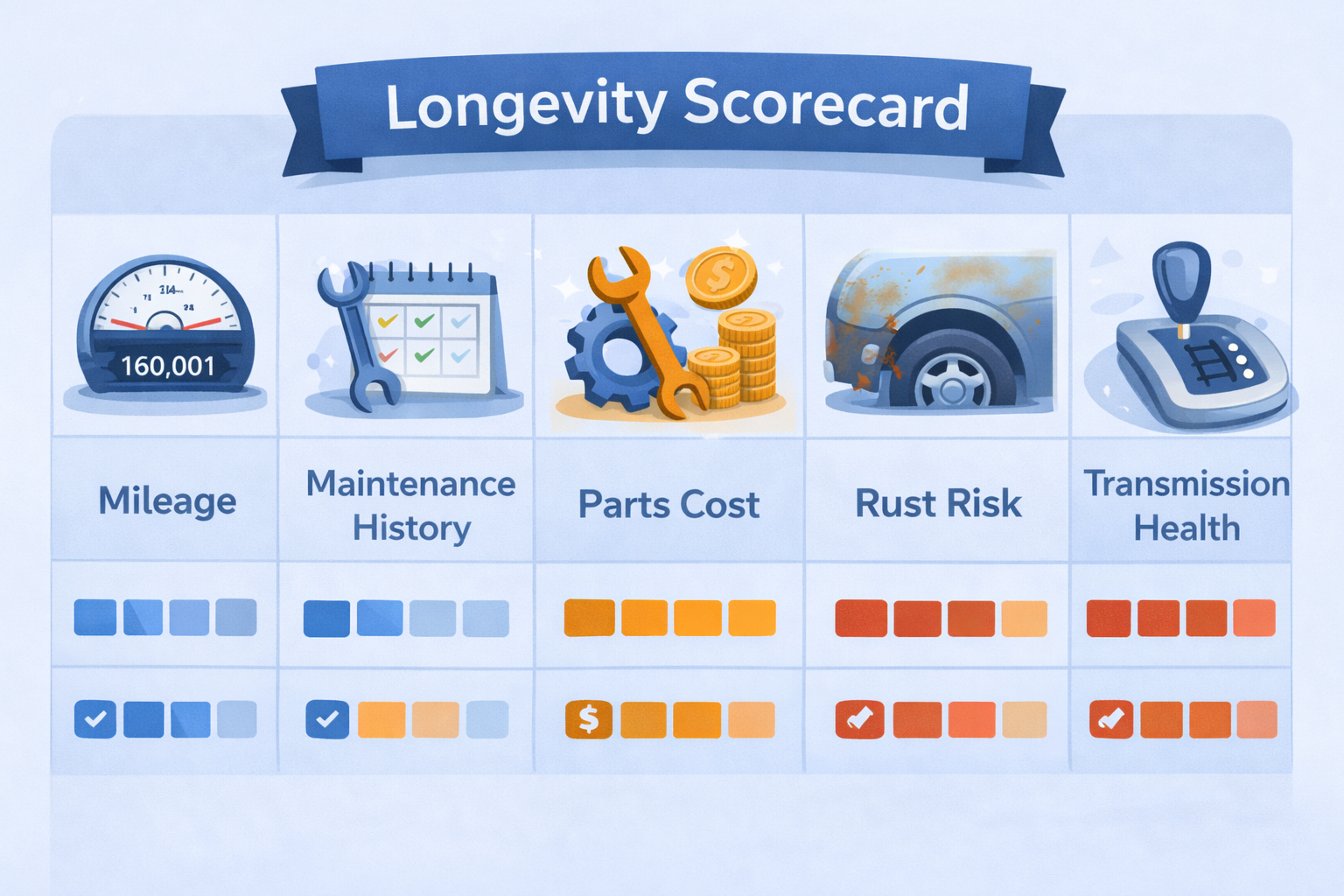
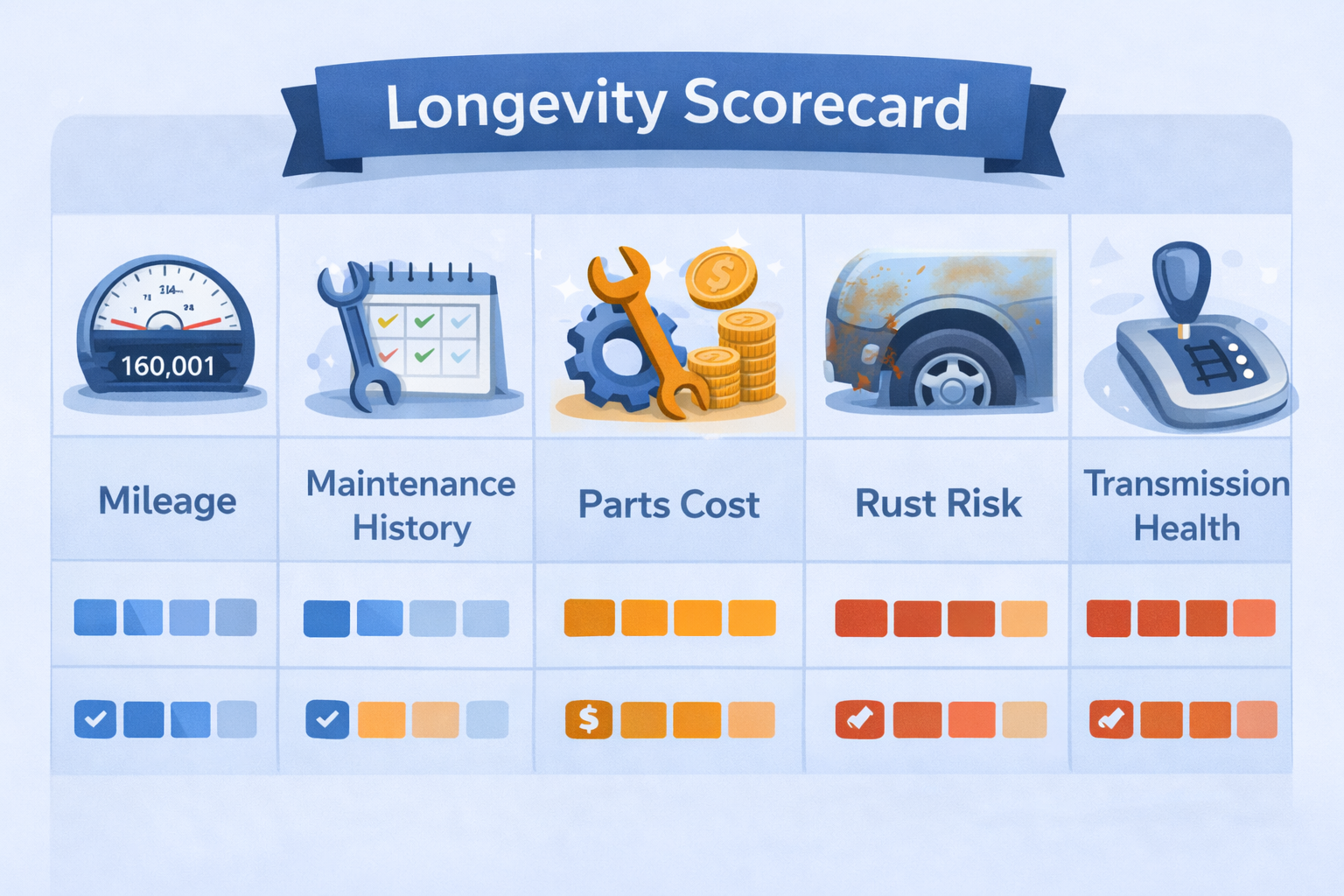
Quick Longevity Checklist
FactorWhy It MattersWhat You Want to SeeMaintenance historyShows whether the car was cared for properlyRecords, receipts, or a clear service storyParts availabilityAffects repair cost and downtimeCommon model with easy-to-find partsTransmission conditionMajor failures are expensiveSmooth shifting, no slipping or harshnessRust conditionCan shorten the life of the vehicle quicklyMinimal structural rust, no major corrosion concernsEngine behaviourHelps reveal current healthSmooth idle, no major smoke, leaks, or knockingThe main takeaway is simple: the used cars that last the longest are not just the ones with a good badge. They are the ones with the best combination of design, condition, maintenance, and realistic ownership cost.
What Buyers Should Realistically Expect Under $10000
A budget of $10,000 can still buy a solid used car in Canada, but it helps to be realistic about what that money usually gets you. In most cases, you are not shopping for something new-feeling, low-mileage, and fully loaded all at once. You are choosing where to compromise.
That is not necessarily a bad thing. Once you stop expecting every good used car under $10,000 to check every box, it becomes easier to focus on condition, history, fit, and long-term ownership cost.
Age, Kilometres, and Condition Usually Trade Off Against Each Other
At this price point, the strongest listings are often a balancing act.
You may find:
- an older car with lower kilometres
- a newer car with much higher kilometres
- a practical model in average condition
- a better-kept example with fewer features
Usually, you do not get all the advantages in one vehicle. A clean, reliable car under $10,000 often asks you to accept one or two compromises, such as older styling, basic trim, cosmetic wear, or mileage that looks high at first glance.
That is why buyers should avoid judging a listing too quickly. A well-maintained car with 220,000 km may be a safer long-term buy than a neglected one with 160,000 km. The number on the odometer matters, but how the car got there matters too.
If your budget is lower than this range, it also helps to compare these options with our guide to the best used cars under $5000 in Canada.
What This Budget Usually Looks Like by Vehicle Type
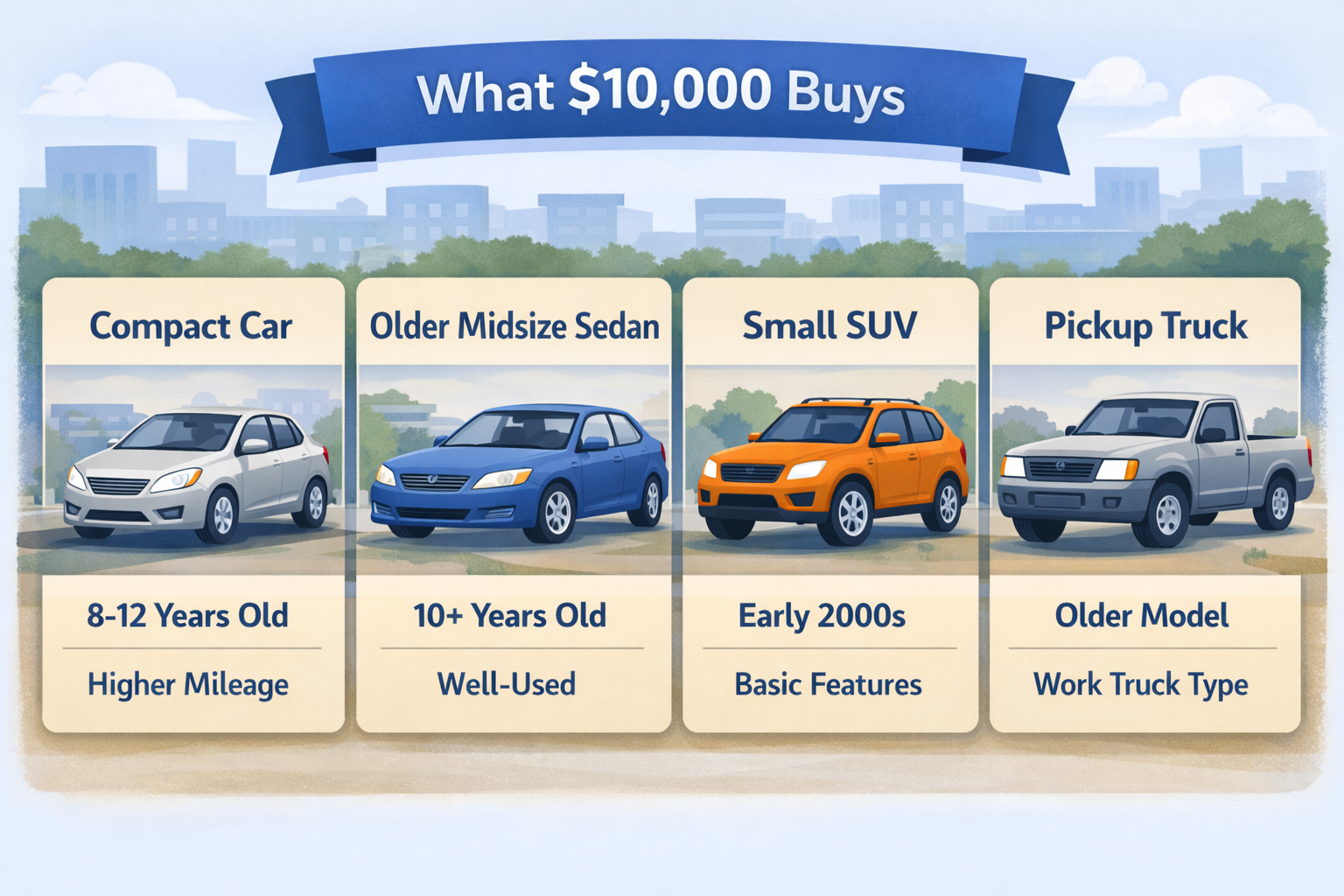
The exact mix changes with the market, but under $10,000 in Canada, buyers are usually shopping in the older, higher-mileage end of the used market.
Vehicle typeWhat $10,000 usually buysWhat buyers should expectCompact sedanOften the strongest value categoryOlder model years, moderate to high kilometres, but better odds of affordability and lower running costsHatchbackGood practical value when you find a clean oneUseful cargo space, often strong commuter option, but clean examples may sell quicklyMidsize sedanMore comfort and space for the moneyUsually older and less efficient than compact cars, but can offer good long-term valueSmall SUVHarder to find in truly strong condition at this budgetMore age or mileage is common, so inspection matters moreFor many buyers, compact sedans and hatchbacks offer the safest balance of reliability, fuel economy, and repair affordability. Small SUVs can still make sense, but the margin for error is usually smaller.
Why the Best Listings Do Not Last Long
One of the more frustrating parts of shopping under $10,000 is that the cleanest listings often move quickly. Vehicles with a good reputation, believable history, and a fair price tend to attract attention fast.
That means buyers need to be prepared before they start contacting sellers. It helps to know what type of vehicle you want, what warning signs matter most, and what questions you plan to ask right away.
A broad or casual search often leads to wasted time. A more focused search gives you a better chance of spotting the listings that are worth serious attention before they disappear.
Why a Slightly Higher Price Can Be the Better Deal
Many buyers lock themselves into one number and try to stay under it no matter what. That can be understandable, especially when money is tight, but it can also lead to expensive decisions.
Sometimes a car priced a little higher within your budget range offers:
- better maintenance history
- newer tires or brakes
- lower repair risk
- cleaner ownership background
- a more suitable fit for daily use
In practical terms, that can make it the cheaper car to own, even if the asking price is not the lowest one you found.
This is one reason it often helps to search in a range rather than around one exact number. The goal is not to buy the cheapest car possible. The goal is to buy a car you can realistically keep on the road.
A Better Mindset for This Budget
If you are shopping under $10,000, a more useful question is not, “What is the cheapest car I can find?” It is, “What kind of vehicle can I realistically buy, verify, insure, maintain, and live with in my budget?”
That shift in thinking tends to lead to better decisions. It moves the focus away from price alone and toward total value.
Best Used Cars Under $10000 That Last the Longest
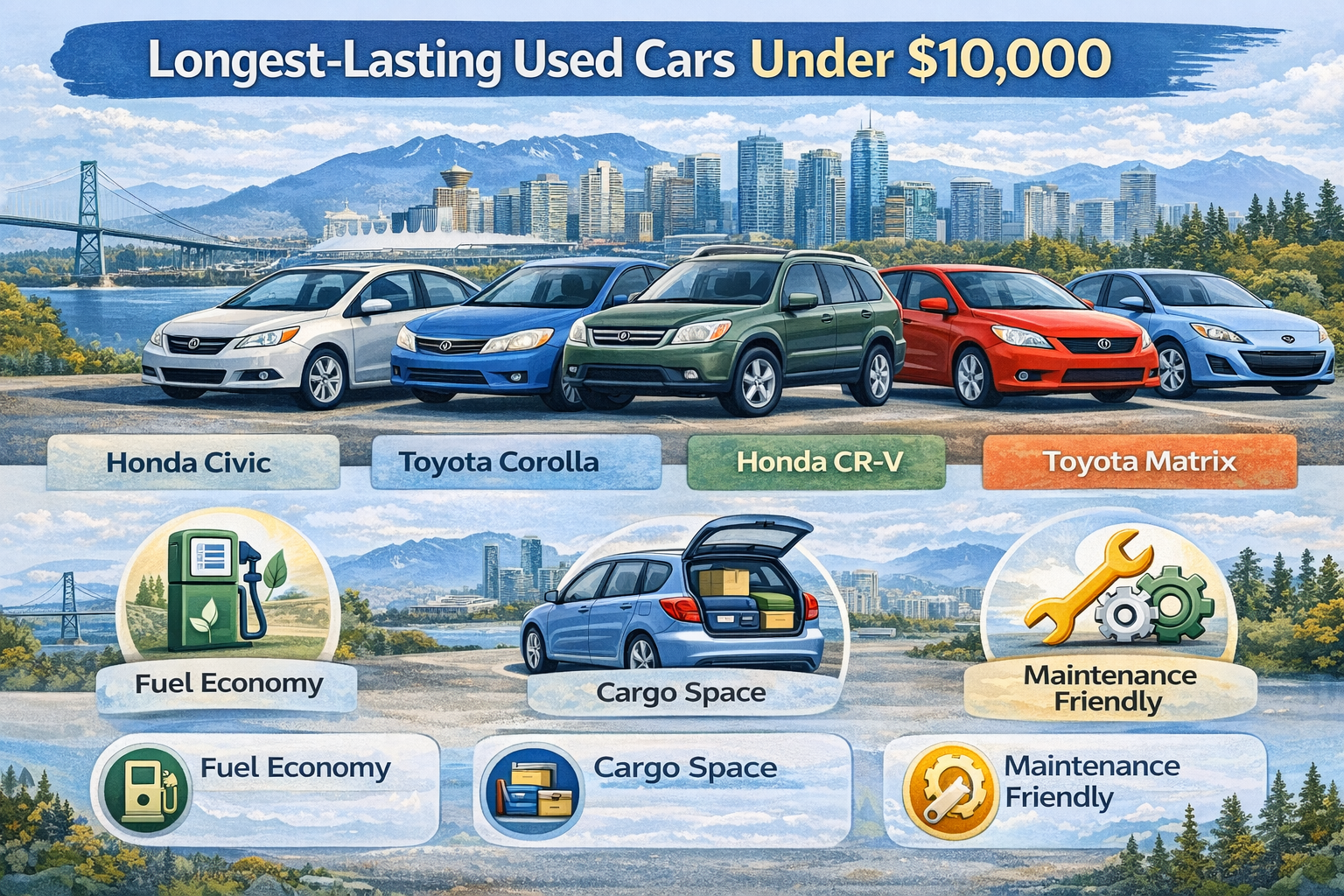
When buyers ask which used cars under $10,000 last the longest, the answer is usually not one perfect model. It is a shortlist of vehicles with a strong record for durability, reasonable ownership costs, and broad parts availability.
The best options at this budget are usually mainstream cars sold in high numbers and kept on the road well past average mileage. That does not mean every example is a safe buy. It means these models tend to give you better odds when the condition and service history make sense.
Toyota Corolla
The Toyota Corolla is one of the safest places to start for buyers who want dependable transportation without a lot of drama. It has a long-standing reputation for reliability, modest running costs, and the ability to stay useful for many years when it is maintained properly.
Under $10,000, most buyers will be looking at older model years with moderate to high kilometres. That is normal. The Corolla still stands out because even higher-mileage examples can make sense when the service history is believable and the vehicle feels mechanically sound.
Why it stands out:
- strong long-term reliability reputation
- affordable maintenance and commonly available parts
- good fuel economy for commuting
- easier to own than many alternatives at the same price
What to watch for:
- signs of neglect hidden behind a clean exterior
- rust on older Canadian examples
- suspension wear, brakes, and fluid condition
Best fit for:
commuters, students, first-time buyers, and anyone who wants a low-drama daily driver
Honda Civic
The Honda Civic belongs on almost any list of durable used cars under $10,000. It tends to offer a good balance of reliability, fuel efficiency, easy drivability, and parts availability.
At this price point, the Civic can be a strong long-term buy, but condition matters a great deal. Some Civics have been carefully maintained for years. Others have been modified, driven aggressively, or kept up only minimally. That means buyers need to be selective.
Why it stands out:
- proven reputation for lasting a long time
- efficient and practical for everyday driving
- widely available across the used market
- easy to research, inspect, and maintain
What to watch for:
- modified examples
- weak maintenance history
- rust, suspension wear, and transmission behaviour depending on year
Best fit for:
city drivers, commuters, younger buyers, and shoppers who want a practical all-rounder
Toyota Camry
For buyers who want more room than a compact car offers, the Toyota Camry is often one of the smartest midsize choices in this budget. It is known for durability, comfortable daily driving, and the ability to remain useful well into higher mileage when it has been cared for properly.
The Camry often appeals to buyers who want long-term value without moving into the higher ownership costs that can come with older luxury sedans. It may not be exciting, but that is part of the point.
Why it stands out:
- strong record for long-term dependability
- more comfort and cabin space than smaller cars
- often a better long-term choice than a cheaper but riskier alternative
- widely supported with parts and service knowledge
What to watch for:
- older examples with deferred maintenance
- leaks, suspension wear, and rust on high-kilometre vehicles
- general wear that reflects age more than mileage alone
Best fit for:
families, highway commuters, and buyers who want comfort without moving into an older luxury model
Honda Accord
The Honda Accord is another midsize sedan that often makes sense for long-term value. When maintained properly, it can offer strong durability, good practicality, and a more substantial feel than smaller budget cars.
In the under-$10,000 market, the Accord can be attractive because it gives you extra room and comfort while still staying within the mainstream segment. The main caution is that not every year, trim, or powertrain ages equally well, so it is important to evaluate the specific vehicle rather than relying only on the badge.
Why it stands out:
- solid long-term reputation in the midsize category
- practical mix of comfort, space, and everyday usability
- generally easier to maintain than many premium alternatives
What to watch for:
- poor maintenance history
- rough transmission behaviour depending on age and setup
- signs that the car has simply been run hard for too long
Best fit for:
buyers who want more space than a Civic or Corolla without stepping into a more complicated vehicle
Mazda3
The Mazda3 is often one of the more appealing choices in this price range because it combines reasonable reliability with good fuel economy and a more refined driving feel than many budget shoppers expect.
It can be a very good value, especially for buyers who want something practical but do not want the vehicle to feel dull. That said, condition matters heavily here, particularly on older Canadian examples where rust can become a serious issue.
Why it stands out:
- usually good value for the money
- practical size and strong commuter appeal
- often enjoyable to drive while still staying affordable
What to watch for:
- rust, especially on older model years
- cosmetic aging that may reflect broader neglect
- suspension wear and general condition
Best fit for:
commuters and first-time buyers who want a balance of practicality and driving comfort
Pontiac Vibe / Toyota Matrix
The Pontiac Vibe and Toyota Matrix are often overlooked, which is exactly why they can be smart budget choices. These models are closely tied in design and are known for practical hatchback utility, strong everyday usability, and dependable mechanicals when maintained properly.
For buyers who want cargo flexibility without moving into a small SUV, these can be especially appealing.
Why they stand out:
- practical hatchback design with useful cargo space
- strong reputation for long-term everyday value
- often less hyped than some of the usual budget-car favourites
- good fit for buyers who need flexibility without high running costs
What to watch for:
- age-related wear and rust
- signs of hard use or neglected maintenance
- suspension, brakes, and tires on older examples
Best fit for:
small families, commuters, students, and buyers who want more practicality than a sedan offers
Honda CR-V
The Honda CR-V is one of the few compact SUVs that can still make sense for buyers focused on long-term durability under $10,000. Its reputation for practicality, daily usefulness, and long service life makes it attractive, especially for buyers who need a higher seating position or more cargo space.
The challenge is that SUVs with strong reputations tend to hold their value. At this budget, buyers often need to accept older years, higher kilometres, or both. That makes careful inspection especially important.
Why it stands out:
- practical and versatile for daily life
- better long-term reputation than many budget SUVs
- useful for families, gear, and mixed driving needs
What to watch for:
- age and mileage catching up with the vehicle
- suspension wear, rust, and fluid leaks
- signs that maintenance was delayed because the owner kept driving it anyway
Best fit for:
buyers who genuinely need compact SUV space and are willing to shop carefully
Toyota RAV4
The Toyota RAV4 has long been a strong choice for buyers who want a practical, durable small SUV. Like the CR-V, it benefits from a reputation that keeps resale values relatively strong, which means $10,000 may not buy a particularly new or low-mileage example.
That does not make it a poor choice. It means buyers need to focus even more on condition, ownership history, and overall value rather than trim level or extra features.
Why it stands out:
- strong record for dependability
- practical daily usability and cargo flexibility
- holds value because demand stays strong
What to watch for:
- overpriced listings based on reputation alone
- rust and maintenance shortcuts on older examples
- the temptation to overpay for a weak example just because it is a RAV4
Best fit for:
buyers who want SUV practicality and are willing to prioritize condition over appearance or features
Lexus ES (Select Older Years)
Most older luxury vehicles do not belong on a tight-budget durability list. The Lexus ES is one of the few exceptions that can make sense in select cases. It often appeals to buyers who want comfort and refinement but still care about long-term dependability.
The reason it can work better than many other older luxury sedans is that it tends to have a stronger reputation for durability and a more sensible ownership profile than flashier European options. Still, buyers should be cautious. A neglected luxury car is still a neglected luxury car.
Why it stands out:
- stronger long-term durability reputation than many older premium sedans
- comfortable and refined without being overly complicated in the same way as some rivals
- can offer surprising value if the history is strong
What to watch for:
- service history gaps
- higher costs for some repairs and maintenance items
- buying it for the badge rather than the condition
Best fit for:
buyers who want a more comfortable sedan and are disciplined enough to shop very selectively
Honda Fit or Toyota Yaris
For buyers who care most about low ownership cost, city practicality, and day-to-day efficiency, the Honda Fit and Toyota Yaris deserve serious attention. These are not the most spacious or powerful vehicles on this list, but they often make excellent long-term budget choices.
Their appeal is simple. They are usually efficient, practical for commuting, easier to park, and less financially stressful to own than many larger alternatives.
Why they stand out:
- strong value for buyers prioritizing efficiency and simplicity
- lower ownership cost profile than many larger vehicles
- practical for commuting and urban use
What to watch for:
- signs of heavy city wear
- neglected maintenance on vehicles that were treated as disposable appliances
- whether the size truly fits your daily needs
Best fit for:
students, solo drivers, commuters, and buyers who want the simplest path to affordable transportation
Quick Comparison Table
ModelMain strengthBest forMain cautionToyota CorollaReliability and low running costCommuters, first-time buyersDon’t ignore rust or maintenance gapsHonda CivicStrong all-round valueDaily drivers, younger buyersBe careful with modified examplesToyota CamryComfort and durabilityFamilies, highway useOlder cars may hide deferred maintenanceHonda AccordSpace and practicalityBuyers wanting a midsize sedanSpecific years and powertrains varyMazda3Good balance of value and efficiencyCommutersRust matters a lot on older examplesPontiac Vibe / Toyota MatrixHatchback utility and practical valueSmall families, flexible useAge-related wear can be significantHonda CR-VUseful small SUV practicalityBuyers needing spaceGood examples are harder to find cheapToyota RAV4Dependable small SUV reputationBuyers wanting SUV versatilityReputation can inflate weak listingsLexus ESComfortable long-term luxury exceptionSelective sedan buyersRepairs can still cost moreHonda Fit / Toyota YarisLow-cost everyday practicalityStudents, city driversSize may be limiting for some buyersThese are not the only used cars under $10,000 that can last a long time, but they are among the most sensible places to start.
Best Options by Buyer Type
A good used car is not just the one with the best reputation. It is the one that fits how you actually live. A model that works well for a student commuting alone may not be the right fit for a small family, and a practical hatchback may make more sense than an SUV for buyers who do not really need the extra size.
This is why it helps to match the shortlist to your real use case.
Best for Daily Commuting
If your main priority is reliable transportation to work, school, or everyday errands, compact cars usually make the most sense. They tend to be easier on fuel, easier to park, and more affordable to maintain than larger alternatives.
The strongest options here are usually the Toyota Corolla, Honda Civic, and Mazda3.
Why these make sense for commuting:
- good fuel economy
- simpler day-to-day ownership
- easier maintenance and parts availability
- less financial risk than moving into a larger or more complex vehicle
Best for Families on a Tighter Budget
Buyers who need more room for passengers, child seats, or regular highway use often need to look beyond compact cars. In this case, a practical midsize sedan can sometimes offer better long-term value than forcing the budget into a tired SUV.
The Toyota Camry and Honda Accord usually stand out here. For some buyers, the Pontiac Vibe / Toyota Matrix can also work well because the hatchback layout adds useful cargo flexibility without the full price and weight of an SUV.
Best fit when you need:
- more rear-seat room
- better comfort for longer drives
- practical cargo space without moving into a riskier vehicle category
Best for First-Time Buyers
First-time buyers usually benefit from keeping things simple. A vehicle that is easy to research, easy to inspect, and widely understood by mechanics is often the safest starting point.
That is why the Toyota Corolla, Honda Civic, Honda Fit, and Toyota Yaris are often smart choices.
Why these work well for first-time buyers:
- simpler ownership experience
- predictable running costs
- easier to compare across listings
- less chance of expensive surprises if bought carefully
Best if You Need Hatchback Utility
Not every buyer needs an SUV. Sometimes what you really need is a practical shape that gives you more room for groceries, work gear, strollers, or everyday cargo without increasing ownership cost too much.
This is where the Pontiac Vibe / Toyota Matrix and Honda Fit stand out.
Why hatchbacks can be the smarter choice:
- useful cargo flexibility
- easier parking than many SUVs
- lower weight and lower running costs in many cases
- practical for buyers who need space but not full SUV size
Best Small SUVs if You Need More Space
Some buyers genuinely need the higher seating position, extra cargo room, or family-friendly practicality of a small SUV. If that is your situation, the Honda CR-V and Toyota RAV4 are usually among the safest places to look in this budget.
The important word there is need. Strong-reputation SUVs often cost more for their age and mileage, so they are best for buyers who will actually use the extra space and accept the fact that under $10,000 usually means shopping older and more carefully.
These can make sense if you need:
- extra cargo room
- easier entry and exit
- more flexible daily-use space
- a vehicle that suits family or mixed-use driving better than a compact car
Best if Comfort Matters More Than Features
Some buyers care less about having the newest screen, the flashiest styling, or the most popular model. They simply want a car that feels comfortable, composed, and easy to live with on longer drives.
In that case, the Toyota Camry, Honda Accord, and in select situations the Lexus ES, can make sense. The key is to stay disciplined. Comfort should not come at the expense of condition or repair risk.
Quick Buyer-Type Comparison
Buyer typeStrongest optionsWhy they fitDaily commuterToyota Corolla, Honda Civic, Mazda3Efficient, practical, easier to maintainFamily on a budgetToyota Camry, Honda Accord, Pontiac Vibe / Toyota MatrixMore space without jumping straight to an older SUVFirst-time buyerToyota Corolla, Honda Civic, Honda Fit, Toyota YarisSimpler ownership and easier budgetingNeeds hatchback utilityPontiac Vibe / Toyota Matrix, Honda FitMore flexibility without full SUV costsNeeds a small SUVHonda CR-V, Toyota RAV4Useful space and stronger long-term reputationWants more comfortToyota Camry, Honda Accord, Lexus ESBetter ride and room when bought carefullyThe best used car under $10,000 is not the same for everyone. A vehicle with a strong reputation still has to suit your actual needs, your daily routine, and your ability to maintain it properly.

Which Used Cars Under $10000 Are Usually Riskier Long-Term?
A low price can make almost any used car look tempting. The problem is that some vehicles are cheap for a reason. At this budget, the biggest mistakes usually happen when buyers focus too much on appearance, brand, or features and not enough on long-term ownership risk.
That does not mean every car in the categories below is automatically a bad purchase. It means buyers should be much more cautious, because these types of vehicles are more likely to create repair costs, downtime, or financial stress after the sale.
Older Luxury Cars Often Bring Luxury Repair Bills
One of the most common budget-car mistakes is assuming that an older luxury vehicle is automatically a better deal than a simpler mainstream car.
In practice, older luxury cars often become expensive because the purchase price falls much faster than the repair cost. Parts can be more expensive. Labour can be higher. Electronic systems can be more complex. And once maintenance has been delayed for years, catching up can cost far more than most tight budgets can absorb.
That is why many older BMW, Audi, Mercedes-Benz, and similar premium models do not belong on a long-term value shortlist for buyers under $10,000.
Cheap Performance Cars Can Be a Financial Trap
Performance-oriented cars sometimes look like great deals in the used market, especially when the price drops into budget range. The problem is that these vehicles are often bought by owners who care more about style or speed than long-term operating cost.
That can lead to several risks at once:
- harder driving history
- modifications that complicate maintenance
- more wear on brakes, tires, suspension, and transmission components
- higher ownership costs even when nothing major breaks
A cheap performance car can still be fun. It is just rarely the smartest answer for someone shopping for lasting value under a tight budget.
Large SUVs and Trucks Can Get Expensive Quickly
Many buyers like the idea of getting a larger SUV or truck for under $10,000. Sometimes that can work, but very often the lower price reflects higher age, heavier wear, worse fuel economy, or bigger upcoming maintenance costs.
Even when the engine is strong, larger vehicles usually bring higher costs in other areas:
- fuel
- tires
- brakes
- suspension work
- general wear from weight and age
For buyers who do not truly need the extra size, a compact sedan, hatchback, or well-chosen small SUV is often a safer long-term budget decision.
Vehicles With Known Transmission Problems Need Extra Caution
Transmission issues are some of the most dangerous problems in the under-$10,000 market because they can turn an affordable purchase into a major financial setback very quickly.
That is why buyers should be cautious with any vehicle that shows signs such as:
- delayed engagement when shifting into drive or reverse
- slipping under acceleration
- harsh or unpredictable shifting
- warning lights that the seller minimizes
- vague answers about past repair history
Unusually Low Prices Are Often a Warning Sign
A bargain can be real, but unusually low prices deserve extra scrutiny. When a listing is far cheaper than similar vehicles, there is often a reason behind it.
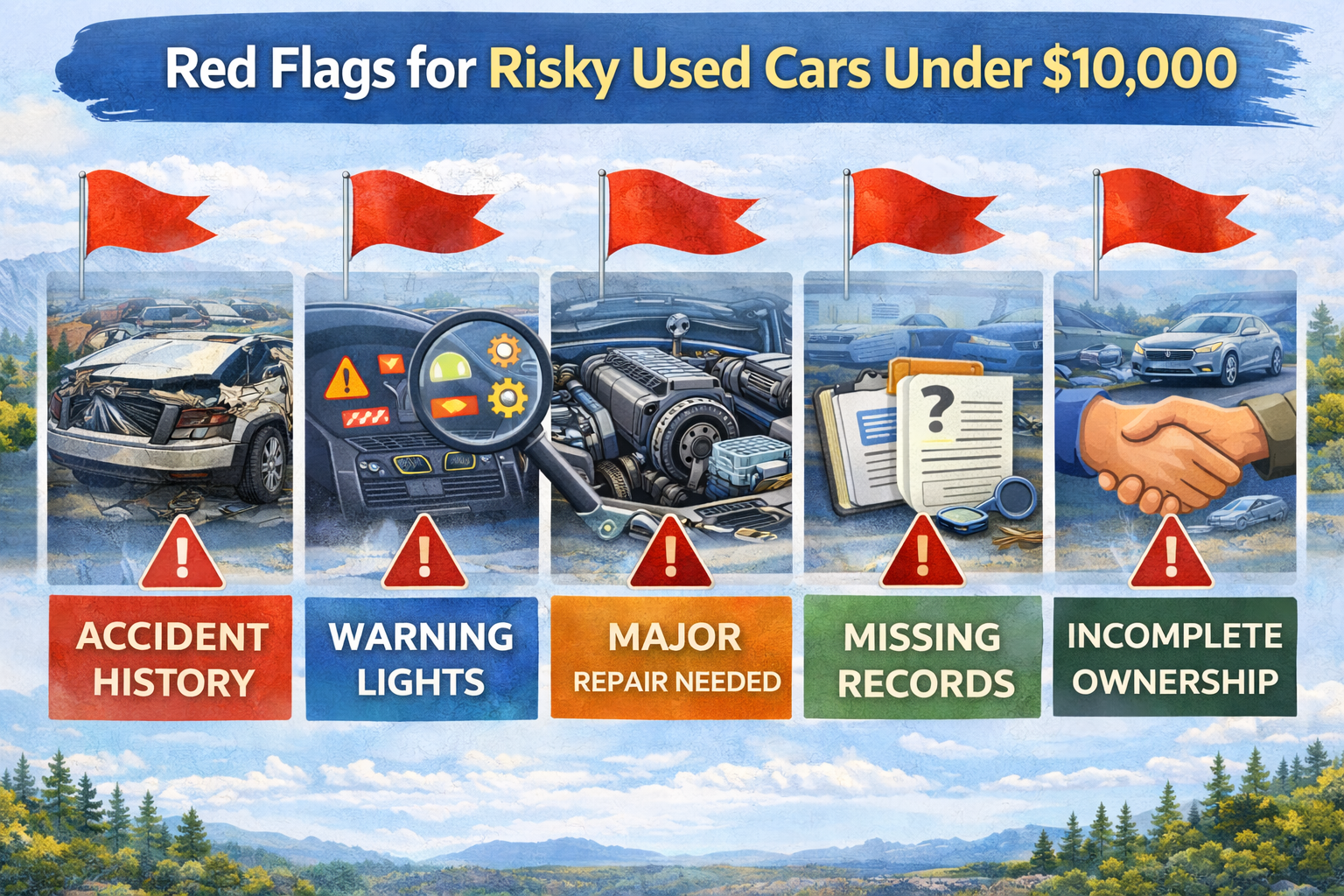
Sometimes the reason is simple and manageable, such as cosmetic wear or a rushed private sale. Other times the lower price reflects one or more serious issues:
- hidden rust
- accident history
- warning lights
- expensive overdue maintenance
- paperwork problems
- unrealistic seller explanations
The safest mindset is not to assume that a low price means you found the best deal. It is to ask what risk the price may be hiding.
Quick Red-Flag Categories
Riskier categoryWhy buyers should be carefulOlder luxury sedans and SUVsRepair and maintenance costs can stay high even when purchase prices fallCheap performance carsHarder past use, more wear, and higher running costsLarge SUVs and trucksBigger fuel, tire, brake, and suspension costsVehicles with rough shiftingTransmission repairs can exceed the value equation quicklyListings priced far below the marketLow price may reflect hidden problems rather than true valueThe goal is not to scare buyers away from every imperfect used car. It is to help them avoid the kinds of vehicles that are more likely to turn a tight budget into a bigger problem.
How to Shop for Long-Term Reliability Instead of Just a Low Price
Knowing which models tend to last is helpful, but it is only part of the decision. Under $10,000, the bigger difference often comes from how you shop. A strong model with poor history can still be a bad purchase, while a higher-mileage example of the right car can still offer very good value if it has been maintained properly.
Use a shortlist of dependable models as a starting point, then evaluate each vehicle carefully based on condition, records, and overall risk. If you want a more detailed walkthrough of the inspection process itself, see our used car inspection checklist.
Check the Vehicle History Before You Get Serious
Before you spend much time on a listing, try to understand the vehicle’s background as early as possible. You want to know whether the car has a believable ownership story and whether anything major changes the value equation.
A history report will not tell you everything, but it can help you spot issues such as:
- accident history
- branding or title concerns
- inconsistent mileage records
- frequent ownership changes
- recall-related questions that need follow-up
Treat Service Records Like Part of the Vehicle’s Value
At this budget, maintenance records are not just a bonus. They are part of what you are paying for.
A seller who can clearly explain oil changes, brakes, tires, fluids, battery replacement, or recent repairs is usually giving you more useful information than one who simply says the car runs great.
When two similar cars are priced close together, the one with stronger service history is often the better value, even if it costs a little more.
Look Beyond the Paint and Check the Real Wear Items
It is easy to be influenced by a clean exterior, polished interior, or a seller who presents the car well. But long-term reliability depends much more on mechanical condition than surface appearance.
Pay close attention to the areas that often tell a more honest story:
- tire condition and whether wear is even
- brake condition
- leaks under the car or in the engine bay
- rust underneath and around vulnerable areas
- warning lights on the dashboard
- how the engine starts, idles, and responds
Use the Test Drive to Look for Expensive Problems
A short drive should do more than confirm that the car moves. It should help you notice the kinds of issues that can become expensive after purchase.
During the test drive, pay attention to:
- how the transmission shifts
- whether the steering feels stable and predictable
- whether braking feels smooth and controlled
- whether the car tracks straight
- whether you hear clunks, rattles, grinding, or unusual road noise
Always Make Room for a Pre-Purchase Inspection
One of the most important buying rules in this price range is simple: do not rely only on your own impression of the vehicle.
A pre-purchase inspection can help uncover problems that do not show clearly during a quick viewing or test drive. This is especially important when you are considering a higher-mileage car, an older SUV, or any vehicle where maintenance history is incomplete. When you are ready to compare actual vehicles, you can browse our used car inventory and narrow your shortlist before booking an inspection or viewing.
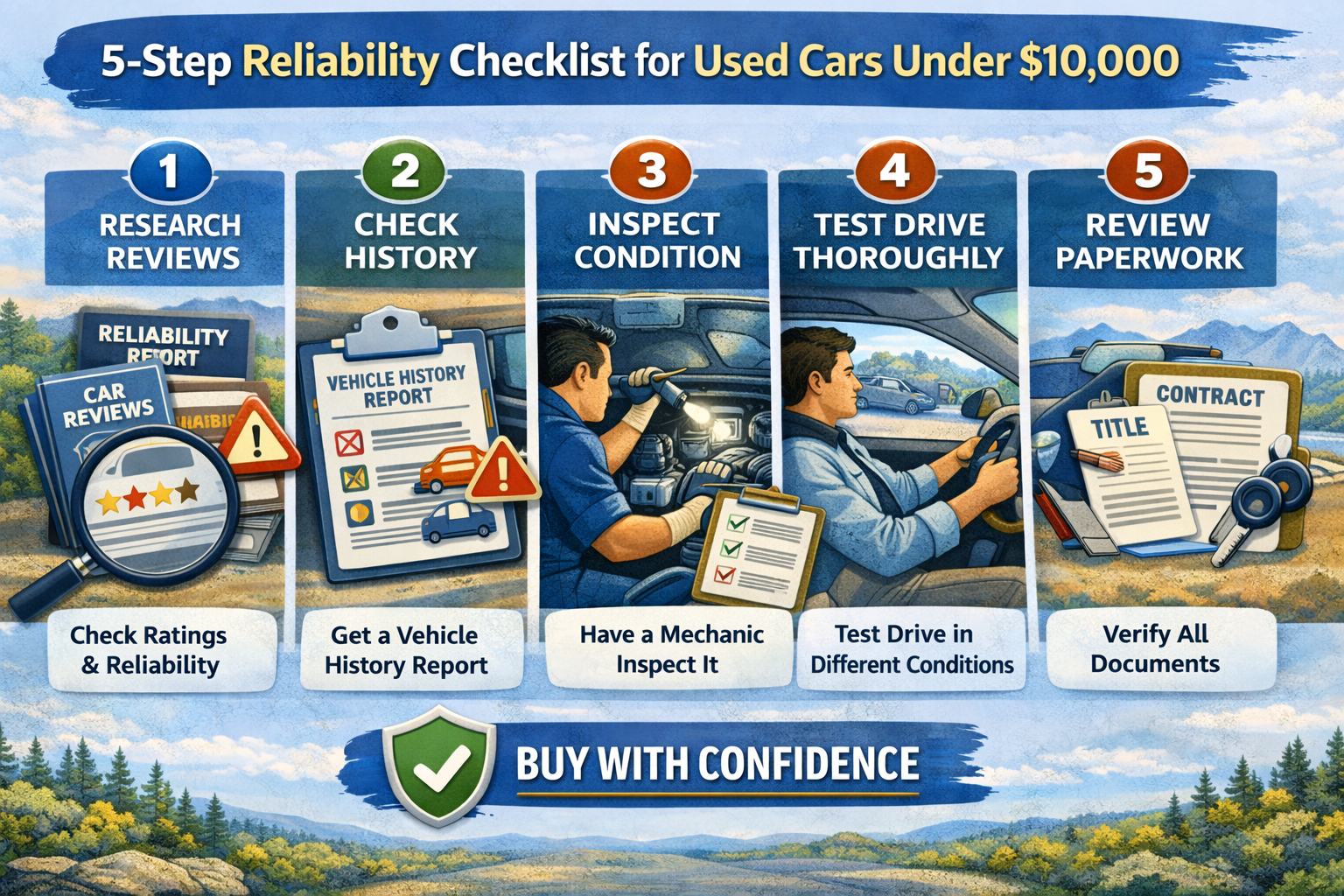
A Better Shopping Process in One View
StepWhat to doWhy it mattersShortlist the right modelsFocus on durable, mainstream vehicles firstGives you better odds from the startCheck the historyReview accidents, ownership pattern, and record consistencyHelps spot hidden risk earlyReview service evidenceAsk what has actually been maintained or replacedClarifies value and likely upcoming costsInspect key wear areasLook at rust, tires, brakes, fluids, and warning lightsReveals condition beyond the photosTest drive carefullyPay attention to shifting, braking, steering, and noiseHelps uncover expensive warning signsGet a pre-purchase inspectionHave a professional verify what you may missReduces the chance of a bad purchaseThe main point is that long-term reliability is not something you buy just by choosing the right badge. You improve your odds by choosing the right model, then verifying that the specific vehicle in front of you still deserves your trust.
How Much Maintenance Budget Should You Keep After Purchase?
One of the most common mistakes budget buyers make is spending every dollar on the purchase price and leaving nothing aside for what happens next. Even a good used car under $10,000 may need some attention shortly after you buy it, especially if it is older, has higher mileage, or was priced to reflect upcoming maintenance.
That does not mean the car is a bad purchase. It means used-car ownership works best when you think beyond the initial deal and prepare for the first round of ownership costs.
Why Buying at the Top of Your Budget Can Be Risky
A car that takes your full budget may leave you exposed right away. If the vehicle needs tires, brakes, fluids, a battery, or small repairs within the first few months, the financial pressure can build quickly.
This is one reason the cheapest safe purchase is not always the same as the highest asking price you can technically afford. A slightly cheaper car that leaves room for early maintenance often puts the buyer in a stronger position.
Costs Buyers Should Plan for After Purchase
Even when the vehicle checks out well, it is smart to expect at least some near-term costs after purchase.
Common examples include:
- pre-purchase inspection cost
- registration and insurance setup
- oil change and fluid service
- tire replacement or alignment
- brake service
- battery replacement
- small repairs that were not urgent enough to stop the sale
Some of these costs are routine. Others may reflect the fact that the previous owner delayed work because they planned to sell the vehicle soon.
A Small Reserve Can Protect a Good Purchase
For many buyers, the goal should not be to spend the full $10,000. It should be to buy a vehicle and still keep a modest reserve for early ownership needs.
That reserve helps you:
- handle basic maintenance without stress
- fix smaller issues before they become bigger ones
- avoid driving on worn tires or overdue brakes
- keep the vehicle in better long-term condition
In practical terms, the used cars that last the longest are often the ones their owners can afford to maintain properly after purchase.
Sample Post-Purchase Reserve Budget
ItemExample budget rangePre-purchase inspection$150–$300Registration / insurance setupVaries by buyer and vehicleOil and fluid service$100–$300Battery$150–$300Tires or alignment$300–$1,000+ depending on needBrake service$300–$800+ depending on conditionBasic repair reserve$500–$1,500These numbers will vary, but the principle stays the same: leaving yourself no room after purchase can turn even a reasonable used car into a stressful ownership experience.
A Better Budgeting Mindset
When buyers ask how much they should spend on the car itself, a better question is often: how much can I spend and still stay comfortable after the purchase?
That mindset helps protect you from buying too aggressively. It also supports the main goal of this article, which is not just finding a car under $10,000, but finding one that can stay practical and affordable for the long term.
Final Thoughts: Buy for Condition, History, and Fit
The best used cars under $10000 that last the longest are usually not the flashiest ones. They are the vehicles that combine a strong reliability record with sensible ownership costs, believable service history, and condition that still makes sense for the price.
For most buyers, that means starting with practical mainstream models such as the Toyota Corolla, Honda Civic, Toyota Camry, Honda Accord, Mazda3, Toyota Matrix, Pontiac Vibe, Honda Fit, Toyota Yaris, Honda CR-V, or Toyota RAV4. Some buyers may also find value in a carefully chosen older Lexus ES, but only when the history is strong and the repair risk still feels manageable.
The bigger lesson is that a good used car under $5,000 is rarely found by badge alone. It is found by matching the right type of vehicle to your needs, checking the history, inspecting the wear items, and leaving yourself enough room in the budget to maintain it properly after purchase.
If you keep those principles in mind, you give yourself a much better chance of buying a vehicle that stays affordable, dependable, and useful for years rather than just looking like a deal on the day you buy it.
If you already know what type of vehicle you want, you can browse our available used cars, book a test drive, or contact our team for the next step. Buyers who need help with payments can also start a finance application.
FAQ
What is the most reliable used car under $10,000?
There is no single answer for every buyer, but models such as the Toyota Corolla, Honda Civic, Toyota Camry, and Honda Accord are often among the safest places to start. The specific vehicle still matters more than the badge alone.
Is a used car with over 200,000 km worth buying?
It can be, especially if the vehicle has a believable service history, drives well, and passes a proper inspection. Higher mileage is not always a deal-breaker, but it should make you pay more attention to maintenance and condition.
Are Toyota and Honda always the best choices under $10,000?
Not always, but they are often strong starting points because of their reliability reputation, parts availability, and manageable ownership costs. Other models, such as the Mazda3, Toyota Matrix, Pontiac Vibe, Honda Fit, and Toyota Yaris, can also make a lot of sense.
Is it better to buy a sedan or an SUV under $10,000?
For many buyers, a sedan or hatchback offers better value because it is usually easier to maintain and more efficient to own. A small SUV can still make sense if you truly need the space, but the condition and value equation need closer attention. Buyers who are still sorting out the financial side can also review our guide on how used car financing works in Canada.
How much money should I keep aside after buying a used car?
That depends on the vehicle and your situation, but keeping a reserve for inspection, fluids, tires, brakes, and small early repairs is a smart move. Buyers who spend the full purchase budget often leave themselves exposed. If financing is part of your plan, your monthly payment is only one piece of the picture, which is why it helps to understand how used car financing works in Canada before you commit.
What matters more: lower mileage or better maintenance history?
In many cases, better maintenance history matters more. A well-kept higher-mileage car can be a better long-term buy than a lower-mileage car that has been neglected.
Can you still find a good used car under $10,000 in Canada?
Yes, but expectations need to stay realistic. Buyers usually need to compromise on age, mileage, features, or body style and focus more on overall condition, history, and long-term value than on the lowest asking price. A broader step-by-step overview is available in our complete used car buying guide for Vancouver.