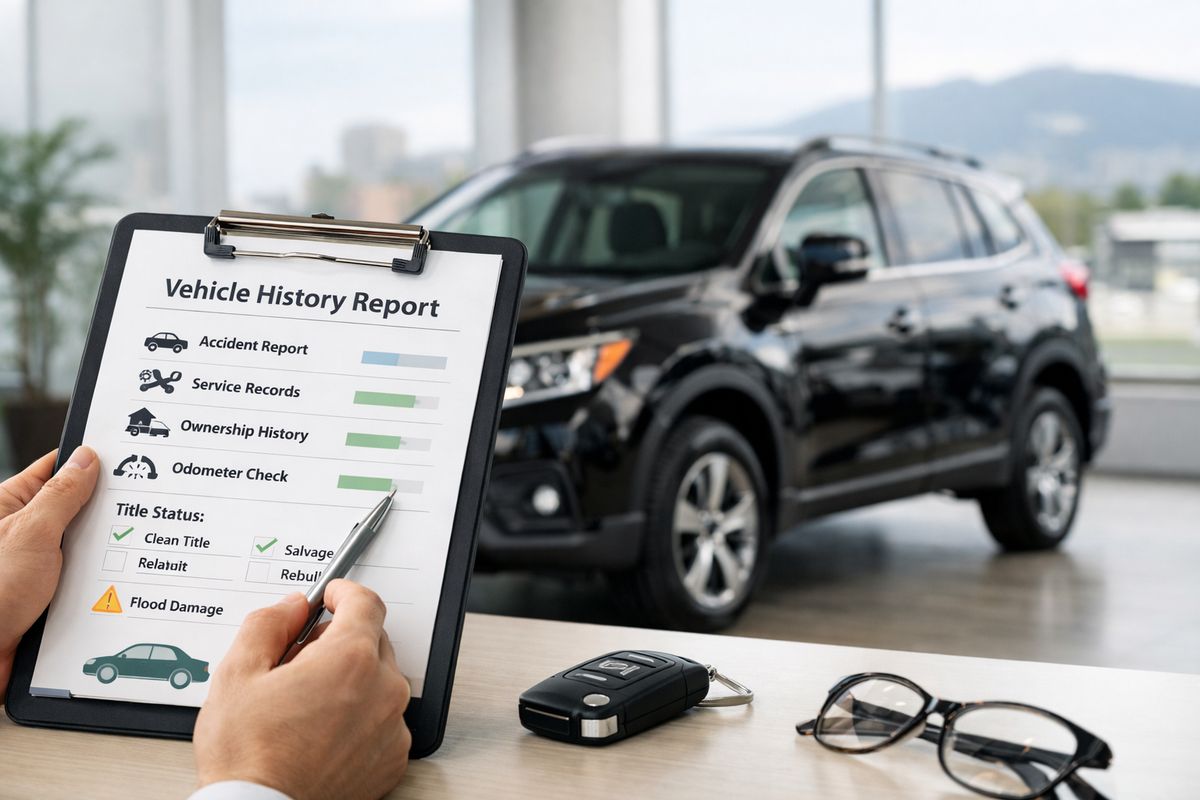
A vehicle history report can reveal problems that a test drive cannot. Before buying a used car in Vancouver, check its reported damage, registration history, vehicle status, mileage records and liens. Then compare those records with the car, its service documents and an independent inspection.
A report helps you ask better questions. It cannot certify that a vehicle is problem-free. Records may be missing, and a car’s current mechanical condition still needs to be checked.
Start with the VIN, not the listing
Ask the seller for the vehicle identification number (VIN) before you commit to a purchase. Use that VIN to obtain the report, then compare it with the number on the vehicle and its registration documents. If the numbers do not match, resolve the discrepancy before proceeding. ICBC’s used-vehicle checklist also recommends checking that VIN plates and decals have not been tampered with.
Check the date the report was run. An older report may not reflect more recent records. If a dealer provides one, read the report itself and ask about anything you do not understand. The Vehicle Sales Authority of BC (VSA) recommends paying attention to both the report date and its stated limitations.
Which vehicle history report should you get in BC?
The right report depends partly on where the vehicle has been registered.
An ICBC Vehicle Claims History Report focuses on information from BC. It can show damage claimed through ICBC, available claim dates and amounts, vehicle status, and whether the vehicle was imported into the province. It does not provide the vehicle’s history from outside BC.
A CARFAX Canada Vehicle History Report can bring together available registration, damage, service, odometer, recall and US-history records. Its report options differ: a standard vehicle history report does not include a Canadian lien search. If you need that search, choose the Vehicle History Report + Lien Check or arrange a separate lien search. Reported information depends on what the data sources have supplied.
A report is only as complete as its available records. If a vehicle moved between provinces or came from the US, give its earlier history particular attention. An ICBC report can indicate that a vehicle was imported into BC without showing what happened before it arrived.
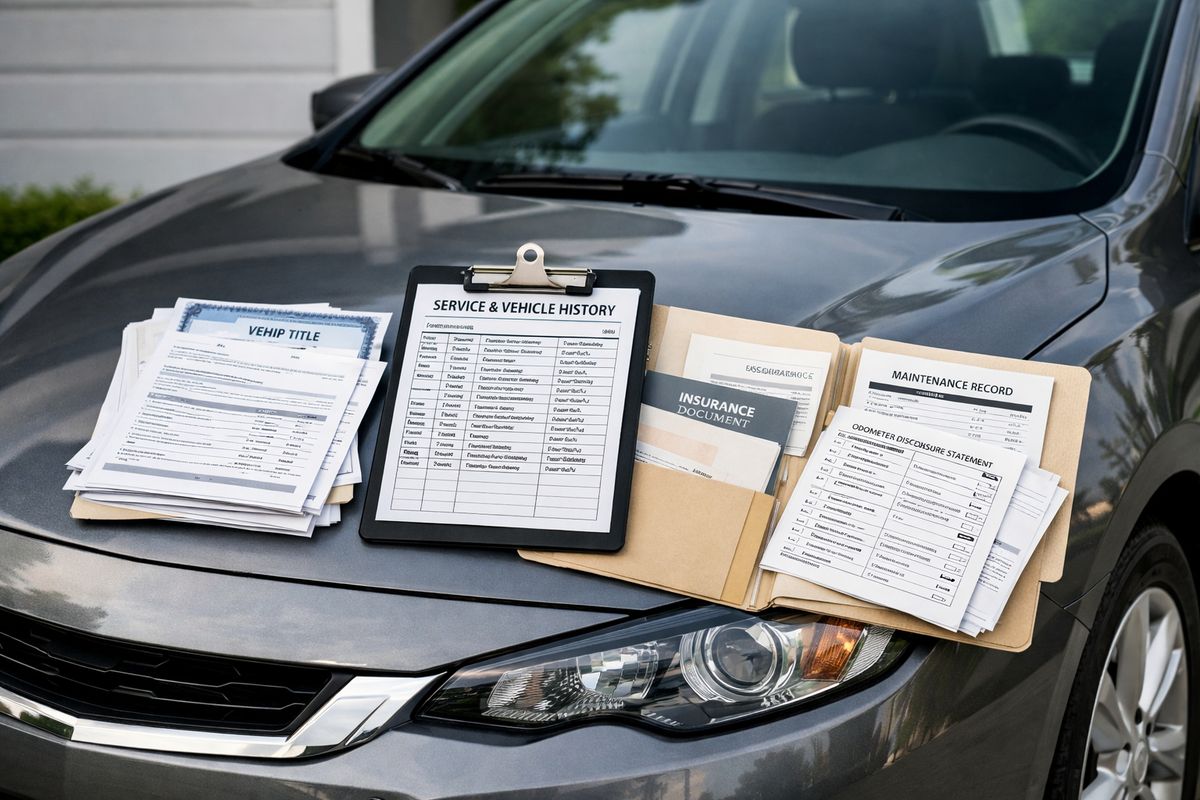
How to read the report, section by section
1. Review each damage entry
For every reported accident or damage event, note the date, description, affected area and amount, if available. Ask the seller for repair invoices and an explanation of what was fixed.
A damage entry deserves investigation, but it does not tell the whole story by itself. The amount may reflect the cost of parts and labour without telling you whether the repair was completed well. Look for any reference to structural damage or airbag deployment, and have an appropriate professional inspect repairs that concern you.
Compare the report with the vehicle. Do the panel gaps, paint, lights and tires appear consistent with the seller’s explanation? If the vehicle has been in a crash, ICBC suggests that a licensed auto body shop can help assess whether it remains structurally safe and whether rebuilding work was done properly.
2. Check vehicle status and registration history
Look for status terms such as normal, salvage, rebuilt or irreparable. A rebuilt status calls for a closer review of the original damage, repair documentation and inspections. Ask what happened and what evidence supports the repair work.
Also review where the vehicle has been registered. An out-of-province history is a reason to check records from those places; it is not, on its own, evidence of a problem.
For vehicles sold by a BC dealer, the VSA says the written sales agreement must declare certain facts, including whether the vehicle was brought in for sale from outside the province, specified former uses, whether the odometer accurately records the distance travelled, and damage costing more than $2,000 to repair. Read the agreement alongside the history report and ask for any inconsistency to be addressed in writing.
3. Follow the mileage trail
Compare the odometer reading on the vehicle with the readings shown across the report, service records and inspection documents. They should form a reasonable sequence over time.
If a later record shows less distance than an earlier one, ask why. A recording error is possible, but do not assume that is the answer. Similarly, a gap in mileage records is an unanswered question rather than proof of an odometer problem.
Mileage is useful context, not a measure of condition by itself. A car with consistent maintenance records may be easier to assess than one with a lower reading and little documentation.
4. Search for liens
A lien is a legal claim against a vehicle, often connected to a debt. This check matters especially in a private sale. ICBC warns that a vehicle can be repossessed from a buyer if a previous owner fails to pay a debt secured by a lien.
Do not assume “CARFAX included” means “lien search included.” Confirm the exact report type. In BC, liens are registered with the Personal Property Registry. ICBC lists options for obtaining a BC search, while the CARFAX Canada Vehicle History Report + Lien Check searches the Canadian jurisdictions specified for that vehicle in its report terms.
If a search shows a lien, ask how it will be paid and discharged. Obtain documentation that resolves the issue before completing the purchase.
5. Check recalls separately
A history report may contain recall information, but check the vehicle independently as well. Use Transport Canada’s recall resources to research recalls for the model. Then use the manufacturer’s VIN lookup, where available, to check whether the particular vehicle is affected. Ask for proof if the seller says the repair has been completed.
6. Compare service records with the report
Some history reports include oil changes, brake work or other service entries. Missing entries do not necessarily mean the work was never done: CARFAX Canada says service records are not available for every VIN and depend on information supplied by participating sources.
Ask for invoices, maintenance records and receipts. Pay particular attention to work due soon for the vehicle you are considering. If records are limited, a mechanic can help identify what needs attention now and what to budget for next.
What if the report says there is no accident history?
Treat that as no accident history found in the available report data, not a guarantee that the vehicle was never damaged. Repairs paid for privately, unreported events or missing data may not appear. CARFAX Canada states that information about a vehicle may not have been reported to it, and the VSA cautions that history reports have limitations.
This is why the report and inspection belong together. Check the car’s body, interior, warning lights and road behaviour even when the paperwork looks straightforward. Our used car inspection checklist provides a fuller walkthrough of what to examine before buying.
What should Vancouver-area buyers watch for?
The checks are the same whether you are shopping in Vancouver, Burnaby, Richmond, Surrey or Coquitlam. What matters is the vehicle’s history, which may extend far beyond the city where it is now for sale.
An out-of-province or US history: Review records from before the vehicle arrived in BC. Ask the seller to explain any substantial gaps.
Possible water damage: Do not try to diagnose it from a report alone. ICBC advises checking for musty odours, rust or mud beneath seats and in hidden areas, and electrical functions that do not work properly. If you suspect water damage, arrange an inspection by a qualified technician.
Heavy use or limited maintenance documentation: A history report may give clues through former use, mileage and service entries. An inspection is needed to assess wear today.
A story that changes: If the listing, seller’s answers, report and sales documents disagree, ask for an explanation and supporting paperwork before paying.
Avoid treating a location as a diagnosis. A car advertised in Richmond is not automatically more likely to have flood damage, and stop-and-go driving cannot be established from an address. Focus on evidence tied to the vehicle.
A practical process before you buy
You can make this review manageable by taking it in order:
Request the VIN and a recent report. Confirm exactly which report you received and whether it includes a lien check.
Match the VIN. Compare the report, registration and vehicle identifiers.
Mark every question. Note damage entries, changes in status, registration moves, mileage inconsistencies, recalls and missing periods.
Ask for supporting documents. Request repair invoices, service records, inspection reports and written answers where appropriate.
Inspect and test drive the car. Compare its visible condition and behaviour with the records.
Arrange a pre-purchase inspection. Give the mechanic the report and point out any entries that concern you.
Resolve lien and paperwork issues before payment. Make sure the documents and the explanation agree.
For a broader walkthrough of the purchase, see our guide to buying an affordable used car in Vancouver. If you are comparing vehicles, you can also browse Variety Auto’s current inventory and ask for the history and inspection information on a vehicle that interests you.
Frequently asked questions
Is an ICBC claims history report enough?
It may be useful for a vehicle with BC history, but it does not show history from outside BC. Choose a report that covers the vehicle’s registration history and arrange a lien search when needed. You should still inspect the vehicle.
Does a CARFAX Canada report include a lien check?
Only if you obtain a report option that includes one. CARFAX Canada says its standard Vehicle History Report does not include a Canadian lien search.
Can a clean vehicle history report hide problems?
Yes. A report contains available records, and some damage, repairs or maintenance may never have been supplied to the reporting company. Check the car and its documents, and consider an independent inspection.
Does rebuilt status mean I should automatically walk away?
It means you need more information before deciding. Ask about the original damage, obtain repair and inspection documents, and have the vehicle assessed independently. Its history should also make sense in relation to its asking price and your tolerance for risk.
When should I get the report?
Request it early enough to investigate questions before you commit to buying. Check the report date again when you are close to completing the purchase.
The key takeaway
A vehicle history report is a starting point for a careful used-car purchase. Match the VIN, read every entry, confirm whether a lien search is included, and follow up on anything the records cannot explain. When the paperwork, seller’s answers and vehicle inspection support the same story, you can judge the purchase with greater confidence.
Frequently asked questions
Is a vehicle history report enough on its own?
No. Pair it with records and an inspection.
Can a clean report still hide problems?
Yes. Missed maintenance will not always show up.
Why check for liens?
A lien means money may still be owed on the car.
What does rebuilt status mean?
The car was badly damaged, then repaired and retitled.