Table of Contents
- Used Family Cars: What to Look For
- Best Used SUVs for Families
- Used Minivans for Sale: Space and Practicality
- Reliable Sedans and Hatchbacks Under Budget
- Used Cars Under $10,000: Budget-Friendly Options
- Vehicle History Reports and Pre-Purchase Inspection Checklist
- Total Cost of Ownership for Used Family Vehicles
- Where to Find Used Family Cars Locally
- Financing and Trade-In Options
- Frequently Asked Questions
Last Updated: October 21, 2026
Used Family Cars: What to Look For
Finding the right used family car in the Lower Mainland means balancing space, safety, reliability, and cost. Families need vehicles that handle daily commutes, weekend trips, and unexpected detours without breaking the budget or requiring constant repairs.
When shopping for used family cars, focus on three core factors: how much cargo space you actually need, what safety features matter most for your household, and how much you're willing to spend on maintenance over the next five years. These decisions narrow your options faster than brand loyalty alone.
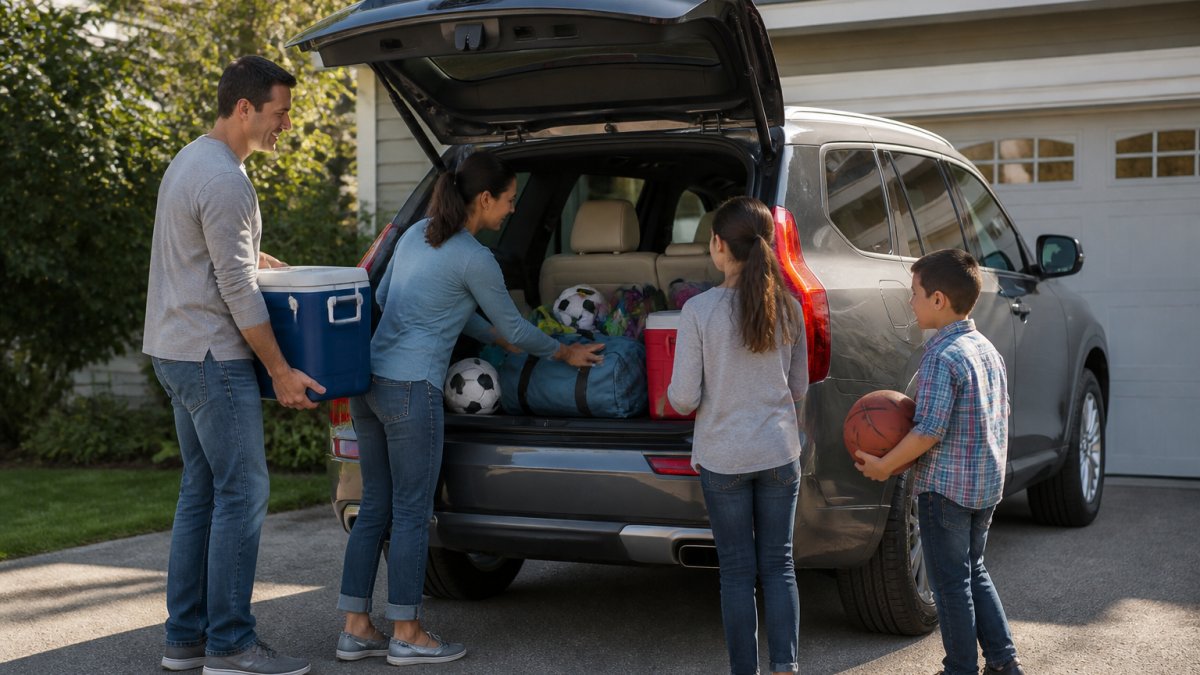 Family loading groceries and sports equipment into the open trunk of a spacious SUV in a driveway, with two children and a parent visible, natural afternoon lighting
Vehicle history reports are non-negotiable. Before you test-drive anything, pull a report that shows accident history, service records, and whether the odometer has been rolled back. A clean history doesn't guarantee reliability, but a hidden accident or flood damage can cost thousands in repairs later.
The best used family cars combine three qualities: they hold up under real-world use, they don't drain your wallet on maintenance, and they fit your family's actual needs, not some imagined version. At Variety Auto, we help families navigate this process by offering a curated inventory of pre-owned vehicles backed by transparent vehicle history reports.
Best Used SUVs for Families
Sport utility vehicles dominate family car shopping for good reason: they offer cargo space, elevated seating position, and all-wheel-drive options that handle winter conditions. The challenge is finding one that balances these features without excessive fuel costs or repair bills.
Toyota Highlander
The Toyota Highlander is a three-row SUV that delivers functional family transportation. Consumer Reports identifies it as a family-friendly option with decent fuel economy for its class. Model years 2013-2019 offer reliable performance with manageable maintenance costs.
What makes the Highlander practical for families is the third row. It seats up to eight, though the third row is tighter for adults. The cargo space behind the second row accommodates strollers, sports equipment, and groceries without constant reorganization.
The Highlander's reputation for longevity matters. Toyota engines in this generation often exceed 200,000 kilometres with basic maintenance. Transmission issues are rare compared to competing SUVs, which saves money on major repairs.
Resale value remains strong, which matters if you plan to sell or trade in within five years. Used Highlanders hold their value better than many competitors in the same age range.
Nissan Rogue
The Nissan Rogue is a compact SUV with surprising interior space. Model years 2013-2017 offer good safety ratings and a spacious layout that works well for families with young children. The Rogue is smaller than the Highlander but more fuel-efficient, which appeals to budget-conscious buyers.
The Rogue's real strength is cargo versatility. The back seat folds flat to create a nearly rectangular cargo area, making it easy to fit larger items. Child-seat installation is straightforward, and the rear doors open wide for car-seat access.
Fuel economy for this generation runs around 8.0-8.5 litres per 100 kilometres in mixed driving, better than larger three-row SUVs. Insurance costs are typically lower than for full-size SUVs as well.
The trade-off is third-row seating. If your family needs to transport six or more people regularly, the Rogue falls short. For families of four or five, it's adequate.
Chevrolet Traverse
The Chevrolet Traverse is an affordable three-row SUV designed specifically for large families. Model years 2013-2016 offer practical seating for seven, with a third row that actually works for children and smaller adults. The Traverse prioritizes interior volume over luxury features.
What families appreciate is the straightforward design. The Traverse doesn't try to be premium; it focuses on hauling people and cargo reliably. The second and third rows reconfigure quickly to shift between passenger and cargo modes.
Fuel economy is modest at around 9.5-10.0 litres per 100 kilometres, but that's expected for a vehicle this size. Maintenance costs are reasonable, and parts availability is excellent since Chevrolet dealers are widespread.
The Traverse depreciates faster than Toyota or Honda competitors, which means lower purchase prices on the used market. If you're buying used, this works in your favour.
Kia Telluride
The Kia Telluride represents newer technology in the three-row SUV category. Car and Driver includes it in family-car rankings. The Telluride offers modern safety features, comfortable seating, and a more upscale interior than older competitors.
Kia's warranty coverage transfers to second owners on some components, which adds value when buying used. The Telluride's infotainment system is intuitive compared to older models, making family road trips less frustrating.
The catch is availability. Tellurides are newer to the market, so used inventory in the Lower Mainland is limited compared to established models. Pricing reflects this scarcity.
| SUV Model | Best For | Key Advantage | Fuel Economy |
|---|---|---|---|
| Toyota Highlander | Families needing proven reliability | Strong resale value, third row | 8.0-8.5 L/100km |
| Nissan Rogue | Budget-conscious families of 4-5 | Cargo flexibility, lower fuel costs | 8.0-8.5 L/100km |
| Chevrolet Traverse | Large families on a budget | Affordable, spacious, easy maintenance | 9.5-10.0 L/100km |
| Kia Telluride | Families wanting modern features | Advanced safety tech, upscale interior | 9.0-9.5 L/100km |
Used Minivans for Sale: Space and Practicality
Minivans get dismissed by people who haven't sat in one recently. They offer more usable interior space than any SUV, easier access for children and elderly passengers, and superior cargo flexibility. For families with three or more children, a minivan often makes more practical sense than an SUV.
The Honda Odyssey and Toyota Sienna dominate the used minivan market. Both models prioritize interior volume and sliding doors that open in tight parking spaces. Second-generation Honda Odysseys (2011-2017) offer reliable performance with manageable fuel costs around 8.5-9.0 litres per 100 kilometres.
Minivans excel at what they're designed for: transporting people comfortably. The low floor makes loading children into car seats faster. Stroller storage is straightforward since the rear cargo area accepts full-size strollers without folding seats. Ground-level seating makes it easier for elderly grandparents to get in and out compared to high-riding SUVs.
The downside is perception. Resale value for minivans drops faster than SUVs because fewer buyers want them. Financing can be harder to find compared to SUVs, though Variety Auto works with multiple lenders to make approval possible for credit situations.
Insurance costs are typically lower for minivans than comparable SUVs, which offsets some depreciation concerns over ownership.
Reliable Sedans and Hatchbacks Under Budget
Not every family needs an SUV or minivan. Sedans and hatchbacks offer fuel efficiency, lower maintenance costs, and easier parking in urban areas. For families with one or two children, these vehicles handle daily life while keeping operating costs down.
Toyota Corolla
The Toyota Corolla is the standard for affordable reliability. Model years 2013-2019 are plentiful on the used market. CoverageX lists used Corollas, making them accessible for first-time buyers and budget-conscious families.
What the Corolla offers is predictability. These vehicles run for 300,000 kilometres or more with basic maintenance. Repair costs are low because parts are inexpensive and widely available. Insurance premiums are among the lowest in the sedan category.
The trade-off is features. The Corolla prioritizes reliability over luxury. Infotainment systems in older models lack smartphone integration. Fuel economy is solid at 6.5-7.5 litres per 100 kilometres, but acceleration is modest.
For families that drive predictable routes and prioritize dependability over features, the Corolla remains unbeatable on value.
Mazda6 and Mazda3
The Mazda6 sedan and Mazda3 hatchback offer more personality than the Corolla while maintaining reasonable reliability. CoverageX includes both in used-car top picks. Model years 2014-2018 deliver a better driving experience than comparable Toyotas without sacrificing dependability.
The Mazda6 is a midsize sedan that feels more refined than the Corolla. It handles curves better and the interior is more modern. Fuel economy sits around 7.0-7.5 litres per 100 kilometres, slightly higher than the Corolla but offset by the improved driving dynamics.
The Mazda3 is a compact hatchback that combines practicality with driving engagement. The hatchback configuration provides more cargo flexibility than a sedan. For families with young children who need stroller storage, the Mazda3 works better than a sedan.
Resale value for Mazdas is better than Corollas in the first few years, though maintenance costs creep up after 150,000 kilometres.
Honda Civic
The Honda Civic is the practical choice between the Corolla's reliability and the Mazda's driving dynamics. Model years 2014-2018 are abundant on the used market. CoverageX lists used Civics.
The Civic offers responsive handling, a spacious interior for its size, and Honda's reputation for longevity. Fuel economy ranges from 6.5-7.5 litres per 100 kilometres depending on driving habits. Parts are affordable and available everywhere.
The Civic appeals to families that want more driving engagement than a Corolla without paying Mazda prices. It's the middle ground that works for most people.
| Sedan/Hatchback | Best For | Estimated Price Range | Fuel Economy |
|---|---|---|---|
| Toyota Corolla | Budget reliability | $10,000-13,000 CAD | 6.5-7.5 L/100km |
| Mazda6 | Refined driving | $11,000-14,000 CAD | 7.0-7.5 L/100km |
| Mazda3 | Hatchback practicality | $9,000-12,000 CAD | 6.5-7.0 L/100km |
| Honda Civic | Balanced choice | $10,500-13,500 CAD | 6.5-7.5 L/100km |
Used Cars Under $10,000: Budget-Friendly Options
Families on tight budgets can find reliable transportation under $10,000 CAD. The key is focusing on models with strong reliability records and avoiding vehicles with hidden mechanical problems.
Toyota and Honda dominate this price range because their vehicles hold up under years of use. A 2013-2015 Toyota Corolla or Honda Civic with 150,000 kilometres and a clean history is far safer than a 2018 model with unknown service records.
Mazda3 hatchbacks in this price range offer more interior space than sedans. The hatchback design is practical for families transporting sports equipment, groceries, or strollers.
The risk at this price point is hidden damage. A vehicle that looks good on the surface might have transmission issues, rust damage, or engine problems that surface after purchase. This is where vehicle history reports and pre-purchase inspections become essential, not optional.
Variety Auto's transparent approach to used vehicle sales includes access to vehicle history reports. This reduces the risk of buying a hidden problem.
Vehicle History Reports and Pre-Purchase Inspection Checklist
Before committing to any used vehicle, obtain a vehicle history report and have an independent mechanic inspect it. These two steps reveal problems that photos and test drives miss.
What to Check Before Buying
A pre-purchase inspection should cover:
- Engine condition (compression test, oil analysis for metal particles)
- Transmission operation (smooth shifting, no grinding or delays)
- Brake system (pad thickness, rotor condition, brake fluid colour)
- Suspension and steering (worn components, alignment issues)
- Cooling system (hose condition, coolant colour, radiator leaks)
- Electrical systems (battery condition, alternator output, warning lights)
- Undercarriage (rust, corrosion, hidden damage)
- Interior condition (seat wear, dashboard cracks, electrical function)
An independent mechanic can complete this inspection in 45-60 minutes. The cost is typically $100-150 CAD. This investment protects you from buying a vehicle with major hidden problems.
Understanding Vehicle History
A vehicle history report shows:
- Accident history (minor fender-benders to major collisions)
- Title status (clean, salvage, branded, or lien holders)
- Service records (maintenance intervals, repairs performed)
- Odometer readings (to detect rollback fraud)
- Ownership history (number of previous owners)
- Recalls (manufacturer safety issues requiring repair)
Reports from services like Carfax or AutoCheck cost $15-30 CAD. They're worth the cost because they reveal problems that sellers might not disclose.
A clean history doesn't guarantee the vehicle is perfect, but it eliminates major red flags. A history showing multiple accidents or title issues means walking away regardless of price.
Total Cost of Ownership for Used Family Vehicles
Purchase price is only part of the cost equation. Fuel, insurance, maintenance, and repairs add up over five years of ownership.
A reliable used sedan like a Toyota Corolla costs less to own overall than a newer SUV because fuel consumption is lower and maintenance is cheaper. A 2015 Corolla might cost $12,000 to purchase but $3,500 annually in fuel, insurance, and maintenance. Over five years, that's $29,500 total.
A newer Chevrolet Traverse might cost $18,000 to purchase but $5,000 annually in fuel, insurance, and maintenance. Over five years, that's $43,000 total.
The difference matters. Families on tight budgets should calculate total ownership cost, not just purchase price. A less expensive vehicle often stays affordable throughout ownership.
Fuel efficiency makes a measurable difference. A vehicle consuming 7.0 litres per 100 kilometres costs roughly $1,400 annually in fuel at current prices. A vehicle consuming 10.0 litres per 100 kilometres costs $2,000 annually. Over five years, that's a $3,000 difference.
Insurance varies by vehicle type, age, and driver history. Older vehicles typically cost less to insure. A five-year-old sedan might cost $80-120 monthly to insure, while a newer SUV costs $120-160 monthly.
Maintenance costs escalate after 150,000 kilometres. A vehicle with 80,000 kilometres is cheaper to maintain than one with 180,000 kilometres. Factor this into your purchase decision.
Where to Find Used Family Cars Locally
The Lower Mainland has multiple options for finding used family vehicles: private sales, independent dealers, and established retailers like Variety Auto.
Private sales offer lower prices but require more due diligence. You're responsible for verifying vehicle history and arranging inspections. Financing is your responsibility; sellers rarely offer it.
Independent dealers offer convenience but variable transparency. Some are reputable; others cut corners on disclosure. Ask for vehicle history reports and inspection records before purchasing.
Established retailers like Variety Auto offer curated inventory with transparent pricing, simplified financing, and trade-in services. The convenience comes at a premium compared to private sales, but the reduced risk often justifies the cost for families buying their first used vehicle or those seeking simplified financing.
Variety Auto's online inventory lets you browse available vehicles before visiting, saving time on unsuitable options. The simplified finance application process works for buyers with varied credit histories, and the trade-in appraisal service provides fair valuations for your current vehicle.
Financing and Trade-In Options
Financing a used vehicle is more complex than financing a new one because lenders assess vehicle condition and age differently. Traditional banks often have stricter requirements for used cars, particularly for vehicles over seven years old.
Trade-in services simplify the process by eliminating the hassle of selling your current vehicle privately. Variety Auto's trade-in appraisal service delivers fast, fair valuations that you can apply directly toward your next purchase.
A trade-in also simplifies financing because the loan amount is lower. Instead of financing the full purchase price, you finance the difference between the vehicle's price and your trade-in value. This reduces monthly payments and approval risk.
First-time buyers often face financing challenges despite adequate income. Variety Auto's online finance application and simplified approval process work with buyers who have varied credit histories or limited credit history. Multiple lenders in the network increase approval odds.
Pre-approval gives you negotiating power. When you know your financing is approved before visiting, you focus on the vehicle rather than paperwork. Variety Auto handles the pre-approval process online, making it transparent and stress-free.
Finding the right used family car in the Lower Mainland requires balancing space, safety, reliability, and budget. Whether you choose an SUV, minivan, or sedan depends on your family's actual needs, not marketing hype. The vehicles covered here, from the Toyota Highlander's proven durability to the Honda Civic's practical balance, represent reliable options that families trust.
Start by determining how much space you need, what safety features matter most, and your realistic budget. Pull vehicle history reports for any candidate. Request a pre-purchase inspection from an independent mechanic. Compare total cost of ownership over five years, not just purchase price.
At Variety Auto, we simplify this process with a curated inventory of quality used vehicles, transparent vehicle history reports, and a simplified financing application that works for buyers with varied credit situations. See our inventory online and discover how convenient buying a used family car can be.
Frequently Asked Questions
What should I check before buying a used family car?
Inspect the vehicle's exterior for rust or damage, test all safety features including airbags and seatbelts, check the engine and transmission for unusual sounds, verify tyre condition and alignment, review the vehicle history report for accidents or flood damage, and confirm that child-seat anchor points (ISOFIX) are functional.
Which used family cars are the most reliable?
Toyota and Honda models consistently rank high for reliability. The Toyota Highlander, Toyota Corolla, Honda Civic, and Nissan Rogue are popular choices for families because they hold up well over time and have lower maintenance costs. Look for vehicles with complete service records and fewer than 160,000 kilometres.
Is a used SUV or minivan better for a family?
It depends on your family's needs. SUVs like the Highlander and Traverse offer better cargo space, all-wheel drive for varied weather, and higher seating positions. Minivans provide easier access for children with sliding doors, more flexible interior space, and lower step-in height. SUVs typically cost more in fuel and maintenance, while minivans excel at child-seat fit and stroller capacity. Consider your household size, trip types, and budget when deciding.
What used cars can I find for under $10,000?
Models like the Toyota Corolla, Mazda3, Mazda6, and Honda Civic frequently appear in the budget-friendly range when shopping for used vehicles. These sedans and hatchbacks offer good fuel economy and lower maintenance costs, making them suitable for families. Pricing depends on model year, mileage, and condition. Check local inventory for current availability and exact pricing, as these vehicles sell quickly.
How do I know if a used vehicle has been in an accident?
Request a vehicle history report, which documents reported accidents, flood damage, and insurance claims. Physically inspect the vehicle for misaligned body panels, paint inconsistencies, or welding marks that suggest repairs. Check that all lights and safety features work correctly. Ask the seller directly about the vehicle's accident history and get their answer in writing.