
Last Updated: November 12, 2026
Quick Summary
How long do hybrid car batteries last depends on chemistry, cooling and driving habits, but the commonly quoted estimate is 8 to 15 years or 100,000 to 200,000 miles. Those figures are a working estimate, not a lab result, and some packs fail early while many outlast the vehicle.
- Heat is the single biggest enemy of a hybrid battery, so park in shade or a garage when you can.
- Mild hybrids see shallow charge cycles and tend to wear slowly, while plug-in packs face deeper discharge cycles.
- Watch for falling fuel economy, slower electric-only running and frequent engine restarting at stops as warning signs.
- Confirm warranty transferability, mileage limit and in-service date in writing before buying a used hybrid.
- Individual cell replacement is often the cheapest repair path when the fault is isolated and the rest of the pack is healthy.
Table of Contents
- How Long Do Hybrid Car Batteries Last?
- Hybrid Battery Lifespan: What the Estimates Actually Tell You
- Battery Chemistry and Hybrid System Type: Why Lifespan Varies
- Factors That Affect How Long a Hybrid Battery Lasts
- Signs of a Failing Hybrid Battery
- How to Test a Hybrid Battery Before You Buy
- Hybrid Battery Warranty Coverage: What to Check
- Hybrid Battery Replacement Cost and Repair-vs-Replace Decisions
- Practical Steps to Extend Hybrid Battery Life
- Shopping for a Used Hybrid: What to Verify Before You Commit
- Frequently Asked Questions
How Long Do Hybrid Car Batteries Last?
If you are asking how long do hybrid car batteries last, the honest answer is that lifespan varies widely. Those figures are estimates, not guarantees. This guide from Variety Auto breaks down what actually drives that range, how to spot a weak pack before you buy, and what replacement really involves.
Hybrid batteries have earned a better reputation than most shoppers expect. Early fears about packs dying at 60,000 kilometres never matched what owners reported in practice. Still, "usually fine" is not "always fine," and a used hybrid deserves a proper check.
Below, we walk through the factors that shorten or stretch battery life, the warning signs of a failing hybrid battery, and the warranty details worth confirming before you sign.
Hybrid Battery Lifespan: What the Estimates Actually Tell You
The 8-to-15-year range you see quoted everywhere is a working estimate, not a lab result. Car and Driver's reporting on hybrid battery longevity notes that there are no comprehensive studies of hybrid-battery life, and that the widely shared 100,000-to-200,000-mile figure is closer to an educated guess.
That matters for how you shop. Treat lifespan numbers as a planning tool, not a promise.
- Years: Lifespan depends heavily on how the vehicle is driven and cared for.
- Distance: Mileage at which a pack wears out varies by model and use.
- Reality: Some packs fail early. Many outlast the vehicle.
Here is how the commonly quoted hybrid battery lifespan figures break down.
| Item | Value | Note |
|---|---|---|
| Quoted lifespan range | 8 to 15 years | A working estimate, not a lab result |
| Quoted mileage range | 100,000 to 200,000 miles | Closer to an educated guess |
| Years | Varies | Depends on driving and care |
| Distance | Varies by model and use | Mileage at wear-out differs |
| Reality | Some fail early, many outlast the vehicle | No comprehensive studies exist |
Battery Chemistry and Hybrid System Type: Why Lifespan Varies
Two hybrids built the same year can age very differently, and the battery type is a big reason why. It helps to consider chemistry and hybrid system design when comparing vehicles.
Nickel-metal hydride (NiMH) packs, common in older full hybrids, are known for durability and tolerate being held at a partial charge. They are less energy-dense than lithium-ion, which is why they are heavier for the same capacity, but they are forgiving of the partial-state-of-charge cycling a hybrid delivers. NiMH packs in well-cooled full hybrids can last a long time, and some outlast the vehicle. The trade-off is that NiMH packs are less efficient to charge and discharge, so they suit hybrids that rely on the engine and regenerative braking rather than long electric-only runs.
Lithium-ion packs, now standard in newer hybrids and plug-in hybrids, store more energy in less weight but are more sensitive to heat and to being run flat or fully charged. Their lifespan depends heavily on how deeply they are cycled and how well the pack is cooled. A lithium-ion pack in a mild hybrid that never runs electric-only for long may age slowly; the same chemistry in a plug-in that is repeatedly drained and recharged can lose capacity faster.
System design matters as much as chemistry. A mild hybrid uses a small battery and motor-generator to assist the engine and recover braking energy, but it cannot drive on electricity alone. Because the pack stays in a narrow charge window and sees shallow cycles, mild-hybrid batteries tend to wear slowly. A full hybrid can run short electric-only stretches and relies more on regenerative braking, which puts moderate, frequent cycles on the pack. A plug-in hybrid runs long electric-only stretches and draws grid power, so its pack sees deeper and more frequent discharge cycles, which can speed up capacity loss compared with a conventional hybrid pack.
A common assumption is that a plug-in hybrid battery will last as long as a conventional hybrid pack. Deeper and more frequent discharge cycles on a plug-in can accelerate wear, and a larger pack does not automatically mean a longer service life. When you compare vehicles, ask what chemistry the pack uses, whether the system is mild, full, or plug-in, and how the pack is cooled. Those three details tell you more about expected lifespan than the model year alone.
Factors That Affect How Long a Hybrid Battery Lasts
Heat is the single biggest enemy of a hybrid battery. A pack that lives in a hot climate, or sits in direct sun day after day, ages faster than one kept cool. Cold weather is gentler on long-term wear but can temporarily cut usable capacity and range.
Driving habits play a real role. Gentle acceleration, steady cruising and letting regenerative braking do the slowing all reduce strain. Hard launches and constant heavy loads work the pack harder.
Then there is the battery management system and its cooling system. These keep the pack in a safe temperature and charge window. A clogged cooling fan or a neglected cabin filter can quietly shorten battery life.
- Frequent short trips in extreme heat can mean more wear
- Mostly highway cruising at mild temperatures tends to mean less wear
- Long periods parked at full or empty charge can mean more wear
Vehicle use ties it together. A hybrid that sits unused for months may lose charge and condition faster than one driven regularly.
Signs of a Failing Hybrid Battery
A failing hybrid battery rarely dies without warning. Most packs degrade gradually, and the clues show up in daily driving long before a warning light appears.
Watch for these signs of a failing hybrid battery:
- Falling fuel economy: the gas engine runs more often to cover for a weak pack.
- Slower electric-only running: the car switches to gas sooner than it used to.
- A dashboard warning light: the hybrid system or battery icon lights up.
- Reduced power or sluggish acceleration: the pack cannot deliver its usual boost.
- Frequent engine restarting at stops: a sign the battery is not holding charge.
These symptoms can also come from a weak 12-volt accessory battery or a sensor fault, not only the traction pack itself. A proper diagnostic test separates the two before you spend money. If a seller brushes off a warning light as "nothing," that is your cue to walk.
How to Test a Hybrid Battery Before You Buy
Testing a used hybrid battery is a two-part job: a scan tool check for stored codes and live battery data, then a real test drive to see how the pack behaves under load. A scanner can read the state of charge, cell balance and any history of battery degradation across the pack. Cell-to-cell imbalance is a red flag.
On the drive, watch how quickly the car drops out of electric mode and whether the battery gauge swings wildly.
For a full pre-purchase routine, our guide on 20 things to check before buying a used car covers the VIN, history and test-drive checks that pair well with a battery scan.
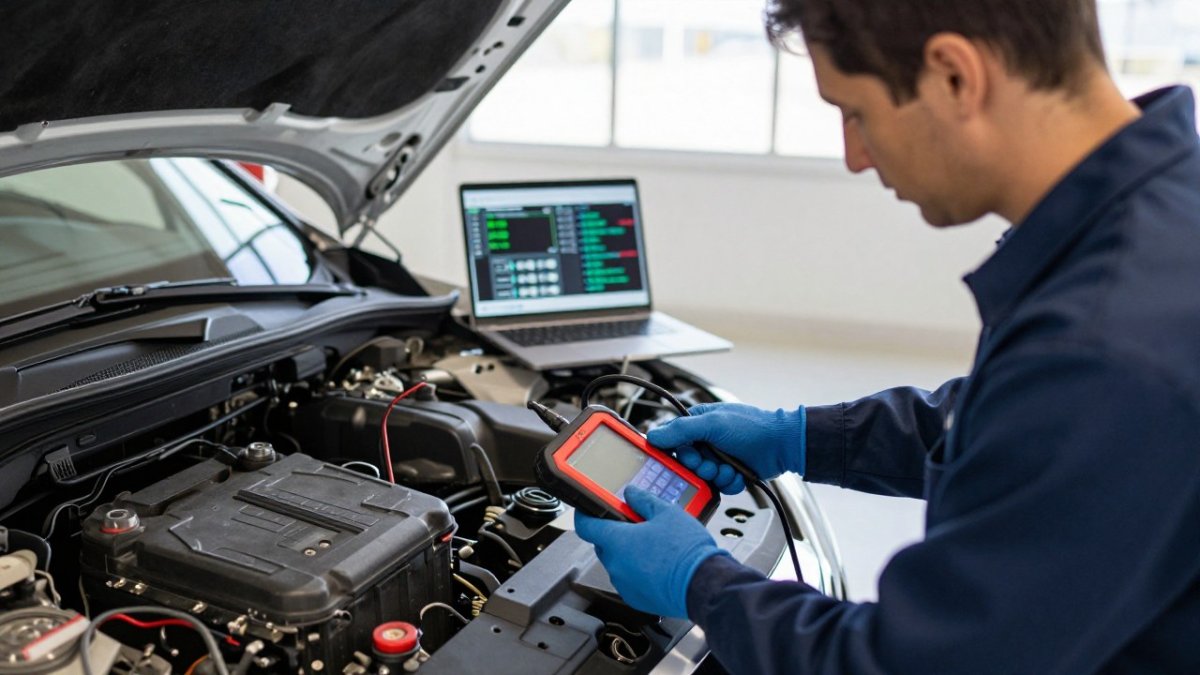 Mechanic using a diagnostic scanner to test hybrid battery health to determine how long do hybrid car batteries last
Hybrid Battery Warranty Coverage: What to Check
Hybrid battery warranties are the most misunderstood part of a used purchase. Hybrid battery warranty terms vary by manufacturer and model. Confirm the period, distance limit and start date for the specific vehicle.
Here is what to confirm before you buy:
- Transferability: does the remaining coverage pass to a second owner?
- Mileage limit: the warranty often ends at a set distance, not just years.
- In-service date: the true start of the coverage clock.
- Documentation: a service record proving the warranty is still active.
Model-specific rules vary, and a dealer or the manufacturer can confirm the exact terms for a given vehicle. Do not take a seller's word for remaining coverage. Get it in writing.
Hybrid Battery Replacement Cost and Repair-vs-Replace Decisions
Replacement cost is a common question for used-hybrid shoppers. Exact pricing depends on the model, the pack size, whether you choose a new battery, a refurbished battery, or replacement cells, and on local labour rates, so any single number is misleading. What you can do is understand the cost structure and the decision rules before you talk to a shop.
Start with the options, from least to most expensive in most cases:
- Individual cell or module replacement: a shop identifies weak cells and replaces only those, keeping the rest of the pack. This is often the cheapest path when the fault is isolated, but it depends on finding a shop that will do the work and on the rest of the pack being healthy.
- Refurbished pack: a used pack is tested, weak modules are replaced, and the unit is resold. It typically costs less than new and may carry a short warranty, but quality varies by supplier.
- New pack: the most expensive option, usually with the longest warranty. For older vehicles, the cost can approach or exceed the vehicle's value.
Labour is a real part of the bill. Pack removal and installation takes time, and some models require more disassembly than others. Ask for a written quote that separates parts from labour so you can compare offers.
Watch out: a quote that is dramatically cheaper than others often means a salvaged pack with no tested history or no warranty on the work. Confirm what is covered and for how long before you agree.
The repair-versus-replace decision comes down to the whole car, not just the pack:
- Repair the pack if the rest of the vehicle is solid, the fault is isolated cells or a cooling issue, and the repair cost is a small fraction of the car's value.
- Replace the pack if the vehicle is otherwise sound and you plan to keep it long enough to justify the cost.
- Replace the car if the battery is one of several looming problems, or if the quote is close to what the vehicle is worth.
Before you decide, get a proper diagnostic test so you know whether you are dealing with a traction pack, a 12-volt accessory battery, or a sensor fault. If the numbers push you toward a different vehicle, our roundup of the best used cars under $10,000 that last the longest is a practical place to compare durable options.
Practical Steps to Extend Hybrid Battery Life
You can add years to a hybrid pack with a few habits. None of them are complicated, and most cost nothing.
- Keep it cool: park in shade or a garage when you can.
- Avoid sitting at full or empty: for plug-in hybrids, stay in the middle of the charge range.
- Drive smoothly: easy acceleration and early braking let the pack work gently.
- Do not skip cooling maintenance: keep the battery cooling fan and cabin filter clean.
- Drive it regularly: regular use keeps the pack conditioned.
- Watch the charge window: avoid leaving the car parked at extremes for weeks.
The pack itself needs little, but the cooling system and airflow around it do need attention. Regular care of these components can help extend battery life.
Shopping for a Used Hybrid: What to Verify Before You Commit
Before you commit to any used hybrid, it is wise to verify the battery's health from a scan, the remaining warranty in writing, and the full history of the car. Get the battery data, confirm the in-service date, and check for any past hybrid-system repairs.
Budget matters too. Understanding what your money really buys helps you spot a fair deal, and our guide on cheap used cars and what budget really means explains how to read a listing without getting burned. When you are ready to browse, you can view used SUVs for sale in Vancouver and book a test drive to put a hybrid through its paces.
At Variety Auto, we help Vancouver drivers shop used vehicles with an easy online finance application and trade-in appraisals. Our team can help answer questions about a vehicle.
Buying a used hybrid should not feel like a gamble on a battery you cannot see. Variety Auto makes it simpler with a curated inventory, a streamlined online finance application and fair trade-in valuations, backed by feedback from real Google reviews. Get started with Variety Auto and find a used hybrid you can feel good about.
Frequently Asked Questions
How many years does a hybrid car battery usually last?
Most hybrid battery packs last between 8 and 15 years, but that range is an estimate rather than a guarantee. Your actual result depends on chemistry, climate, driving habits, and how the battery was treated by previous owners. A well-maintained pack in a mild climate often outlasts a neglected one in extreme heat.
What are the signs of a failing hybrid battery?
Watch for a dashboard warning light, reduced fuel economy, slower acceleration, frequent engine cycling, and a battery gauge that drops quickly or refuses to hold a charge. Some cars display a hybrid system message. These signs of a failing hybrid battery often appear gradually, so a sudden drop in fuel economy is worth investigating. A diagnostic scan can confirm whether capacity loss is the cause or whether a sensor or cooling issue is to blame.
How much does it cost to replace a hybrid battery?
Hybrid battery replacement cost varies widely by model, battery chemistry, and whether you choose a new pack, a refurbished pack, or individual replacement cells. A refurbished pack or module-level repair usually costs far less than a new battery from a dealer. Because pricing depends on the specific vehicle and parts availability, ask for a written quote for your model rather than relying on a generic figure. Factor in installation labor and any core charges.
Can a hybrid car still run if its battery fails?
Most full hybrids can still move using the internal combustion engine, but performance and fuel economy suffer and some models enter a limited-power mode. A plug-in hybrid may lose electric-only range entirely. Driving long-term with a failed pack can strain the electric motor and charging system, so have it diagnosed promptly. If you are buying used, a pre-purchase hybrid battery test is the safest way to avoid inheriting a pack that is already degraded.
