
Table of Contents
- What to Expect From Used Car Dealerships With Warranty
- Understanding Used Car Warranty Coverage
- Certified Pre-Owned Vehicles and Their Protections
- Factory Warranty vs. Extended Warranty for Used Cars
- Vehicle Inspection and Reconditioning Standards
- Using a Used Car Inspection Checklist Before You Buy
- Vehicle History Reports and Title Verification
- Total Cost of Ownership: Warranty, Fees, and Financing
- Choosing the Right Dealership for Your Used Vehicle Purchase
- Frequently Asked Questions
Last Updated: October 17, 2026
What to Expect From Used Car Dealerships With Warranty
When you're shopping for a used car, the warranty from used car dealerships warranty coverage is often what separates a confident purchase from a risky one. Used car dealerships with warranty coverage give you protection against unexpected repairs and mechanical failures that can drain your budget. At Variety Auto, we understand that buying a used vehicle means balancing price with peace of mind.
The right used car dealership with warranty protection doesn't just sell you a vehicle; it backs up its quality with terms that cover your investment. Whether you're buying your first used car or upgrading from an older model, knowing what warranty coverage means and how it protects you is essential to making an informed decision.
Understanding Used Car Warranty Coverage
A used car warranty is a promise from the dealership or manufacturer to cover specific repairs and parts for a defined period or mileage limit. Coverage typically includes engine, transmission, electrical systems, and other major components, though the exact details depend on which warranty you choose.
Most dealerships offer two main types of warranty protection. Factory warranties are backed by the original manufacturer and typically transfer to you if the vehicle is still within its coverage period. Extended warranties, sometimes called service contracts, are offered by dealerships and cover repairs after the factory warranty expires. Understanding the difference between these two options helps you choose the protection that matches your needs and budget.
Common coverage exclusions include wear-and-tear items like brake pads, wiper blades, and routine maintenance. Some warranties also exclude damage from accidents, misuse, or lack of maintenance. Reading the fine print on your warranty terms is crucial, you want to know exactly what's covered before you sign.
Certified Pre-Owned Vehicles and Their Protections
Certified pre-owned vehicles are used cars that have passed a rigorous inspection and reconditioning process, usually by the manufacturer or an authorized dealer. These vehicles come with stronger warranty coverage than standard used cars, making them a popular choice for buyers who want extra assurance.
The certification process typically includes a multi-point inspection, fluid replacements, and cosmetic detailing to bring the vehicle up to dealer standards. This added layer of protection is why certified pre-owned vehicles often cost more than non-certified used cars, but many buyers find the investment worthwhile.
Certified pre-owned vehicles also come with roadside assistance, vehicle history reports, and sometimes complimentary maintenance during the warranty period.
Factory Warranty vs. Extended Warranty for Used Cars
The choice between factory and extended warranty coverage depends on your vehicle's age, mileage, and how long you plan to keep it. Factory warranties are built into the vehicle at the time of manufacture and transfer to subsequent owners, but their coverage period is limited and may be running out by the time you buy a used car.
Factory warranties typically cover 3 to 5 years or a specific mileage threshold, whichever comes first. If your used vehicle is already 2 years old, you may only have 1 to 3 years of factory coverage remaining. Extended warranties, by contrast, start from the date you purchase them and can extend coverage for several additional years or kilometres beyond what the factory warranty provides.
Extended warranties cost extra, pricing depends on the vehicle's age, mileage, and the coverage level you select, but they protect you from costly repairs once the factory warranty expires. For buyers planning to keep their vehicle for 5 to 10 years, an extended warranty often makes financial sense. For those trading in or selling within a few years, factory coverage alone may be sufficient.
Vehicle Inspection and Reconditioning Standards
Before a used car is offered for sale, reputable dealerships conduct thorough inspections to identify mechanical issues, safety concerns, and needed repairs. A standard inspection covers brakes, suspension, engine performance, fluid levels, lights, and battery condition.
Reconditioning is the process of repairing or replacing items found during inspection. This might include replacing worn brake pads, fixing electrical issues, updating fluids, or addressing suspension problems. Dealerships that invest in proper reconditioning reduce the likelihood that you'll face unexpected repairs shortly after purchase.
When evaluating used car dealerships, ask about their inspection process. Do they use a checklist? Are inspections documented? Do they offer a copy of the inspection report? Transparent dealerships share this information willingly because it demonstrates their commitment to quality and builds trust with buyers.
Using a Used Car Inspection Checklist Before You Buy
Before you finalize your purchase, conducting your own inspection, or hiring an independent mechanic, gives you a second opinion on the vehicle's condition. A used car inspection checklist helps you systematically evaluate critical systems and catch issues the dealership's inspection may have missed.
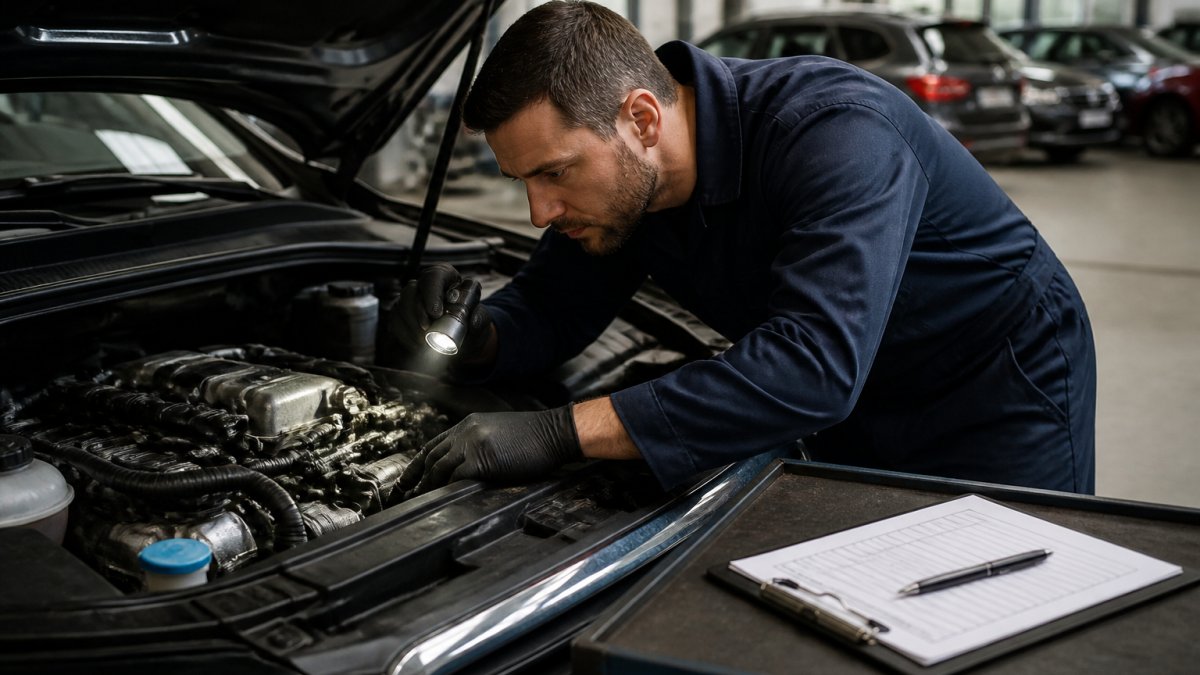 Professional mechanic in uniform examining engine bay of used vehicle, using flashlight to inspect components, with inspection clipboard and pen on workbench nearby
Start with the exterior: check for rust, dents, mismatched paint, and signs of previous accidents. Move to the interior and test all electrical features, windows, locks, climate control, and dashboard lights. Pop the hood and look for fluid leaks, corrosion on battery terminals, and any obvious mechanical damage. Start the engine and listen for unusual noises like knocking, grinding, or excessive rattling.
Take the vehicle for a test drive and evaluate how it handles: Does the steering feel responsive? Do the brakes engage smoothly? Are there vibrations or pulling to one side? Listen for transmission hesitation or engine hesitation during acceleration. Check that all safety features work, airbags, stability control, and backup cameras if equipped.
A thorough pre-purchase inspection protects you by identifying problems before you're locked into a purchase. Many independent mechanics offer pre-purchase inspections for a reasonable fee, and the investment often pays for itself by revealing issues that could cost hundreds or thousands to repair later.
Vehicle History Reports and Title Verification
A vehicle history report is a detailed record of a used car's past, including accident history, service records, ownership changes, and title status. Reports from services like Carfax or AutoCheck compile data from insurance claims, repair shops, and government records to give you a complete picture of the vehicle's background.
Checking the title status is equally important. A clean title means the vehicle has no outstanding liens or damage claims. A salvage title indicates the vehicle was previously declared a total loss by an insurance company, these vehicles are typically not eligible for standard warranty coverage and may have underlying structural or mechanical damage that makes them risky to buy.
When shopping at a used car dealership, request the vehicle history report and title documentation before making a decision. Reputable dealerships provide this information upfront because it demonstrates transparency and confidence in their inventory. If a dealership is reluctant to share vehicle history, that's a red flag worth investigating.
Total Cost of Ownership: Warranty, Fees, and Financing
The advertised price on a used vehicle is rarely the amount you sign for. Dealership fees, taxes, financing charges, and insurance all stack on top, and comparing two dealerships on sticker price alone is one of the most common ways buyers overpay. A transparent out-the-door calculation is the single most useful habit you can build before you visit a lot.
Build an out-the-door number, not a sticker number
Ask every dealership for a written breakdown that includes, at minimum:
-
Vehicle price as listed, plus any dealer-installed accessories
-
Documentation or administrative fee, a flat charge many dealerships apply to cover paperwork; it varies widely and is negotiable in some cases
-
Preparation or reconditioning fee, if charged separately from the vehicle price
-
Applicable federal and provincial taxes on the vehicle and on any add-ons
-
Financing charges, total interest over the life of the loan, not just the monthly payment
-
Registration, transfer, and plate fees
A dealership that will not itemize these in writing before you commit is telling you something about how it handles the rest of the transaction. The out-the-door figure is the only number worth comparing across dealerships.
Warranty cost: what actually drives the price
Extended warranty or service-contract pricing is not a single rate. It typically scales with:
- Vehicle age and mileage at the time of purchase, older, higher-kilometre vehicles usually cost more to cover and may face eligibility limits
- Coverage tier, powertrain-only plans sit at the low end; comprehensive or exclusionary plans that mirror factory coverage sit at the high end
- Deductible, a higher deductible lowers the upfront cost but raises your cost per claim
- Term length and kilometre cap, longer terms and higher caps cost more
- Whether the plan is manufacturer-backed or a third-party service contract, manufacturer-backed plans are generally more portable and easier to claim against at franchised dealers
Ask for the plan's sample contract or a summary of coverage before you agree to a price. The cost is only meaningful next to the deductible, the kilometre cap, and the list of excluded components.
Financing: compare total interest, not monthly payment
A longer loan term lowers the monthly payment but raises the total interest you pay, and it can leave you owing more than the vehicle is worth for longer. When comparing finance offers, ask for the annual percentage rate, the term in months, and the total interest over the life of the loan. A shorter term at a slightly higher rate can cost less overall than a longer term at a lower rate.
If a dealership arranges financing, ask whether it is compensated by the lender and whether that affects the rate you are offered. You are entitled to shop your own financing from a bank or credit union before signing.
British Columbia consumer protections worth knowing
Used-vehicle sales in the province are subject to consumer-protection rules that affect what a dealership can claim and what recourse you have.
- Written contract terms govern. Any service-contract promise should appear in the written agreement. Verbal assurances about coverage are difficult to enforce; get them in the document.
- Misrepresentation is actionable. If a dealership misstates a vehicle's history, condition, or service-contract coverage, consumer-protection law provides remedies. Keep copies of listings, advertisements, and written communications.
This is general information, not legal advice. If a dispute arises, the provincial consumer-protection agency and the Motor Vehicle Sales Authority of British Columbia are the bodies to contact; both publish plain-language guidance on used-vehicle purchases and dealer obligations.
Choosing the Right Dealership for Your Used Vehicle Purchase
Most dealerships will tell you they stand behind their vehicles. The most useful thing you can do when comparing dealerships is evaluate the vehicle's documentation itself, not the sales pitch around it.
A warranty evaluation checklist
Before you sign, work through these questions and get answers in writing:
- Who backs the warranty? Is it the manufacturer, the dealership itself, or a third-party service-contract provider? Manufacturer-backed coverage is generally the most portable and the easiest to claim against at any franchised dealer.
- What is covered? Ask for the list of covered components, not just the categories. "Powertrain" can mean different things at different dealerships, confirm whether it includes the transmission, the differential, seals and gaskets, and internal lubricated parts.
- What is excluded? Wear items (brake pads, wiper blades, clutches, tires), routine maintenance, and damage from accidents or neglect are commonly excluded. Ask specifically about diagnostic fees and whether they are covered when a claim is approved versus denied.
- What is the deductible, and is it per visit or per repair? A per-visit deductible is usually more favorable than a per-repair one.
- What are the term and kilometre limits? Confirm both the time limit and the distance cap, and which one expires first.
- Where can repairs be performed? Some plans require repairs at the selling dealership or an approved shop. If you move or travel, that restriction matters.
- How do you file a claim? Ask for the phone number, the authorization process, and whether pre-approval is required before work begins. A plan that requires pre-approval but does not explain how to get it quickly is a practical problem.
- Is the warranty transferable? If you sell the vehicle privately, a transferable warranty can support resale value. Confirm any transfer fee and the deadline to transfer.
- Is there a cancellation or cooling-off period? Some service contracts allow cancellation within a set window; ask for the terms.
- Does the warranty require you to follow a maintenance schedule? Many plans condition coverage on documented maintenance. Keep your service records.
A dealership that can answer these questions clearly and provide the contract for review before you sign is demonstrating exactly the transparency you are looking for. Vague answers, pressure to decide before reading the document, or reluctance to share the contract are reasons to walk away.
Verify the dealership's standing
In British Columbia, vehicle dealers are licensed and regulated, and the regulator publishes information about licensed dealers and complaint processes (How do I become a dealer?). Before you visit, confirm the dealership is licensed and check whether it has any recorded complaints. Combine that with recent customer reviews, paying attention to feedback specifically about how a dealership handles issues when something goes wrong is a better signal than how it handles a sale.
Ask for the vehicle history and inspection report upfront
A dealership confident in its inventory will share the vehicle history report and its inspection documentation before you ask twice. If either is withheld until after you have committed, treat that as a warning sign. A clean history plus a documented inspection is the foundation for a quality vehicle.
What a strong warranty offer looks like
A strong offer names the administrator, lists covered and excluded components, states the deductible and kilometre cap, explains the claim process, confirms transferability, and is provided in writing before you sign. A weak offer is described only in conversation, uses broad categories without specifics, and is presented as non-negotiable fine print at signing. The gap between the two is where most warranty disputes begin.
Frequently Asked Questions
What does a used car dealership warranty usually cover?
Dealerships may offer various protections for major mechanical components like the engine, transmission, and drivetrain for a set period or kilometre limit. Coverage often excludes wear items (brakes, wiper blades), maintenance, and damage from accidents or misuse. Always review the specific documentation to understand what is and isn't covered, as terms vary significantly between dealerships and vehicle types.
Does a certified pre-owned vehicle come with a warranty?
Certified pre-owned vehicles typically include a manufacturer-backed warranty that extends beyond the original factory warranty period. These vehicles have passed rigorous multi-point inspections and reconditioning to meet brand standards. The warranty duration and coverage limits depend on the manufacturer and the vehicle's age and mileage at the time of certification.
Can I buy an extended warranty for a used car?
Yes, extended protection for used cars may be available from various providers. This protection can supplement or replace other coverage, offering support for repairs. Compare coverage terms, exclusions, and cost before purchasing, and confirm any transferable benefits if you plan to sell the vehicle later.
How do I know if a used car has hidden mechanical problems?
Request a detailed vehicle history report to check for past accidents or service records. Ask the dealership for documentation of their inspection and reconditioning work. Have an independent pre-purchase inspection performed by a trusted mechanic before finalizing your purchase. A comprehensive used car inspection checklist covering brakes, fluids, suspension, and electrical systems can reveal issues the dealership may have missed.